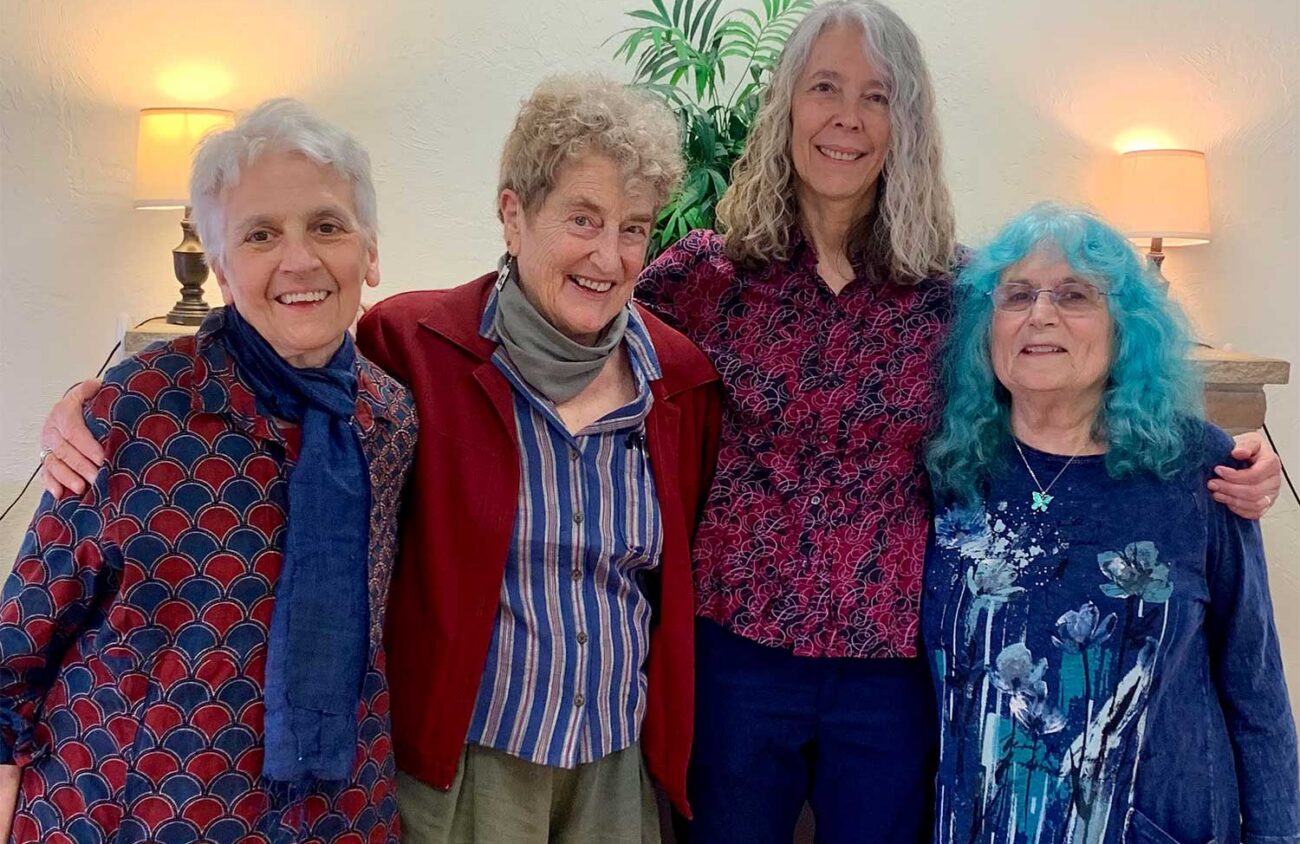
River Road: The Anthology grew out of the River Road Reading program and includes literary works on such topics as love and loss, humility and outrage, queer experiences and more.
The Anthology, a two-volume collection of short works of poetry and prose from nearly 150 area writers, is now available from the Emerald Literary Guild, an organization promoting the writing community in the mid-Willamette Valley.
I recently spoke with two of the four editors, Joan Dobbie and Erica Goss, and our conversation has been edited for length and clarity.
How does River Road: The Anthology reflect the spirit of the literary community in our region?
Goss: It’s completely grassroots and grew out of an idea. Eugene is a literary and art-focused town, and so it felt like we had the right environment to do something like this. And this part of the world is a place where ideas take root. Nobody says you’re crazy because you want to do this amazing thing. They’re like, “Sure, can I help?”
Is there a particular work in the two volumes that stands out to each of you?
Dobbie: Solala Towler’s “The Boy with Stones for Eyes” is absolutely beautiful from beginning to end, it’s engaging to read and absolutely touches your heart.
Goss: Pay attention to Carter McKenzie’s poem called “I Want To Live.” I think those four words are so profound, and the poem is such a beautiful evocation of nature and how we are disconnected from nature, and when we reconnect, we find ourselves again.
You’re both writers. Tell me about your writing and one of the pieces you’ve authored in The Anthology.
Dobbie: In many ways, I write whatever happens to be in my heart and what my head announces to me. I don’t drive, so I bike everywhere. Poems often come to me while I’m biking, so I get home and write them down. I have a poem in The Anthology titled “My First Memory,” which is about being a refugee as a child. My parents were Jewish refugees who made it into Switzerland, where I was born. In the poem, I write about this tiny, neutral country called Switzerland, to which my parents escaped and where I was born, and from which we later were forced to leave.
Goss: I’m predominantly a poet, but I also write book reviews, articles, memoirs and personal essays. Nature and art often find their way into my writing. I have three poems in The Anthology, and one I wrote after I visited Cologne, Germany, where my mom is from. I’d had all of these impressions from photographs of the cathedral turned to rubble after WWII. And looking at it now in person, it was fixed up, and it looked like nothing had ever happened. I had this moment of cognitive dissonance, like, how could that be? How could I be in that place where these things happened? And so that’s what this poem, “Köln Notebook,” is about.
What is the value of the literary arts for helping us make sense of this time we live in?
Dobbie: Peace. And a place where writers can express themselves.
Goss: Poetry, fiction, memoir, these are sensitive and personal forms of writing that allow people to have their feelings. And when I pick up this book and read a poem from somebody that I heard years ago, it wakes up my own sense of empathy and compassion. It increases our humanity, which we desperately need right now.
What do you hope River Road: The Anthology brings to our community?
Goss: Each piece is short, no more than three or four pages. We’ve donated copies to the Eugene Public Library and also to the University of Oregon Knight Library. We would like to have copies everywhere people gather publicly. And that reading a piece in the books could be something that would give you a respite, a break. And that you would be calmed for a moment so you could come back to yourself.