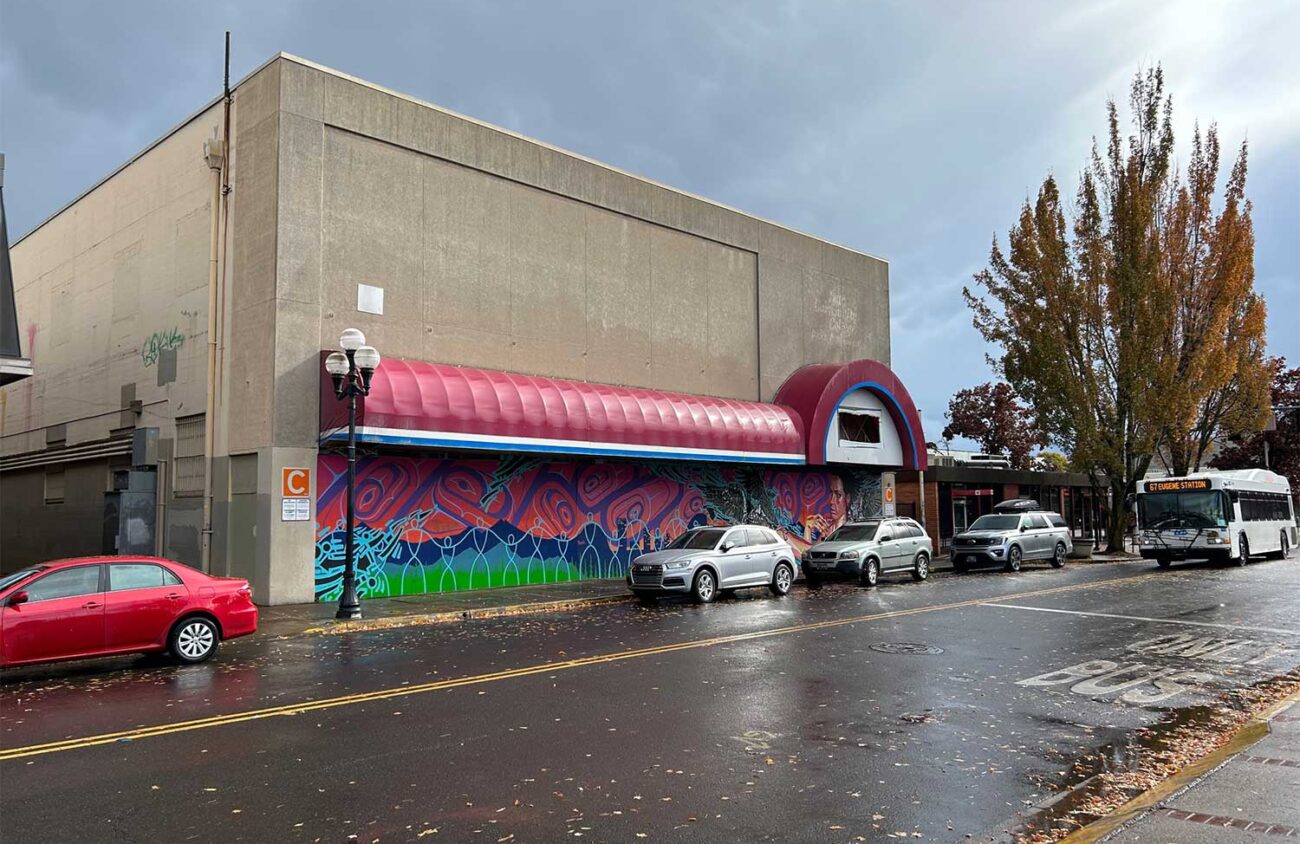
More than four years after it was picked by the city of Eugene, a development company has failed to raise any of the roughly $35 million it needs to construct an apartment building on the site of the empty former Lane Community College annex on Willamette Street in downtown Eugene, city records show.
The developer, a joint venture by Eugene and Portland companies, hasn’t secured commitments for either the roughly $16 million long-term loan it needs, or the $16 million in equity cash from investors, the developer’s correspondence and other city records show.
After receiving the developer’s most recent tale of money-raising woe, the city staff on August 1 gave it one final extension, until Feb. 1, 2026, to show it has the money and to buy the site, which the city owns. The agreement between the developer and the city doesn’t allow extensions beyond that.
But more delays may follow anyway.
“If it’s looking like the project is unable to close by Feb. 1, we’ll bring it back to City Council to discuss next steps for the project and how they’d like to move forward. One of the options is likely to be allowing for another closing extension,” says Lindsay Selser, a city spokesperson.
The developer, 1059 Willamette Investment LLC, is headed by Eugene executive Mark Miksis and Portland-based Edlen & Co. They didn’t respond to emails from Eugene Weekly.
The deal is a novel experiment by the city to have a developer create 68 rent-controlled units in return for modest subsidies from the city. So far, it’s yielded zero results.
Under the original agreement, approved by the Eugene City Council, the developer should have bought the site from the city — for $1 — by Oct. 1, 2023, and completed the new building six months ago. But the developer keeps coming up empty-handed in its search for money, and the city has agreed to repeated delays.
In a letter to the city this summer, the developer said it’s optimistic despite being stymied by “financial market instability,” high interest rates, and the potential for President Trump’s tariffs to drive up construction costs. “We continue to believe we will be able to secure equity for the project,” wrote Jill Sherman, an Edlen & Co. principal and co-founder.
Committed to affordability
The City Council has often talked up the deal as a sign of its commitment to ensuring affordable housing and revitalizing the downtown core.
The developer is supposed to build a six-story apartment complex with 133 units, half of them with market-rate rents, and the rest — 68 studios — with rents capped to make them affordable to moderate-income renters. In return for charging capped rents, the developer would get subsidies from the city: The site for $1; up to $1.8 million in waived permit and other fees, and help with asbestos removal and demolition; and a 10-year property tax waiver.
But the profits the project would generate don’t appear sweet enough to attract equity investors. And without equity investors, a key lender has balked, documents obtained by the Weekly in a public records request show. In her June letter to the city, Sherman said she was trying to get two investment funds to provide equity, but the expected profits are “lower than their threshold, and we are working with them on how to structure their investment to meet their targets.”
Investors, lender balk
The developer’s prospects for raising money have actually dimmed over the past year, the records show. In June 2024, an investment group tentatively pledged all the equity that was needed, Sherman wrote in her June 2025 letter. But in November 2024 those investors cut that to 50 percent of the amount needed. And in January 2025, they backed out entirely, saying they had invested their money elsewhere, she wrote.
Meanwhile, in September 2024, an Idaho credit union tentatively agreed to provide the loan for the project, Sherman wrote. But that promise expired this May, at which point the credit union said it would lend only if the developer first secured equity, Sherman wrote. The developer now continues to cast around for equity money.
Several years ago, a consultant working for the city calculated that even with the subsidies, the project would initially generate an equity investment return of negative 4.7 percent a year, gradually rising to positive 4.2 percent in year 10. Developers typically want 6 percent a year, the report said.
Elected leaders seem sympathetic.
“It’s not easy to make redevelopment projects happen,” Mayor Kaarin Knudson says in an email to EW. The project is the first in which the city is using the property tax waiver to try to create subsidized “workforce” housing, she notes. “We’ll keep listening to and working with our partners.”
City Councilor Mike Clark says the city subsidy is sufficient. “I understand the challenges and difficulties (the developer) is facing,” he says. “I’m patient with them.”
Most rent-capped apartment complexes that have been built in Eugene in recent years for low-and moderate-income residents have received steeply discounted mortgage loans provided through federal and state programs. The Miksis/Edlen project isn’t eligible for that crucial major subsidy.
Should the city offer more help for the project?
“If the development team identifies a particular need, (the) council could consider options to address that need,” Selser says. The council “could consider an increased level of investment in the project, however, at this point, that’s jumping ahead to solutions before the problems have been raised and identified,” she says.
Market-rate development strong
Meanwhile, developers continue to push ahead elsewhere in Eugene to create market-rate apartment complexes that are not hamstrung by rent affordability requirements. These include one student housing highrise under construction near the University of Oregon, two large student complexes in the planning stages, and Obie Companies’ apartment project in the planning stages next to the Eugene Amtrak station.
Apartment development has been brisk-ish in Eugene in the last several years, mainly due to investors’ obsession with building student housing. In 2024, there were 693 multi-family units permitted in the city, up from 422 in 2023, but down from 794 in 2022 and 1,093 in 2021, according to the U.S. Department of Housing and Urban Development.
Elsewhere in Lane County there’s been a mini-boom in apartment construction. In 2024, some 322 multi-family units were permitted in other cities in the county, mostly in Springfield, the HUD data show.
Bricks $ Mortar is a column anchored by Christian Wihtol, who worked as an editor and writer at The Register-Guard in Eugene 1990-2018, much of the time focused on real estate, economic development and business. Reach him at Christian@EugeneWeekly.com.