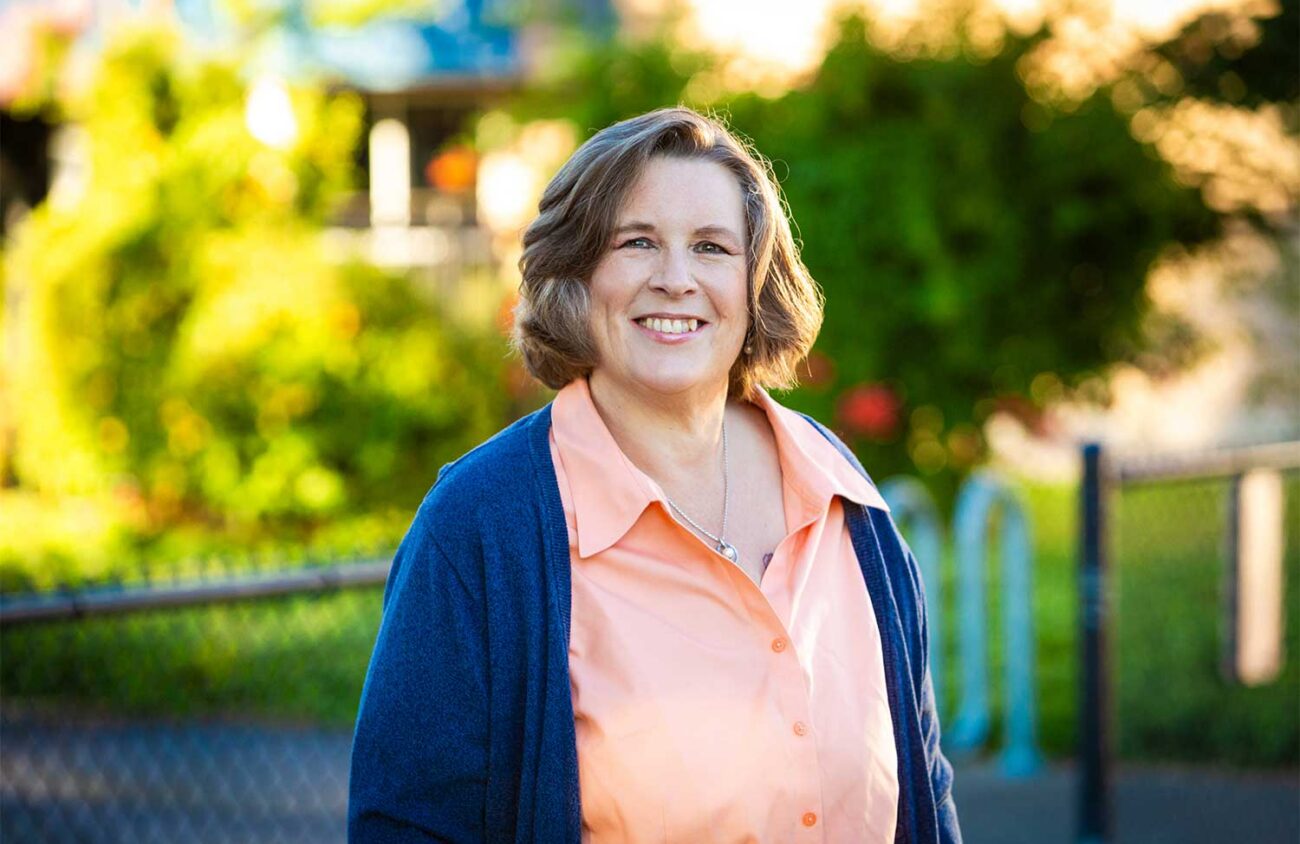
For Kori Rodley, making sure the people of Springfield are represented by someone who worked with them personally and can address their most pressing needs is why they should choose her in the Democratic primary for Oregon’s House District 7, encompassing Springfield.
Rodley, Springfield Ward 3 city councilor, a mother and vocal supporter of disability rights, says she wants to increase HD 7’s access to housing, health care and education.
To do this, Rodley says she’ll take her experience in local government to the next level, bringing a local perspective to the Legislature that will help lawmakers make decisions not just for Springfield but for all Oregon communities.
Rodley was sworn in to represent Ward 3 in December 2021. Ward 3 covers central Springfield, from around Jasper Road to Yolanda Avenue, staying mostly in between 7th Street and 21st Street. Since then, Rodley has served on several committees and supported projects like the Laura Apartments, which will provide stable housing for domestic violence survivors.
“I probably have the most experience in knowing how to do really progressive things,” Rodley says. “The challenges are big, and we’ve got to figure out how to have conversations with people that don’t necessarily agree with us.”
In Oregon, Democratic lawmakers have a supermajority, holding 37 seats in the House and 18 in the Senate. This means Republicans have limited power in passing legislation without bipartisan support. Despite this, Republicans have used tactics like walkouts to stall votes on controversial bills.
Rodley says she wants to bring a more collaborative mindset to the Legislature while also maintaining her progressive values. She adds that in order to achieve priorities like universal health care and affordable housing, a candidate must be able to bridge the social divide between Democrats and Republicans to find common ground on what every Oregonian needs.
“I’ve learned so much about how to do really progressive stuff with relatively conservative colleagues,” Rodley says. “We find the things that we agree on, which is, shouldn’t everyone have decent, good health care?”
By Sept. 15, the Universal Health Plan Governance Board, an appointed board of health care providers and public engagement professionals the Legislature created in 2023, will present its plan for a state-funded health care plan that covers all Oregonians, regardless of income. Rodley says that if she is elected to the Legislature, she will advocate for a plan that works for every Oregonian and addresses the concerns her Republican colleagues have raised.
“It’s happening at a time when we’re seeing rural hospitals close, and we’re seeing a strain,” Rodley says of the universal health plan proposal. “I think that’s an opportunity to expand the conversation. If we’re investing in this as core infrastructure in the state, you’re not going to lose your hospitals in rural communities.”
Across the country, a total of 146 rural hospitals were closed or converted to non-acute care between 2005 and 2023. In Oregon, four rural hospitals are at risk of closure, according to a 2025 report from Massachusetts Sen. Edward Markey.
“If we decide that everyone should have access to affordable health care, then we can prioritize what that looks like,” Rodley says. “If we treat health care as core infrastructure and invest in it that way, we can stabilize rural hospitals instead of watching them close.”
Eugene Weekly’s Christian Wihtol has reported several times on Springfield’s lack of apartments, townhomes and duplexes in his Bricks $ Mortar column. Rodley says she wants to fix this. Rodley says she was an avid supporter of the city of Springfield using the Biden administration’s American Rescue Plan Act funds to purchase land for the development of housing. “If we have land, we can then use that to parlay into some affordable housing and that’s exactly what has happened,” Rodley says.
In 2019, the Oregon Legislature passed House Bill 2001, which requires Oregon cities with populations of more than 10,000 and less than 25,000 to permit the construction of duplexes in areas that previously only allowed for single-family dwellings.
In cities with populations of 25,000 or more, the bill requires cities to allow duplexes, triplexes, fourplexes, cottage clusters and townhouses. One of Rodley’s core beliefs is that this middle housing provides a transitional opportunity for working-class families to live comfortably in an increasingly volatile economy.
If elected, Rodley says she wants to work with Oregon’s budget to increase funding for affordable housing projects across the state. She says her experience on the Springfield Budget Committee will help her work with her colleagues to adjust the budget and expand affordable housing projects in the state. “I love those sort of messy transitions,” she says.
Working families need a place to send their children to learn and be cared for while their parents work. Rodley says one of her dreams is to introduce and pass legislation that would allow child care facilities to be located at public schools.
“Sometimes the pushback is like, ‘Oh, that’s just too big and too hard,’ I’m like, it’s not hard. In my lifetime, we went from having private kindergarten to public kindergarten in the public schools, so it’s not undoable,” Rodley says.
In addition to child care, Rodley says she supports universal preschool, something Gov. Tina Kotek recently advocated for when she called for the creation of a roundtable of early education experts to brainstorm a path to universal preschool access for 3 and 4 year olds. “Infant care is super expensive and I would love to see that co‑located in neighborhoods so that people have access to it,” Rodley says. “We’ve got room, we just need to invest in the workforce.”
Rodley says she also wants to help the Legislature update Oregon’s curriculum to reflect more modern methods of instruction. “We have schools that have not been able to fund new curriculum for a long time,” she says. “We’re still getting back from dealing with the effects of the pandemic.”
Rodley says her biggest goal is to represent House District 7 residents in a way that addresses their most pressing needs. She says through bipartisan collaboration, her experience in government and her passion for community engagement, she will vote for and introduce legislation that increases Oregonians’ access to those basic needs.
At the time of publication, Rodley has raised $29,557 in campaign funding. Rodley is running against Democrats Ky Fireside and K.C. Huffman. Republican Adam Wilson is also running for HD 7. Ballots are mailed to voters starting April 29 and polls close May 19.
To learn more about Rodley’s campaign, visit Kori-Rodley.com.