By Sadie Mordan
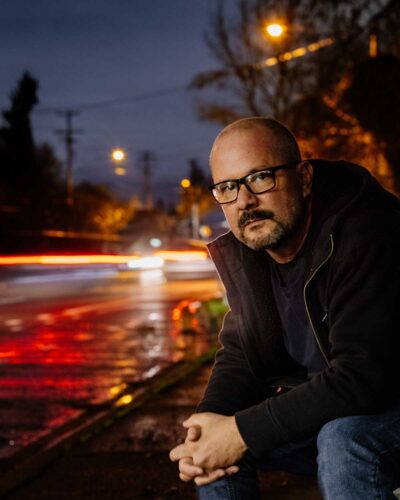
Award-winning journalist Rick Levin made a drastic career change six years ago, trading reporting at Eugene Weekly for bus driving in Eugene. During the first three years on the new job, Levin wrote what would become a novel titled Off Route, which will be released under GladEye Press on Feb. 9.
Off Route demonstrates compassion for those struggling, arguably by design, with the American working class experience, approaching commentary on capitalism with utmost empathy for the working class as informed by Levin’s work in the service sector.
The interview has been edited for length and clarity.
It’s my understanding that after many years of writing, you’re now a bus driver. Why did you decide to become a bus driver after years of writing?
I felt like I had taken journalism as far as it could go. It just felt like I’d done everything I wanted to do. With the election of Trump and the kind of massive online anonymous presence, I just felt I wasn’t up to the fight anymore, if that makes sense. I love journalism. I mean, I wanted to change the world through journalism … It wasn’t a conversation I wanted to participate in anymore. I still believe in journalism, and I think it’s a righteous thing. I just think it’s lost its authority, and it’s not journalism’s fault.
But also, I’m 57. I just felt like if I was going to make some explosive, startling shift in my life that it was time to make a career change. I’ve always felt deeply part of, and empathetic with, the working class, and I just wanted to do something really on the ground. I can say all that stuff about journalism, but it was also very personal. It was just like, I’m going back to the fucking working class, and I’m just going to work. So there’s some romanticism involved in it.
When did you realize you had a story of some kind on your hands — a story that was going to be best as a novel?
I mean, I just wanted my whole life to write the great American novel. Or just try. I wanted to be like Henry Miller, Herman Melville. It’s outrageous, but those were my heroes. It was very existential because that’s my one bucket list [item] is to publish a novel, right? And so when I became a bus driver, I was like, I’m done. And I had to do a lot of spiritual work around it and just kind of grieve it and make it OK that my identity is not what I do. I didn’t fail at life, but it just constantly nagged at me. And I had to grieve it and kind of make peace with it and become somebody who found value outside of that pursuit.
But I stayed part of my writing group; and we’d go out, and we’d do readings. One day we were having a reading, and I was looking through my old stuff. I was bored, and my wife was like, “Why don’t you just write something new?” I was in the middle of my first year or year and a half of driving. It was in the middle of the pandemic. I was working like 65 to 70 hours a week. I was just insane. So I just, like, puked out these 3,000 words about bus driving. And the response was really great. And it also felt really great to sit down and write it.
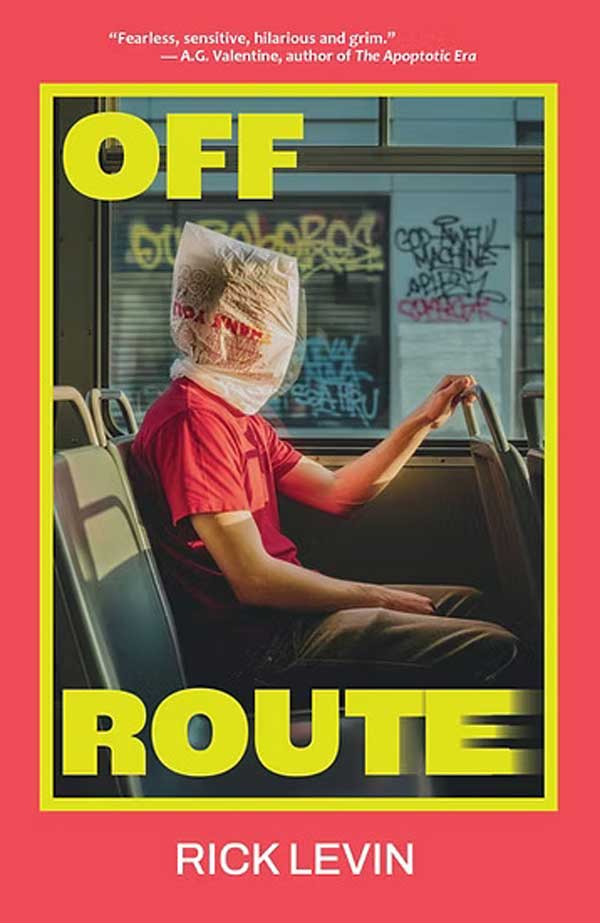
Since Off Route is your first novel, what was the creative process? I’m assuming it was different than when you’re writing articles, shorter fiction. You have to, I imagine, psych yourself up time and again. You said that you’ve wanted to do this for a long time. So why was this the time that it was going to pan out?
If you read the book, you’ll see how [bus driving] completely alters your sense of time, and you’re filled with this kind of ticking clock of anxiety at all times to go, go, go and do something. So I was sitting around on my days off, and I was like, “I think I’m just going to go start writing a book now. I’m not going to start tomorrow. I’m not going to plan to do it.” I just got up, went to a coffee shop, took my computer and just started writing. And so the whole book was written in a mad dash on my days off, which was weird. But I was able to build enough emotional steam that I somehow could pick it up after every little break. Now, I want to say this all sounds so fucking grandiose. It’s just what I went through.
Off Route isn’t a memoir. To what extent, if at all, do you find that your own personality and experiences shaped the narrator?
The book is grounded in my experience over a lifetime of working in the working class because prior to journalism, and even through journalism, I had every job imaginable in the service sector. I worked at a coffee shop; I’ve worked construction; I worked at a grocery store. So I’ve had bosses, and I’ve been part of office politics and workplace politics. I’ve had those grievances of a worker in the working class; so I brought a lifetime of experience to bear, and I placed it all in a first person narrator and tried to stay as focused on that narrator’s experience as possible. Was it drawn from life? Yeah. But it’s amplified. To fit things into a narrative, it’s molded, but there’s not anything in there that is an exaggeration of a working class experience.
You talked about the political climate and that impacting the decision to leave journalism, but then you write a novel that’s set in COVID-19 pandemic America. How did you want to address political undercurrents? Did you have a certain angle in mind, considering the setting and time period?
I am a pretty spontaneous writer with really strong opinions: I hate capitalism; I hate consumerism; I hate the class system that structures work. So the people that do the most work generally get paid the least, and they’re overseen by people making hundreds of thousands of dollars a year. It’s all of that that informed me from my experience.
It was very important to me to make a narrator who was reliably unreliable. The narrator is very traumatized; he’s in therapy; he’s not some soap box, you know? He’s a very flawed, unraveling person. If you’re overworked, underpaid, traumatized by work in ways that, like most workplaces, are so not trauma-informed, it’s just like, go out there and do your fucking job, and then take care of yourself somehow. The things that people in the service sector are seeing are just gut-wrenching. There’s a lot of struggle with compassion fatigue in the novel. I also wanted to show how the working class has been completely sold out and propagandized into supporting this rise of fascism, a very confusing thing if you’re a doctrinaire. So I tried to show it, in a sympathetic or an empathetic way, why that happens.
With everything that is very complicated and emotional, how do you hope readers feel stepping away from the novel?
Well, stepping away from it, I hope they all become Marxist revolutionaries and overthrow the capitalist system. But, reading the novel, I hope they’re moved, and it’s compelling. I think any artistic endeavor is just you’re trying; you’re lonely, and you’re trying to have a conversation with your people, you know? That’s how books affected me. It was like I’m drowning in my 20s and somebody hands me a book; and it’s just like, “Oh my God, somebody else feels like this?”
I want people that don’t typically read books to read my book and to realize that they can write a book, and they can read a book, too.
Do you have just two or three books that come to mind when you say (a book would save your life)?
Tropic of Capricorn by Henry Miller. And that was a huge influence because it’s the one that he wrote after Tropic of Cancer, which is his “I’m off in Paris being bohemian, and I’m free.” He went back, and he wrote one about his time just drowning in New York in the (19)30s and working for a telegraph company. In fact, I nodded to Henry Miller in what I named the bus company that the narrator drives for; it was a total Henry Miller Easter egg. It’s hard; I was reading so much in my 20s. I mean, Faulkner, Virginia Woolf, I like the modern, which is weird because it seems kind of sniffy and aloof, but they really speak to me. Kurt Vonnegut’s Breakfast of Champions is one of the first adult novels I read. It was like they snuck that into the school book cart because it’s such a revolutionary book.
Rick Levin’s Off Route launch party is 7 pm, Jan. 31 at Dark Pine Coffee, 954 Pearl Street.