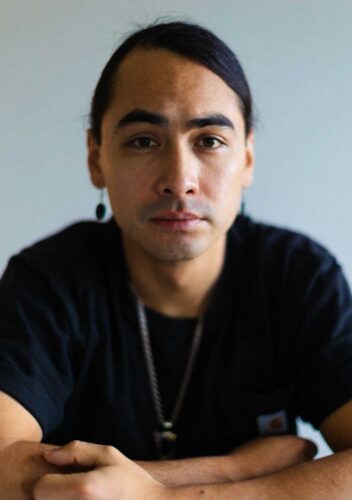
Julian Brave NoiseCat is a journalist, activist and former political strategist and analyst whose work focuses on Indigenous rights, issues and representation in politics. He is an enrolled member of the Canim Lake Band Tsq’secen of the Secwepemc Nation in British Columbia.
On March 5, Community Rights Lane County and University of Oregon Indigenous Studies will host NoiseCat at the Knight Law Center on the UO campus for a presentation and book signing. In 2025, he became the first Indigenous person to be nominated for the Academy Award for Best Documentary Feature for his film Sugarcane (2024), and the first Indigenous person native to North America to be nominated for an Oscar. In October 2025, NoiseCat released his first book, We Survived the Night: An Indigenous Reckoning, which weaves traditional Indigenous storytelling with journalistic work and his own personal journey of reconciling his relationship with his father. His March 5 presentation includes a storytelling performance of “Coyote Steals the Salmon,” a classic piece of Indigenous North American oral tradition.
“It’s the story of how the trickster Coyote led the first salmon up the river, which is obviously a very important environmental story for this region,” NoiseCat says. “I think that embedded within it is a set of ideas and philosophies about how we should relate to one another and the river and the natural world and the salmon.”
NoiseCat is a professional powwow dancer, so the storytelling includes singing, dancing, howling and props along with spoken word elements. The story will be integrated into a discussion of Coyote’s “relevance to the ideas running through the stories to the present day for Indigenous peoples and our understanding of this land of America,” he says.
The close and equal relationship between humanity and nature is crucial in Indigenous tradition and culture. NoiseCat says this harmony “created a healthy relationship between people and salmon for thousands and thousands of years.”
He continues that “a very different way of doing things under colonization has very nearly led to the annihilation of salmon stocks all across the world, but particularly here in the Pacific Northwest, where the fish are not doing so well.”
Though his book, We Survived the Night, is a work of journalistic nonfiction and memoir, it is also a contemporary retelling of a coyote story. Coyote is one of the most prominent characters in Indigenous North American folklore. He is known for his wit, mischief and tendency to get in his own way.
NoiseCat wrote the book while directing Sugarcane, which investigates the missing children and abuse within the Canadian Indian Residential Schools System. He says that “when you’re making a documentary that’s about the system that nearly wiped your people’s way of life off the face this Earth, you ask yourself, ‘What parts of that way of life do you as a storyteller have a responsibility to bring to life on the page?’”
When NoiseCat was a child, his father left his family while carrying the traumatic burdens of his past. In We Survived the Night, NoiseCat set out across North America for five years to learn about the lives, culture and history of Indigenous people, uncovering their traumas, hardships, achievements and the stories that have yet to be told.
“I did a lot of really deep reporting,” NoiseCat says. “I spent a chapter on the fight over herring in Sitka Sound, Alaska. I went back and forth to Alaska a number of times over the course of a month, and helped haul the herring eggs out of the Sitka Sound.”
As part of the writing process, he also moved back in with his father to rebuild their relationship and learn more about his past.
What resulted is a book which “tries to tell the story of what it is to be Indigenous across North America today, through the personal story, the family history, the reporting and a contemporary retelling of one of our most widely told traditional stories,” NoiseCat says.
NoiseCat considers We Survived the Night as a “woven narrative,” which he says “is an homage to my people’s traditional arts. We consider weaving to be of the highest art form.”
Julian Brave NoiseCat’s presentation is 7 pm Thursday, March 5, at Knight Law Center, 1515 Agate Street, UO Campus. Free.