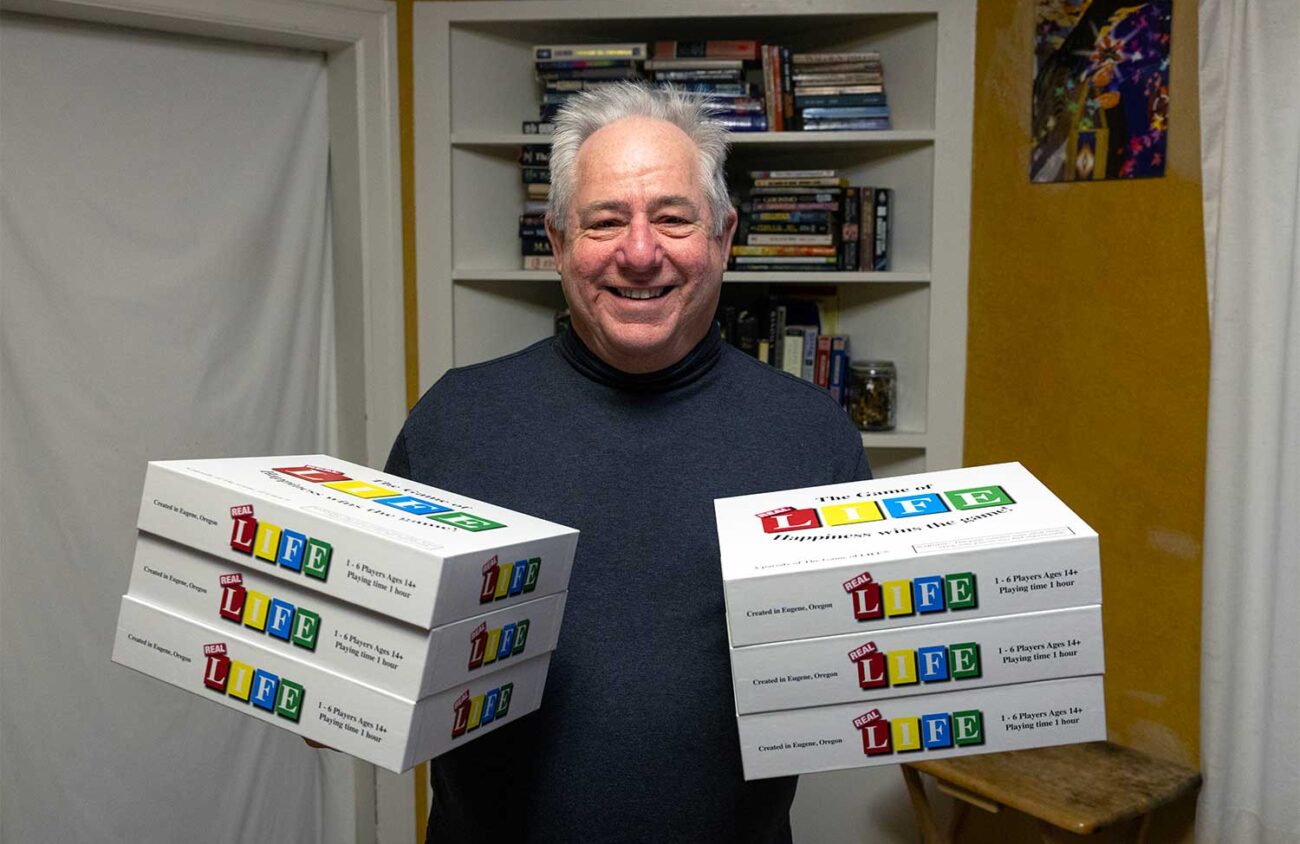
To Chris Pender, there are two types of kids. Monopoly kids and The Game of Life kids. “Monopoly kids are all into money and negotiating,” he says. But he was a Life kid. “I became an actor. And so to me, life always had a storyline.”
Under parody law, Pender has been selling his own rendition of The Game of Life for 27 years, at the Eugene Saturday Market and online. While it contains some similar moments to the classic, Pender’s The Game of Real Life provides players with a much more honest, nuanced, detailed and humorous analysis at what it means to be alive — all with a backdrop of a photograph of Oregon’s coastal trees.
Pender’s version starts with “The Pre-Game,” a spot on the board with a list of instructions to build your character before gameplay starts. In the Pre-Game, you’ll choose a gemstone to move about the board (rather than a pink or blue peg). Then, you’ll flip a coin to determine your character’s biological sex and roll the dice for economic class — circumstances you’re born into that will affect you for the rest of the game. As you play along the board — which vaguely resembles Life, but with more tracks and pauses depending on the things that happen to you — you might find yourself faced with things like circumcision, getting orphaned or broken up with, having a good poop (which earns you points), encountering a “Donner Party Situation,” losing sleep because your baby cries at night, menopause, going on a nice walk with a friend and laughing long and loud.
While it’s been nearly three decades since the 67-year-old began to grace Eugene with the game, he’s been developing it since he was a child.
Along with growing up loving to play Monopoly and The Game of Life, he found himself playing a board game called Careers, which he says gave him a childhood epiphany. In that game, players choose between fame, money and happiness.

Until Careers, Pender says, “I thought all games were about money.” He says he would choose the “happiness” category every time he played, “and I would never win, but I didn’t care.”
In The Game of Real Life, money only serves to make your playing experience easier, but it’s the player with the most happiness points at the end that wins the game. “Happiness is what I’m going for,” he says. “I like natural happiness, more like your parents loving you, falling in love as a teenager, playing with a puppy, catching autumn leaves as they fall,” he says, referring to the squares in his game that are worth the most points.
However, the original concept of his game didn’t necessarily come from the joys of playing with puppies. Pender says that as a child (and throughout his life), he would constantly think back to The Game of Life and ponder the aspects of reality that it was missing, eventually keeping a notebook to jot down the parts that the game seemingly neglected. Growing up in the 1960s with three older sisters, “they were worried about their boyfriends getting drafted,” he says. “And for me, I immediately thought, ‘Oh, they should have that in The Game of Life.’ You land on a space that says ‘YOU’RE DRAFTED.’” This idea evolved into a space in his real game, and it simply says “WAR.”
If you land on it, the dice determines the type of war it is (World War III, 9/11, nuclear war where everyone dies and the game is over, etc.), and what happens as a result (being buried alive, shooting a teenager, ethnic cleansing, and so forth).
Though war happens at the roll of a dice, Pender also made sure to include two essential elements to life where players have just a bit more control. Throughout the game, as in life, players are faced with several opportunities to have sex and do drugs.
When he was an actor in New York, “I was at a party, and so there’s the typical mirror coming towards me with white powder on it,” he says. When he asked what the powder was, the person told him “I don’t know.” At that moment, he says, “I had to decide whether to take the drug or not. And I didn’t.”
In his game, sex and drugs are a choice, but if players go through with either they must face the double-edged sword consequences of gaining happiness points, but potentially losing health points.
“My oldest sister had a baby when I was a kid, and we had to take her to the hospital. And again, I just immediately thought about The Game of Life,” he says. “Sex is much more complicated than putting a peg in a car.” His game has a birthroom as well as gay and lesbian sex options, with men typically scoring more points for having sex than women do, to reflect societal double standards.
As he finally finished putting the game together, he says he had just one more space that needed to be filled in, and it was in the childhood section. “I asked my friend’s son, who was 8-years-old at the time, ‘What’s your happiest memory?’” He says that the little boy told him, “Running naked in the ocean with just my boots on.” That response became the square right then.
Throughout The Game of Real Life, you’ll go through waves of health, and money will come and go. But as you live your life and make memories, it’s the happy little moments that will win you the game.
To purchase or ask questions about The Game of Real Life, visit GameOfRealLife.com, email Chris@GameofRealLife.com or call 541-484-4737.