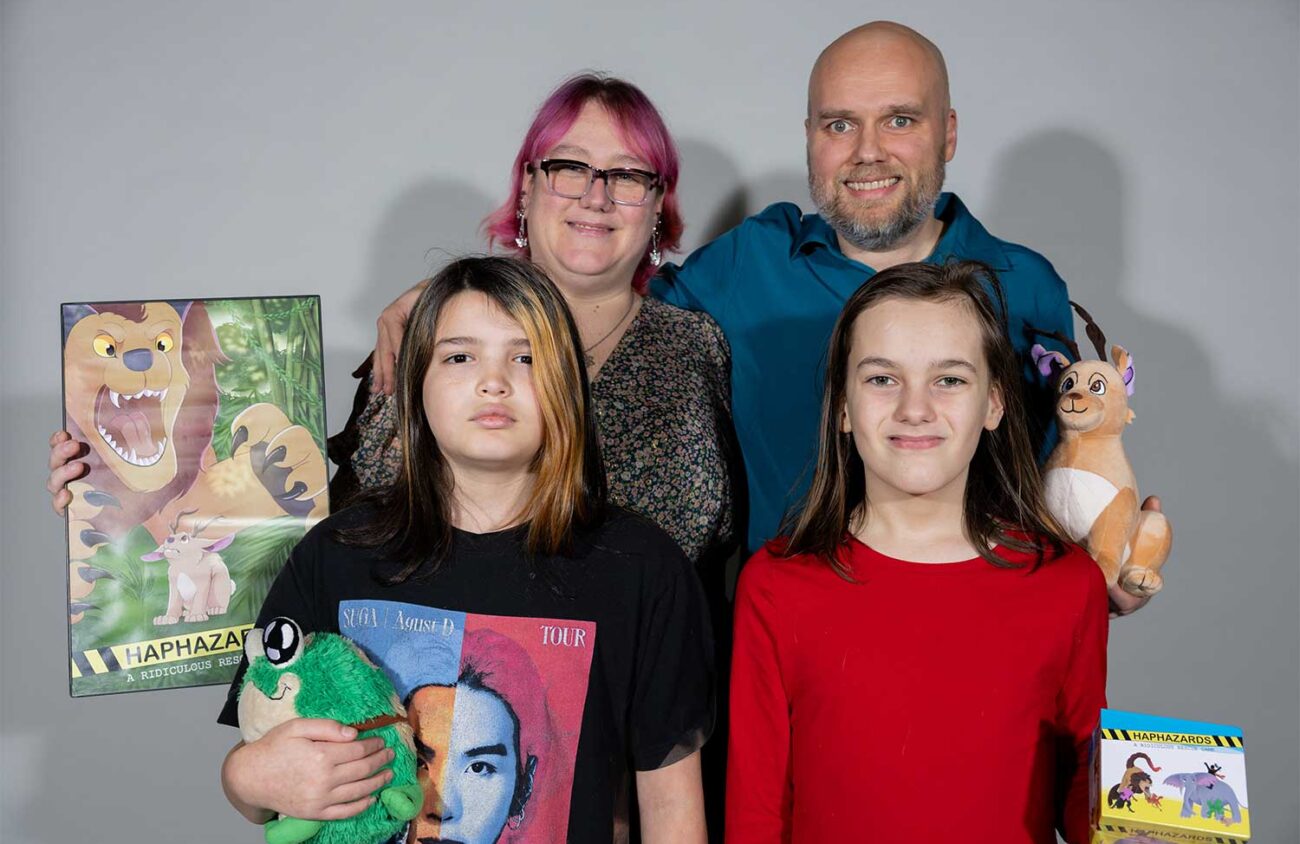
A quiet Sunday in 2020, during the early months of COVID-19 lockdowns, sparked what would become HAPHAZARDS, an imagination-driven card game now shipping its first print run.
The game was created by a Eugene family, Jacob Strandlin, an IT staff member at Lane Community College, and Andrea Strandlin, a stay-at-home mom. What began as a casual conversation quickly accelerated into something tangible.
“We had the idea on a Sunday and by that Wednesday, we were on our second prototype,” Jacob says.
From the beginning, accessibility guided the game’s design. Rather than relying on dense text or complicated rules, HAPHAZARDS centers on visual storytelling — allowing players of varying ages and reading abilities to participate.
“When we made it during lockdown, the kids couldn’t both read yet,” Andrea says. “So we made sure they have big, colorful pictures, so that the kids could kind of make up their own stories based off what they see on the card.”
That approach continues to shape how the game is played today. Now 11 and 12 years old, Xander Strandlin and Noale Strandlin still play HAPHAZARDS at home and at school.
“We donated copies to their schools, so they play the game at school as well with their friends,” Andrea says.
At their respective elementary and middle schools, students regularly play the game with new outcomes emerging each time. Because HAPHAZARDS is built around improvisation, imagination and ever-changing card combinations, no two games ever unfold the same way.
The road to publication was not immediate. In 2022, the Strandlins launched a Kickstarter campaign in an attempt to publish the game. The effort fell short, but the setback did not end the project. Instead, the family chose to self-fund production, placing the cost on a credit card they say they are “still paying off.”
“There wasn’t enough traffic on it to make the goals,” Andrea says.
“I think we probably would have had to spread the word for another year to have had a chance,” Jacob says.
Andrea adds, “Or charge more per copy, which we didn’t want to do. We didn’t want to do some expensive game.”
As the project moved closer to production, visual identity became a priority. Jacob Strandlin reached out to Ari Summers, a California college student studying molecular and cell biology, after discovering and admiring the comics Summers had published online. The collaboration helped shape the game’s distinctive art style, marked by exaggerated creatures, bold colors and visual humor.
Many people in the Eugene area recognize HAPHAZARDS from its presence at the Lane County Fair since 2022 where the Strandlin family hosts a booth centered on live gameplay. Instead of focusing on sales alone, the family invites fairgoers to sit down and play rounds with the creators themselves. The approach at the fair introduced the game to players ranging in age from 3 to 83, according to Andrea, showing its cross-generational appeal. “For the 3 year old, we just set the cards flat on the table and helped them tell the story based on the pictures,” she says.
Designed for three to eight players ages 5 and up, HAPHAZARDS takes about 30 to 60 minutes to play and can be learned in roughly five minutes. Players take turns drawing Hazard cards that present ridiculous dangers, while the rest of the table secretly assemble rescue plans using exactly three item cards.
Each round unfolds as a short burst of collaborative storytelling. Players reveal their items and explain how an often illogical combination somehow saves the endangered player. The person facing the hazard selects their favorite plan, awarding that player the Hazard card as a point before the next round begins.
“When everyone’s ready, everyone tells their rescue plan or their story using the three items, and then the person that got into trouble gets to choose which rescue plan they think is best, and they get to decide what ‘best’ means,” Andrea says.
Play continues until all Hazards are resolved, with the player holding the most Hazard cards declared the winner. Tiebreakers rely on previously banished Hazards and group voting, sometimes resulting in shared victories.
“It’s using creativity and problem-solving skills in just kind of a fun storytelling setting,” she says.
The Strandlins continue to invite community involvement by encouraging players and fans to reach out with ideas for house rules or alternative game modes. One variation featured on the game’s website, hard mode, removes starting hands altogether. Instead, when a Hazard card is revealed, everyone except the player in peril draws three random Item cards and must build a rescue plan using only those cards.
As HAPHAZARDS moved from kitchen-table prototypes to full self published production in January 2023, the Strandlins expanded the project into a broader visual world, releasing posters, pins and plush jackalopes alongside the game. An initial print run of 500 copies has arrived and is currently shipping, with a price increase planned following the prerelease period.
At its core, HAPHAZARDS values imagination over optimization. Each round offers a new experience, shaped entirely by the people at the table — a reminder that sometimes the best response to disaster is a good story and a willingness to lean into it.
The Strandlins are already planning future projects beyond HAPHAZARDS, including another card game currently in the prototype stage titled Pass the Gas.
Ready to face the hazards? Learn more or order the game at HaphazardsGame.com.