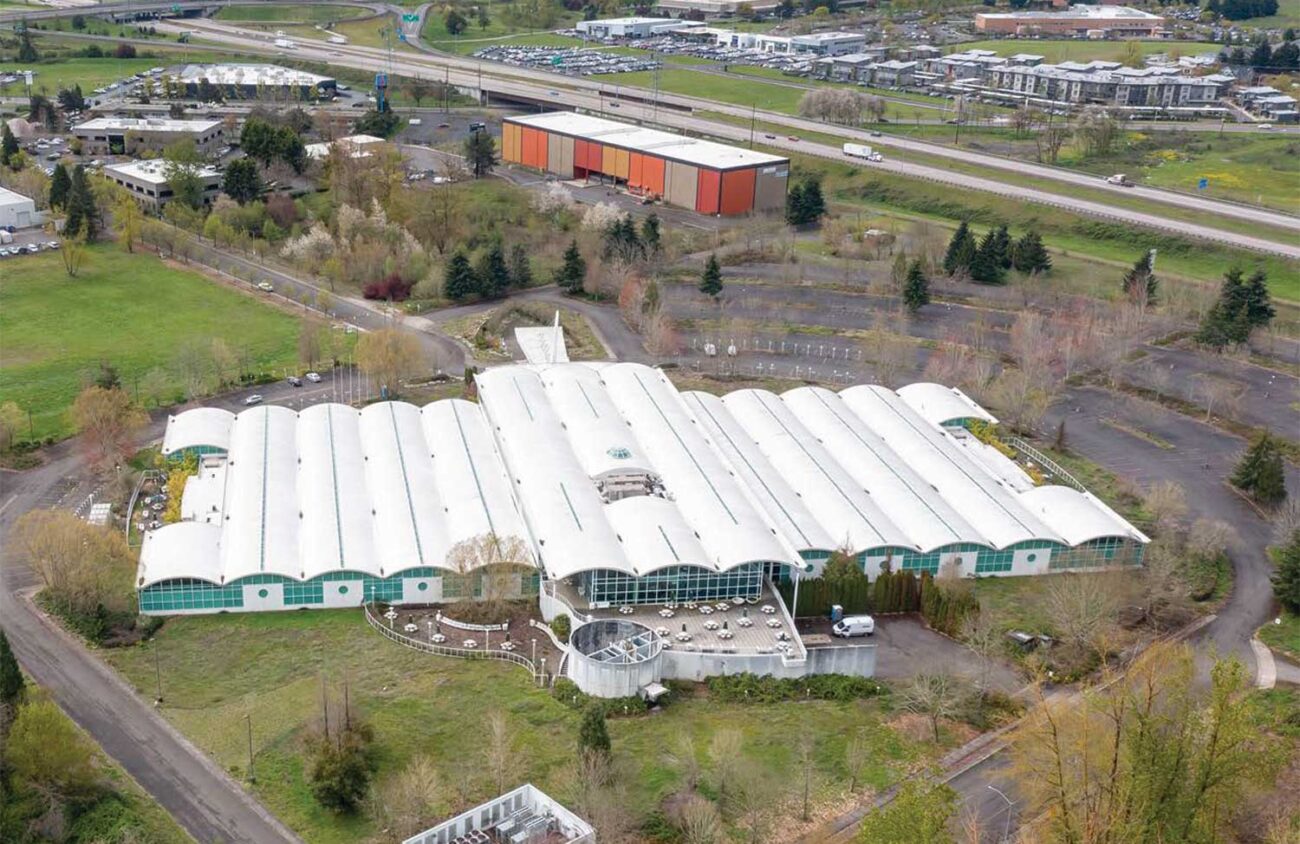
The New Jersey owner of the vacant former Royal Caribbean call center building in Springfield is so keen to sell the place that it’s paying for the complicated process of changing the zoning to let the building be turned into a sports center.
But even assuming the city grants the rezoning, remodeling the 160,000-square-foot Gateway building would be expensive. For example, three-quarters of the roof of the building is too low for the planned court sports such as basketball and volleyball. The roof would need to be pulled off, and a new, higher roof installed, says the broker marketing the building.
Despite the obstacles, the property is one of two contenders in the tentative concept by Lane County and Travel Lane County — the county’s tourism agency — to create a regional sports center to attract visitors and events year-round.
The other contender is the county-owned Lane Events Center in Eugene, where a facility would need to be built from scratch.
No one has figured out the construction costs, where the tens of millions of dollars would come from, or who would own or manage such a facility. The Lane County Board of Commissioners last week asked Travel Lane County to complete an analysis of the sites by the summer.
New Jersey-based real estate investor Hampshire Real Estate isn’t waiting. Last month, it applied to Springfield to change the former call center’s campus-industrial zoning, which doesn’t allow a sports center.
Springfield City Council approval isn’t a sure thing; the application could trigger a fight.
Springfield’s Gateway campus-industrial zoning is a cornerstone of the city’s jobs-creation and economic development strategy. Hampshire wants to change its 22-acre property to “community commercial.” That would allow “recreation” — which Hampshire feels should cover a sports center — plus many other uses, including retail stores, marijuana businesses, hotels, offices, restaurants and hospitals.
Springfield’s decades-long attempt to make the Gateway campus-industrial area into an economic development hub has yielded tepid results. Royal Caribbean closed its custom-built call center building in 2019. Finding a new occupant that would conform to the narrow uses allowed under the campus-industrial rules — for example, light manufacturing or corporate offices — could prove difficult.
“I don’t foresee that the building will ever be a call center again. All those jobs have moved offshore,” says Alan Evans, the Eugene commercial real estate broker marketing the property for Hampshire. “The campus-industrial zone does not work for most commercial uses.”
Zoning battles
Two Gateway property owners, businessmen Dan Giustina and Kelly Richardson, have fought attempts to shoehorn new uses into the campus-industrial zone. They’re suing Lane County and PeaceHealth to try to stop them from building a behavioral health center/psychiatric hospital on campus-industrial-zoned land off International Way in Gateway. And in 2024-25, Giustina and Richardson fought attempts by the Hawes family to allow medical clinics in the Hawes’ campus-industrial-zoned office building on International Way.
Giustina owns land abutting the former call center. Giustina and Richardson declined to comment to Eugene Weekly.
Springfield’s zoning code says the city wants the campus-industrial district to attract “large-scale light manufacturing firms and research and development complexes emphasizing modern technology and employing skilled workers in family wage jobs.”
Hampshire’s rezoning application goes to the Springfield Planning Commission for a recommendation, then to the council for a decision. City councils typically have latitude to approve or reject a rezone, depending on how it fits into their vision for the community. A rezone such as this is also typically subject to review by the Oregon Department of Land Conservation and Development. Any decision can be appealed to the Oregon Land Use Board of Appeals.
Hampshire says it hopes for council approval by the summer.
Expensive study
The county commissioners last week agreed to split the cost of a $450,000 study with Travel Lane County to examine the two sites and develop cost, ownership and operations scenarios. The agency narrowed its focus to the two sites after a preliminary screening of a number of sites last year, says Travel Lane County CEO Samara Phelps.
The nonprofit travel agency has been keen on the former call center for months. Hampshire is asking $18 million for the property, says Evans. The agency last year signed a purchase agreement with Hampshire, Phelps says. The agreement “allowed a defined period for evaluation” of the building, she tells Eugene Weekly. The agency won’t divulge specifics of the agreement, including whether it included a purchase price.
Travel Lane County has let that agreement lapse, Phelps says. “There is no agreement in place today, no purchase price under discussion and no active negotiation related to the property,” she says.
Hit the ceiling
The former call center consists of a central two-story spine of offices, flanked by large open-plan single-story wings to the east and west.
“The roof would need to be raised on the east and west wings of the building, but the center portion would stay as it is,” says Evans, the broker. The wings “need a minimum of 32-foot ceiling height for the multi-courts,” he says. Currently, the ceilings in the two wings consist of a series of supporting arches that rise from about 15 feet to about 25 feet.
An initial study by Travel Lane County’s consultant says a regional sports center could reach operating breakeven point — with rental and other revenues covering staff and other expenses — three years after opening. But that would not account for the big capital costs of constructing a new center, or buying and remodeling a building. A new complex could cost $50 million to $60 million to build, the study said.
Where such money might come from is anyone’s guess. Lane County has $11.3 million stashed away from a special 2 percent tax it began levying three years ago on hotel and motel bookings.
A sports center could help the county’s lodging industry, Phelps says.
“Lane County has experienced a consistent winter slowdown for decades. Indoor sports is one of the few tools we know that directly aligns with that challenge. Indoor tournaments are weather-independent, occur during winter weekends and bring families for multi-day stays,” she says.
Bricks $ Mortar is a column anchored by Christian Wihtol, who worked as an editor and writer at The Register-Guard in Eugene 1990-2018, much of the time focused on real estate, economic development and business. Reach him at Christian@EugeneWeekly.com.