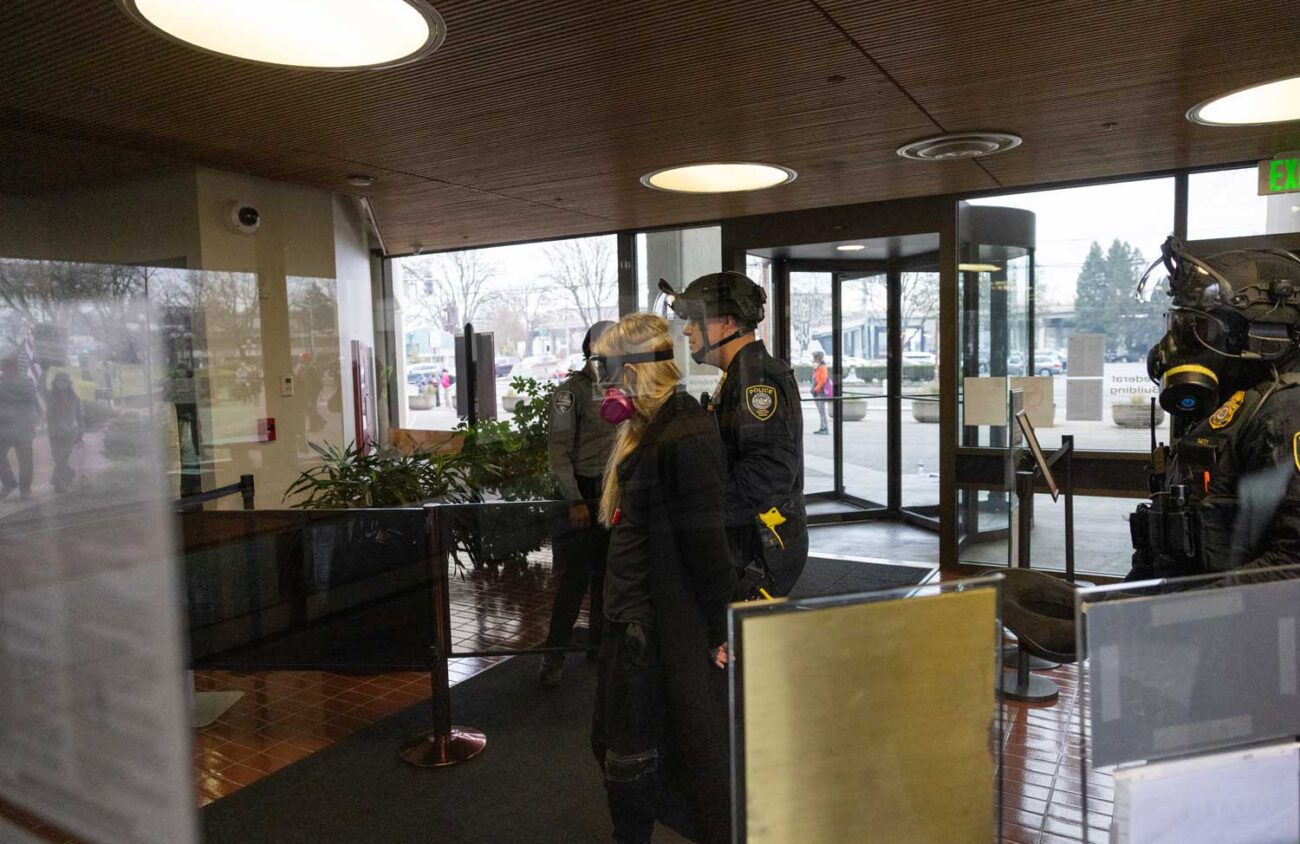
A U.S. District Court Judge granted a preliminary injunction on Feb. 20, barring the Department of Homeland Security from enforcing a rule that prohibits “Creating a loud or unusual noise, noxious odor, or other nuisance,” on and around the traditional free speech areas of sidewalks surrounding the downtown Eugene Federal Building.
The preliminary injunction against DHS, President Donald Trump and Kristi Noem prevents the implementation locally of the new rule regarding conduct on federal property, which DHS issued in November.
The preliminary injunction only applies to the sidewalks surrounding the Eugene Federal Building. The injunction is similar to a restraining order issued by U.S. District Judge Michael Simon, which prohibits the use of tear gas and pepper balls at the Portland ICE facility.
Eugene Weekly broke the news of the lawsuit in December. Now, the injunction, issued by District Court Judge Ann Aiken, finds that the plaintiffs, Anna Lardner and Chloe Longworth, have a likelihood of success on the merits of the case, which claims that the DHS violated their First Amendment rights to free speech by prosecuting and threatening them with the new rules.
“The big problem with these vague and overly broad regulations is that it allows bad actors to abuse the law and arrest a wide swath of people because the language allows them to sweep protected First Amendment conduct within the purview of a crime,” says Lauren Regan, Civil Liberties Defense Center’s director of litigation and advocacy.
Lardner and Longworth, represented by Regan and the CLDC, an activist legal defense network, have been active at the Eugene Federal Building, protesting ICE activity in the area since early July. Both Lardner and Longworth say they’ve faced retaliation from DHS agents when exercising their rights to free speech. Longworth and Lardner were among those arrested on Jan. 27 at a protest which later resulted in DHS using flashbangs and tear gas on protesters.
“I have been engaged in First Amendment protected protest activity at this building and I believe that DHS arrested me in retaliation for that First Amendment protected protest activity,” Lardner said at the Jan. 27 protest, after being released from custody.
Aiken had previously authorized a temporary restraining order against the loud or unusual noise provision of the rules; however, after the court heard oral arguments on Feb. 20, Aiken converted the TRO into a preliminary injunction. In a press release, the CLDC writes, “Plaintiffs and others have and will continue to suffer irreparable harm from the chilling violations of their constitutional rights, and it is in the public interest to restrain the actions of the federal government in this way.” A preliminary injunction remains in effect until a final decision is made.
If the plaintiffs prevail, the injunction will become permanent and the implementation of the rule will be banned nationwide.