There were allegations of assault, petition workers collecting signatures for a union-driven measure who were trying to form their own union, and a union’s failed attempt to recall a legislator known for his pro-union stances.
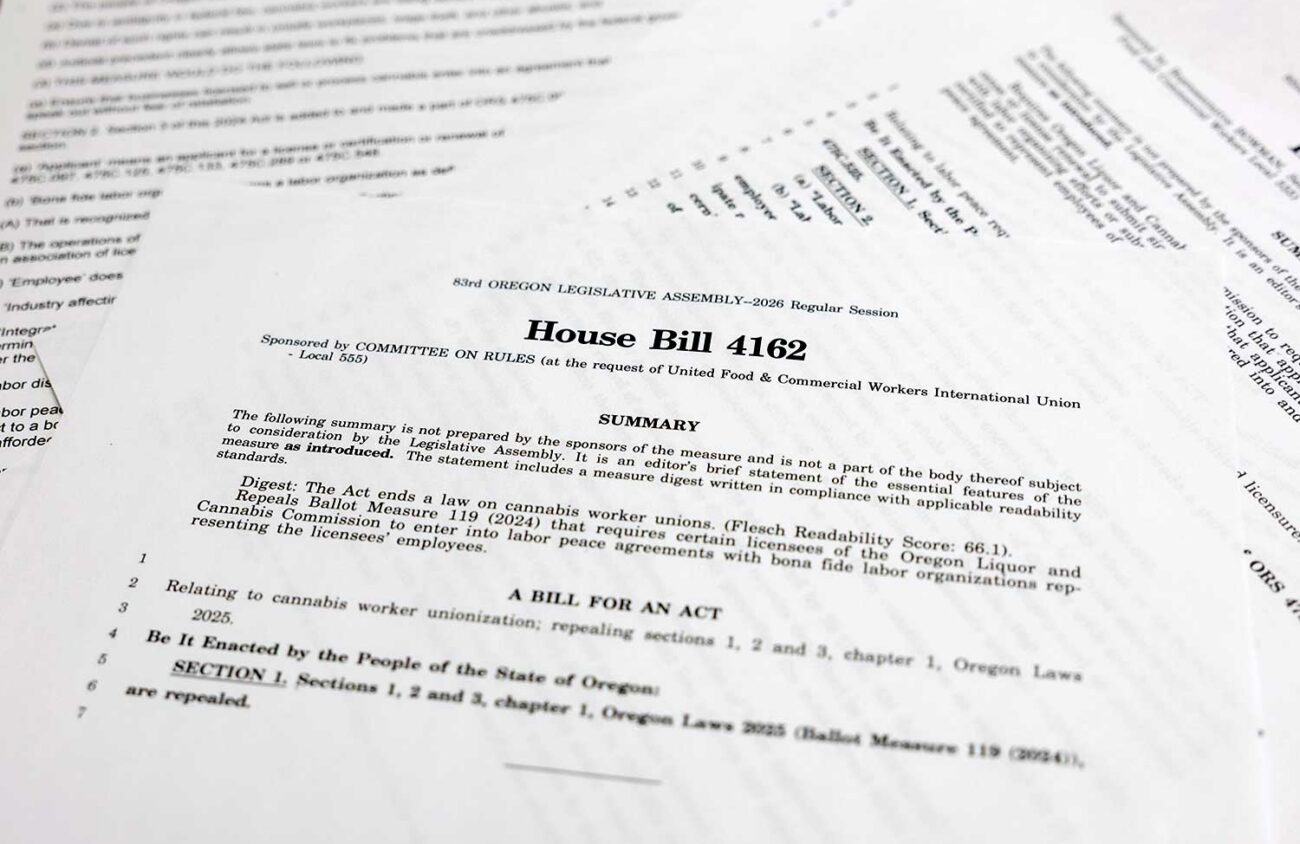
After all that, and now just over one year after United Food and Commercial Workers Union Local 555 successfully lobbied for the passage of Measure 119 — requiring cannabis businesses to enter a “labor peace agreement” with a union before getting its license or license renewed — the UFCW 555 is now asking the Oregon Legislature to repeal it.
In Oregon, a labor peace agreement is a contract between an employer and a labor union in which the employer agrees to remain neutral during union organizing efforts. The Oregon Liquor and Cannabis Commission is responsible for cannabis licensing in the state.
In 2024, UFCW 555 successfully pushed for the passage of Measure 119, the United Cannabis Workers Act. A year earlier, UFCW 555 had tried to get House Bill 3183, an almost identical copy of Measure 119, through the Legislature but blamed its failure to pass on now-retired Eugene Rep. Paul Holvey.
When HB 3183 was introduced, Holvey questioned if the state bill would be preempted by federal law and wanted to get a legal opinion on it. Holvey was one of six legislators voting in favor of moving the bill to the House Committee on Rules while waiting for the legal opinion. The bill died in June 2023 when the Legislature adjourned. “Our legislative council was very clear twice that this was in violation of the National Labor Relations Act and had constitutional issues,” Holvey says.
In response, UFCW 555 launched the $346,000 recall campaign against Holvey, which failed to pass but succeeded in creating drama locally and statewide with signature collectors for the recall alleging an assault by Holvey supporters in the Whiteaker, the gatherers attempting to form a union themselves — and being laid off under a contract switch — and two Eugene cannabis dispensaries, Spacebuds and Flower of Lyfe, who had previously unionized with 555 voting to decertify.
A decertification vote removes the employee’s union as their exclusive bargaining representative. As a result, Local 555 subsequently called for people to boycott the dispensaries and ran advertisements on Facebook claiming Morgan Glenn, Flower of Lyfe owner, was a “union buster.”
Letters to the editor and other reports showed petitioners trying to get people to sign the measure petition used rhetoric like Holvey killed “legislation that would have provided vital assistance to workers who had been on the front lines of the COVID crisis.”
“They wanted to come and take me out, which they attempted to do with lots of political speech that would normally be slander,” Holvey says.
The union succeeded in getting the signatures required to put the bill on the ballot as Measure 119 and donated more than $2.4 million to its campaign.
“I thought it was kind of outrageous,” Holvey says of the original House bill. “It seemed like this [HB 3183] was a very ill-advised concept and was very alarming to me,” Holvey says. He was concerned that HB 3183 included provisions that took the workers’ ability to strike away from them if they had already entered into agreements with the union. Holvey asks, “Why would you give up your most powerful tools to get a contract?”
Measure 119 passed a year later with 56 percent of the vote. The law went into effect Dec. 5, 2024. Now, HB 4162, which aims to repeal the measure, has passed the House. On Feb. 25, the bill passed out of the Senate Committee on Rules and is headed to the Senate floor.
On Feb. 10, Mike Selvaggio, UFCW political director, told the Oregon House Committee on Rules that because of a U.S. District Court ruling which blocked enforcement of the measure, 119 should be repealed before it can be sent to the Supreme Court, which under Trump-appointed justices, has not favored labor unions.
Selvaggio, who led the recall campaign against Holvey and is asking the Legislature to repeal Measure 119, did not respond to Eugene Weekly for comment.
The ruling found that 119 conflicted with the National Labor Relations Act by requiring employers to remain neutral. Federal law allows employers to express opinions regarding unionization, which is also protected First Amendment activity.
“I’ve been in the labor community for quite a long time, and I’ve done a lot for labor,” Holvey says. “Laws already exist to protect the rights of most workers to organize and so the premise of this ballot measure, that they needed this because they weren’t allowed to organize, was a false premise.”