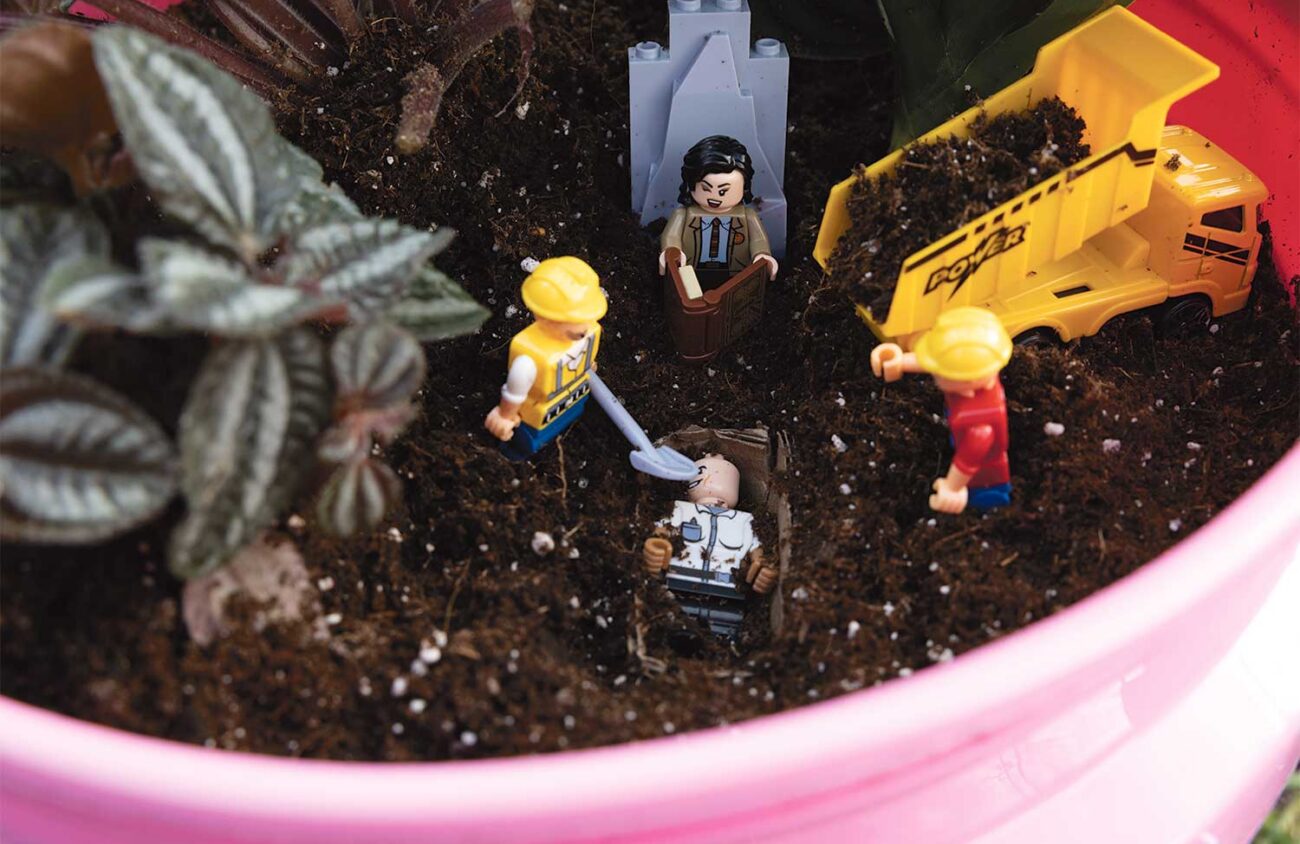
For various reasons, the folks of Eugene Weekly’s editorial team got curious about how one goes about burying a body in the backyard within legal parameters.
We figured the Home and Gardening issue would be the perfect place to figure it out, seeing that it’s the ultimate intersection between the two: How to start pushing up daisies on your property.
It turns out that spending eternity in your own backyard is relatively common (just ask Elvis Presley). Devon Ashbridge, Lane County’s public information officer, reports that Lane County Land Management receives about one private burial application per year.
But, like all things that are literally a matter of life and death, there’s a lot there.
For starters, you have to be the property owner, and the body you’re burying has to be a family member — and as long as they are family members, there is no limit to the number of people you bury.
After those are acquired (property you own and family to bury), you need to obtain your county’s written permission, per Oregon law, ORS 97.460(b). Here in Lane County, you do this by filing a Type I Zoning Determination Application, which asks applicants questions about the site address and the people involved. You need to apply for each burial separately.
Burial “isn’t an outright listed use associated with zoning,” so the application is required, Ashbridge says. She also reports that the applications that come in are mostly people planning their own underground residency, and some requesting it for their loved ones. “Often, those applications are completed by people planning ahead, and the application can be approved and held for recording and completion after the burial,” she says. “In instances where planning ahead was not possible or not considered, our land use technicians work hard to expedite the application process and work with the grieving families.”
Along with the form, you must provide a site plan, which is an architectural drawing of the entire burial location, illustrating everything from the property lines to the wells and the septic systems — though Oregon law does not stipulate any burial depth, location or even distance from water, setbacks or state highways. This means you can legally bury your body at whatever depth you choose.
“We recommend, where possible, that applicants consider a 100-foot buffer between a burial site and a waterway or well,” Ashbridge advises.
After all of that is approved, applicants then record a Private Property Burial Covenant with their property record through the Lane County Clerk’s Office. This is arguably the most important document of them all, because it officially records that there are bodies buried on your property despite the fact that it is not a cemetery, and that all future property owners will be made aware of this, per ORS 97.460(c)(d).
When burying bodies, it’s important to consider your future visitation rights. “We also recommend applicants record an access easement with the County Clerk’s Office so that if the property is sold in the future, family and friends still have legal access to visit the burial site,” Ashbridge says. An easement is a legal right that allows people to enter someone else’s property for a specific purpose. If you don’t acquire one, future property owners are under no obligation to let you visit the gravesite.
There are plenty of alternative options for making one’s backyard an eternal home — so long as the body being in one piece is not a requirement. The Seattle-based funeral home Recompose offers human composting.
“We really rely on microbes to do the work of transforming the body into soil,” Recompose founder and CEO Katrina Spade says. For about a month, bodies are placed in what Spade calls “the vessel,” an 8 foot by 4 foot stainless steel cylinder, along with “a mixture of wood chips, alfalfa and straw, the perfect balance of carbon and nitrogen materials.” Using a basic fan system to keep the body above 131 degrees Fahrenheit, Spade says it creates an environment where microbes “begin to break the plant material and the body down.”
After that first month, the body is already a “fine mulch,” Spade describes. At that point, her team sorts through it for bones and metals (such as titanium hips, she says). The metals get recycled, and the bones and mulch are mixed back together for the second month, where the microbial activity completes and any dangerous pathogens die. “The end result is that soil can be given back to family and friends and used on plants and gardens and trees,” she says. “We recommend you use it for perennials and ornamentals or at the base of trees.” It costs $7,000, compared to direct flame cremation costs of $1,000 to $3,000, per local funeral homes.
Aqua cremation, or alkaline hydrolysis, is another technique for the earthy backyard type. The body is put in a pressurized vessel, with a mix of water, potassium and hydroxide, and heated up to about 320 degrees, essentially cooking it. At the end of the process, bones are soft and tender, to be dried out in an oven and later pulverized.
While it is more expensive than standard cremation, prices vary and are typically comparable to that of direct cremation. With any type of cremation, you can scatter cremated remains along your backyard and your garden to your heart’s content, so long as you’re aware that future property owners do not have to let you come visit after the fact.
Whether you’re burying, breaking down, boiling or burning, the most important thing you can do is to plan ahead.
Now you know how to bury dead bodies in your backyard, legally speaking. You’re welcome.