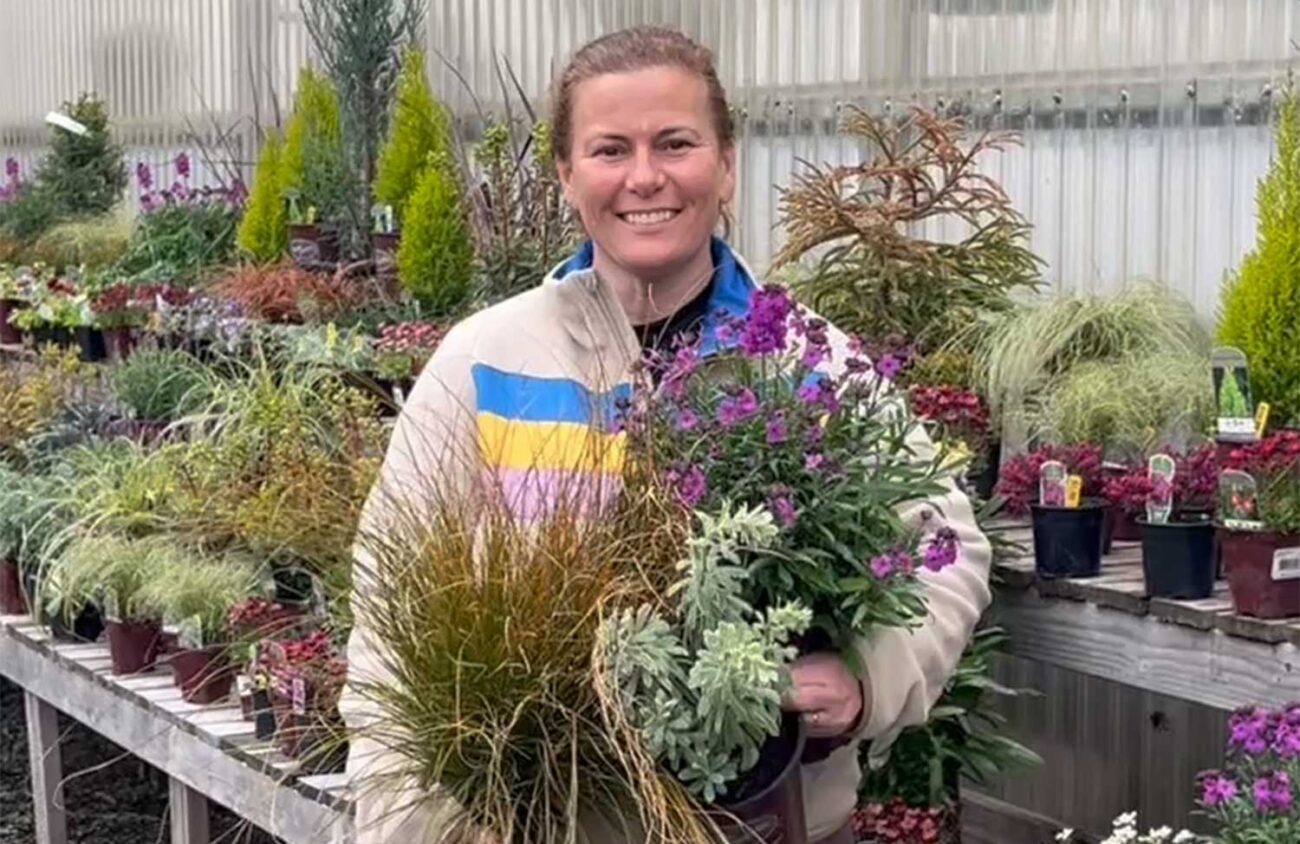
April through early May is a great time to plant perennials, those non-woody flowering plants that come back year after year. Buy them soon, while they are fresh and abundant at nurseries and garden centers, bursting with growth potential. Some perennials may be available in both 4-inch pots and gallons. Four-inch plants are cheaper than gallons and, if they are strong and healthy, tend to take off fast, sometimes making up the size difference in a matter of weeks. Gallon-size plants will, of course, make an immediate impression!
Choose a sunny area in well-prepared soil. Although perennials can be planted among shrubs, there is much to be said for giving them some garden space of their own, where they will get plenty of light. Perennials vary radically in size and growth rate, so check labels for height and spread. Some bloom for a relatively short time — a week or two, maybe a month. So a satisfying perennial bed requires taking bloom-time into account, as well as shape, height and flower color. The payoff is a border that changes constantly but puts on a good show for much of the year.
Life will be simpler if your plants are well adapted to the conditions in your garden and have no very special needs. I consider the need for staking to be a special need — I don’t do it.
Some plants look nice when they flop, sprawl and clamber, but generally, I expect plants to stand up by themselves and stay more or less in the spot assigned to them. For a bit of drama, I like to include a tall grass or a canna lily or two, even in a small bed.
Any perennial you put in a small space should have at least two of the following qualities: 1. It blooms for a long time, or reliably re-blooms. 2. It doesn’t need frequent division to perform well or to stay in scale. 3. It has attractive leaves or is otherwise nice to look at even when it isn’t blooming.
Leaves matter. Look for some variety in leaf shape, size and color, and perhaps include a few with dissected or ‘ferny’ leaves, or leaves that are long and narrow.
My perennial “A team” includes, for their long bloom period, hardy geraniums “Rozanne” (blue flowers, and I do mean blue) and “Anne Folkard” (magenta). Their stems sprawl and climb, but in a good way, and their roots don’t stray much.
Clump-forming Aster x frikartii is almost as long-blooming, and does not spread the way many fall asters do. The lavender-blue flowers go with just about everything.
Yellow-flowered Phlomis russeliana has interesting fuzzy leaves and the stout flowering stems look great before, during and long after bloom time. Some other plants that stand up straight and don’t spread too much include Achillea, ‘Coronation Gold,’ and Veronicastrum (Culver’s root). I also like coneflowers (Echinacea spp.). I recommend varieties with ivory-colored or light yellow flowers, as well as the more familiar deep pink. Tall, lupine-like Baptisia australis (false indigo) blooms early in summer and is soon over, but the stout stems look interesting for months.
Narrow-leafed classics include daylily (Hemerocallis) and Kniphofia (also called torch lily or poker plant). I prefer smaller varieties of these, especially of the latter, which provide pretty pastel shades of coral and light yellow. Then there are Siberian iris (Iris sibirica) and Japanese iris (Iris ensata). The clumps expand at about the same rate and share an all too brief flowering season. Japanese iris leaves stay roughly vertical, while Siberians soon make enormous, arching leaf clumps — a great feature where there’s room for it, but perhaps a nuisance in tight quarters.
Multiple big ornamental grasses can easily overwhelm a small perennial planting, but smaller grasses and sedges can be great foreground plants. Molinia caerulea ‘Variegata’ is a demure, stripy, trouble-free, front of the border plant. It loses its leaves in winter, but the low-growing, copper-colored sedge (Carex comans) is evergreen (everbrown?) and makes an excellent foreground plant.
Great news! One of my favorite sources for both annuals and perennials has, for many years, been Little Red Farm Nursery in Springfield, so I was sorry to learn last year that this family-owned and operated nursery was closing. Happily, it re-opened in mid-February, with new owner Natalie Reeves and familiar staff.
The LRF, as we call it, is at 1020 S. 42nd Street and literally at the end of the road. Midweek is a good time to go if you need assistance in choosing plants.
The Garden Palette is a monthly column coordinated by Kim Kelly. Rachel Foster is a longtime EW garden columnist. Have a gardening question or tip? Email Gardening@EugeneWeekly.com.