Liberty Rossel is a storyteller. She works not with words but with art that other people have made. Her formal title at the nonprofit Maude Kerns Art Center is “director of exhibitions,” but she curated the two shows on view until April 24 to “tell a story.” They both have a clear theme and speak to how we see and treat the environment, as well as each other.
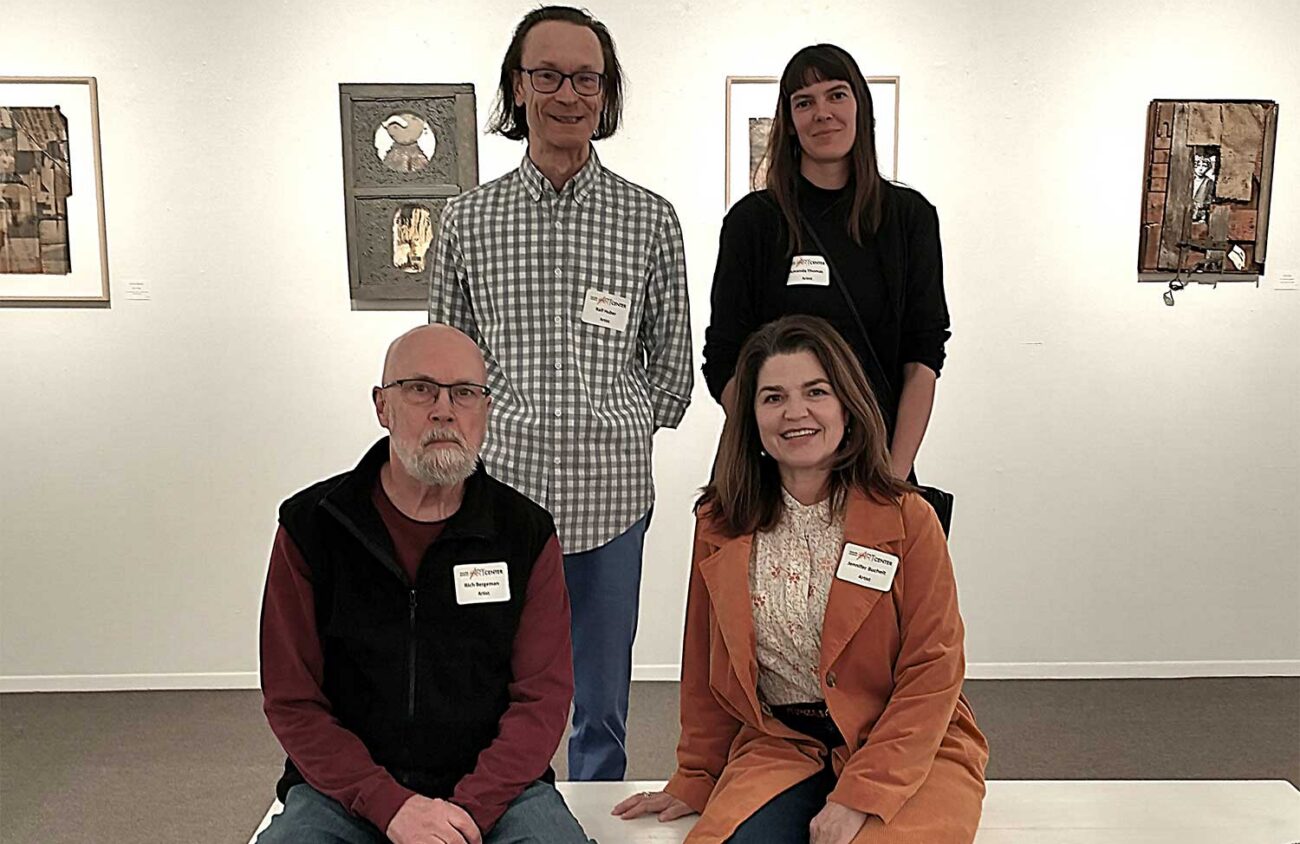
Witness: Earth & Sky and Consume & Dispose, the two exhibits at Maude Kerns this month, feature four artists: Rolf Huber and Jennifer Bucheit in Consume & Dispose and Amanda Thomas and Rich Bergeman in Witness: Earth & Sky.
The Art Center was originally built as a church. Its sizable main room includes a raised platform that likely functioned as a pulpit. Both Bergeman, a Corvallis artist, and Thomas, from Shasta, California, have art that delivers sermons, so to speak. Though Bergeman preaches the least loudly.
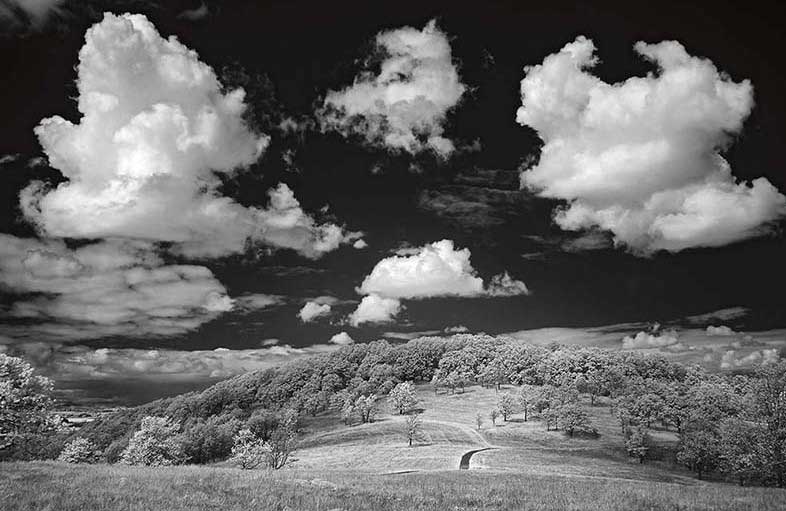
His gorgeous black and white photographs might remind you of Ansel Adams landscapes. But the phenomenon that in part inspired the collection of photographs he has here was “the land acknowledgements movement.”
A self-described history buff, he researched the more than 12 bands of Kalapuya people who historically resided in the Willamette Valley before the colonial era. He found they were settled along watersheds, drew a map of their locations and has so far been photographing them for about three years.
Working with infrared photography, as he does, turns a light blue sky dark. In “Wapato Lake Wetlands: Homeland of the Tualatin Kalapuya,” the clouds, which remain white under infrared, stand out bright against a dark sky. The contrast is striking and slightly strange. He hopes these images that take “you out of what’s normal” will encourage viewers to see these landscapes differently — as Kalapuya land when it was first occupied by Kalapuya people.
Thomas’ photographs are silver gelatin lith prints. Black and white images, too, they are printed on decades-old paper the artist found in the art department at College of the Siskiyous, where she works. The abandoned paper corresponds to the theme of abandonment in her work, as abandoned mines are her central subject matter, especially ones that continue to pose toxic risks to the land, water and health of humans.
Her photographs of mines are accompanied by texts that describe the location, history and specific soil contaminants caused, as well as cost management and the communities of people who might be harmed.
Thomas’ ceramic sculpture “Hours, Days, Years, Centuries” fools the eye, as it resembles part of a tree trunk. The title reminds us that trees can live much longer than humans, but not if we continue to poison the land with thoughtless abandonment.
The materials of “Hours, Days, Years, Centuries” are stoneware, underglaze acid mine drainage wash, and acid mine drainage glaze. The glazes were created with rock samples Thomas says she found at various sites she photographed, which are in the exhibit.
As calls to action, the art in Witness has much in common with that of Huber and Bucheit. Huber, originally from Switzerland, was a commemorative coin designer for 25 years. Then, during the pandemic, looking for something to do at home, he began — with no formal training in art — to create assemblages.
The subject of his art is an issue he’s been long aware of — child labor.
“No Price Too Low” is assembled with pieces of a garment, images of child labor and price tags hanging like decorations on a tree. The whole piece sits on a hanger (though despite its title, it is NFS or not for sale). It’s Huber’s hope that “No Price Too Low” and his work in general will remind us that children should not be “sacrificed for the sake of economic expediency.”
Originally from Wisconsin, photographer Bucheit moved to Eugene in 2020 to be with family during the pandemic. Her collection recalls a statement she heard a couple of years earlier, in 2018, by the United Nations, which warned us that we had 10 years to reduce greenhouse emissions before irreversible harm was done to the earth’s atmosphere. Wanting to create a series that addressed the climate crisis, she photographed her own family’s consumer habits as an example.
From across the gallery, the first thing you notice about her “canvases” are their interesting, different symmetrical shapes. Upon closer inspection, it becomes apparent that each shape is created by a product package.
Huber, Bucheit, Thomas and Bergeman applied separately to be shown at MKAC and were selected by a juried process. Then Rossel paired them to tell two different stories. They all reflect the idea that art, even when fun, beautiful or unusual, can serve as a platform to call for action. Whether that action will be addressed, and what it will look like, is so far unknown, and so the stories presented do not yet have endings.
In the meanwhile, as MKAC volunteer and retired Air Force officer Dana Burall said the day of the center’s opening reception, “These pictures make you think.”
An Artist Talk for Consume & Dispose is 1 pm to 2 pm Saturday, April 18.