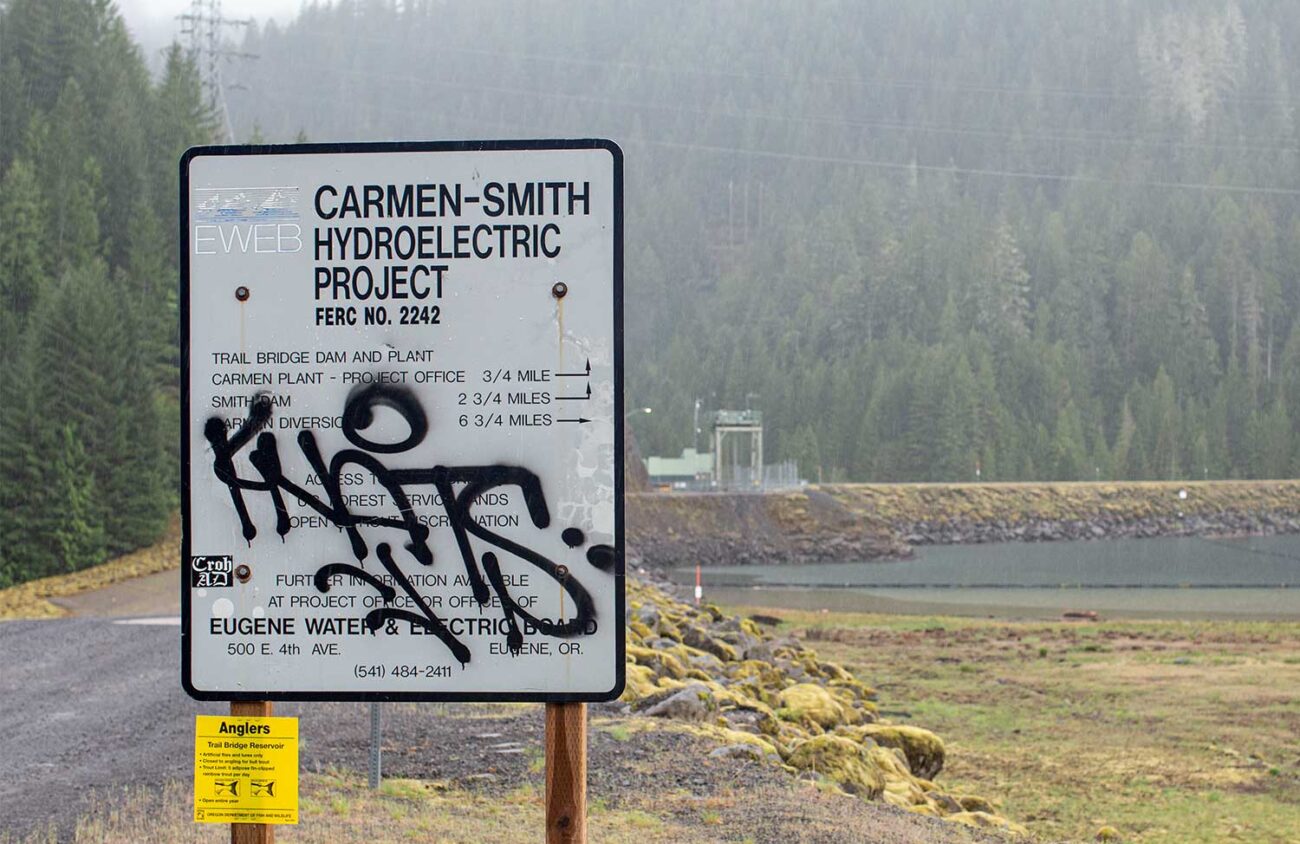
Right now, native fish can make their way past the Trail Bridge Dam on the McKenzie River in two ways: Chinook salmon are trapped and hauled in a truck, and bull trout are caught by anglers and moved upstream.
Conservationists call this method ineffective, and the Eugene Water and Electric Board is seeking to extend the implementation of a new permanent trap-and-haul fish passage system to the 2030s. In December 2025, EWEB filed a notice to the Federal Energy Regulatory Commission, the agency tasked with overseeing non-federal hydroelectric projects, informing it that EWEB is seeking approval to change its license to operate the Trail Bridge Dam, part of the Carmen-Smith Hydroelectric Project on the McKenzie River.
On April 22, conservation nonprofits Cascadia Wildlands, the Native Fish Society and the Willamette Riverkeeper, filed a petition with FERC, asking it to require EWEB to conduct a cost analysis on alternatives to EWEB’s proposed trap-and-haul method of fish passage, which the conservationists call ineffective. They’re also asking FERC to require EWEB to make immediate changes to its current temporary trap-and-haul fish passage system.
Some of the requested changes include relocating the trap downstream where it can receive a stronger current, installing a guidance system for fish to enter and replacing it with a larger cage-style trap to allow multiple fish to enter volitionally.
The Carmen-Smith Hydroelectric Project consists of three dams, two hydropower plants and three reservoirs on the McKenzie and Smith rivers.
In an email to Eugene Weekly, EWEB spokesperson Aaron Orlowski writes that the four- and six-year time extensions will allow EWEB to focus exclusively on the design of the new fish passage facilities instead of continuing to move forward with an old plan for a permanent trap-and-haul fish passage system at the same time as a new one.
“In fact, the whole purpose of the extension of time is to develop a permanent trap and haul facility that is placed in a better location for the benefit of bull trout and Chinook salmon,” he writes.
The construction of fish passage at the Trail Bridge Dam has been plagued with delays, with debates over volitional versus nonvolitional passage beginning in 2006. Volitional fish passage is when fish travel through or over a dam by their own will, without human intervention.
In 2025, conservationists filed a lawsuit against EWEB, claiming the utility failed to implement effective fish passage measures. The goal of the lawsuit was to mandate EWEB to build a fish ladder or, at least construct an entirely new trap-and-haul system. The lawsuit also asked for the court to mandate EWEB to remove Trail Bridge Dam entirely if fish passage could not be completed in a timely manner The lawsuit was dismissed after a U.S. District Court judge ruled the claims belonged in the FERC review process, not the district court.
Upper Willamette River Chinook salmon and bull trout are federally listed as threatened species. Conservation director of Cascadia Wildlands Bethany Cotton says the temporary trap-and-haul system, which has been in place for years, is not effective, and is vulnerable to things like the wildfire season. She adds that trap-and-haul in general is not an effective method to ensure the safe passage of fish for spawning upstream.
During the 2023 and 2024 spawning seasons — which coincide with the wildfire season — no Chinook were captured and moved upstream, which EWEB attributes to wildfire impacts and low numbers of returning fish. Highway 126 is the main access road to the dam, and when it is closed due to fire conditions, EWEB may be unable to staff the trap system, limiting fish passage operations.
According to Orlowski, in 2025 no Chinook were moved due to what biologists concluded as too few Chinook returning to the spawning channel. Orlowski writes that in 2026, EWEB, the Oregon Department of Fish and Wildlife and the National Marine Fisheries Service decided no Chinook will be moved due to the expected low number of returning fish.
For bull trout, EWEB has been operating an “angle-and-haul” program alongside the ODFW and the U.S. Fish and Wildlife Service. This means staff are physically hooking bull trout with fishing equipment, then moving them upstream. Orlowski reports that 42 bull trout were moved in 2023, 48 in 2024 and 62 in 2025, including 17 transported through the trap-and-haul system.
“They don’t normally get hooked in their life cycle,” says Jennifer Fairbrother, Native Fish Society conservation director. “Those stressors can reduce their likelihood of survival. There can be mortality associated with that and it can also reduce their ability longer term to survive and reproduce.”
She adds that a volitional fish passage system is “the best way to allow fish to function the way fish need to function.”
“It’s far more likely to fail year after year as we are facing more intense, climate‑driven wildfires,” Cotton says of the trap-and-haul system. Cotton believes operating a permanent trap-and-haul facility could be more expensive than a fish ladder. “The beauty of a fish ladder is once it’s installed, it just works. It doesn’t require people to be there,” she says.
Orlowski writes that for the past 10 years, EWEB, along with all state and federal regulators, has supported a trap-and-haul system over a fish ladder for safety, effectiveness, cost and operational reasons.
He adds that there is no reason to spend customer dollars on assessing a fish ladder that is not required or under construction.
Fairbrother says she’s worried about further delays to the process since EWEB has promised a trap-and-haul system before, with no results. “We have no confidence at this point that they are going to follow through on it,” Fairbrother says. “We’ve seen time and again that they’ve blown through these deadlines.”
In its 2019 FERC license, EWEB was required to design and build a permanent trap-and-haul system within three years, but did not achieve the deadline. EWEB later installed an interim system, citing dam safety concerns like sinkholes found in the area as reasoning for its delays.
Orlowski writes that EWEB has already begun engagement with engineering consultants and the Fisheries Work Group, a multi-agency stakeholder team, in the design of the new trap-and-haul facility and integrated tailrace barrier. A tailrace barrier keeps fish from entering highly turbulent flows of water created by hydropower projects, which if entered, can result in fish mortality.
Orlowski says typically, the designing is done only after FERC issues an order approving the facility, but EWEB is moving ahead to expedite the process. Additionally, Orlowski writes that EWEB is continuing to work with its independent consulting team and FERC dam safety experts to address questions on the safety of new facilities. “While unknown circumstances can and do arise in any large construction effort,” Orlowski writes, “EWEB is taking concrete steps to minimize these surprises and address issues proactively and quickly, to meet the aggressive schedule presented in its arrangement with federal regulators and the FERC extension of time request.”
He adds that EWEB is “committed to having the downstream passage improvements completed by 2030 and permanent trap-and-haul in place by 2032.”
Fairbrother says she’s worried pushing the date back for fish passage even further could be detrimental to the survival of the threatened Chinook and bull trout species. “We need to get effective fish passage at the dam for these populations if we have any chance of making sure that we can recover them before, you know, they start to go extinct in the next 15 years,” she says.
In response to the petition, Orlowski writes, “While EWEB is still in the process of reviewing the petition and cannot address its substance at this time, it is disappointing, if not surprising, that a few stakeholders have once again chosen to litigate rather than engage productively and collaboratively in the upcoming FERC license amendment process.”
He adds that the petition will not affect EWEB’s plans to receive feedback on a draft license amendment application, which will be available to the public in May.
“We are coming up rapidly on another spawning season and every spawning season makes a significant difference to the population that’s already imperiled,” Cotton says. “This is the time to act right now, while we still have an opportunity to reverse the collapse of these species.”