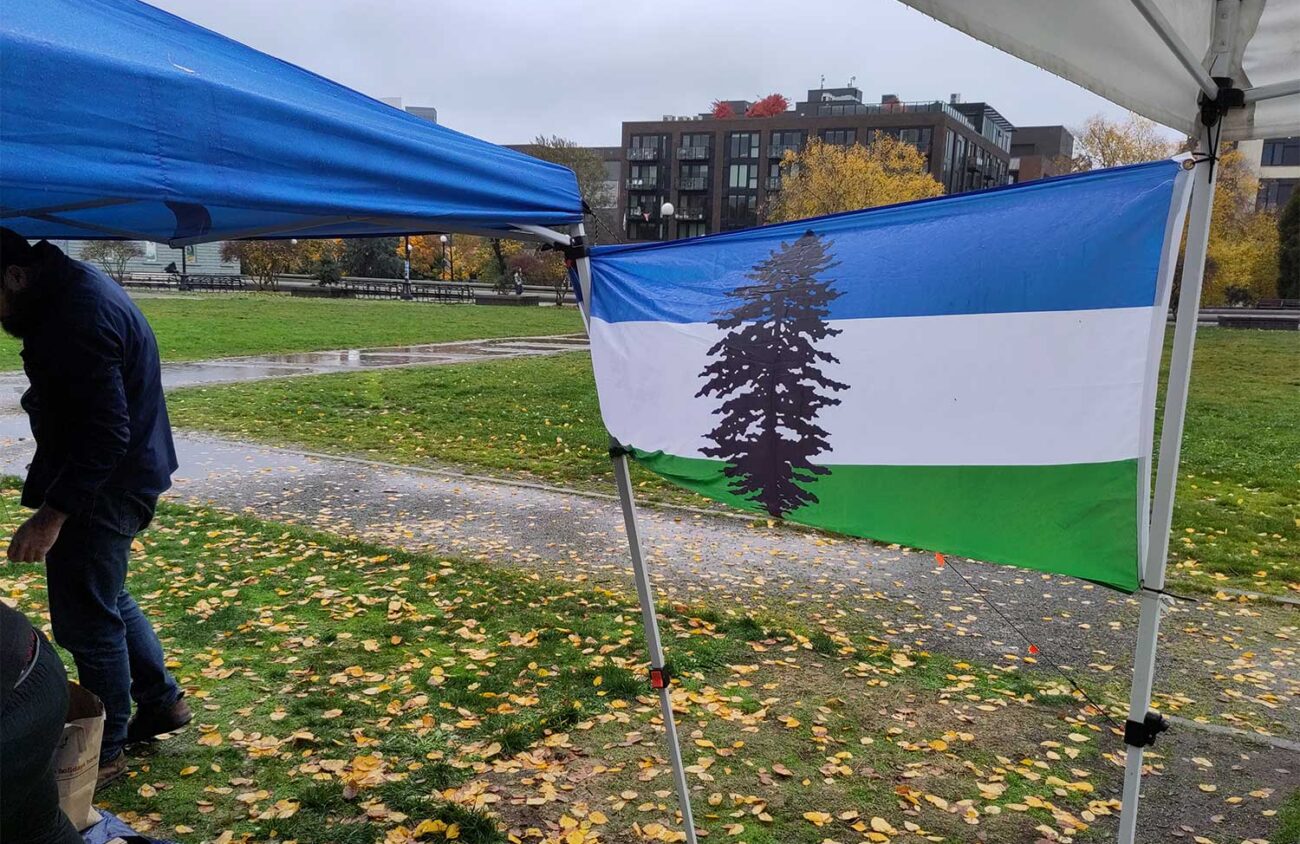
Cascadia Democratic Action, a nonviolent movement whose ultimate goal is to achieve an independent, democratic bioregion, announced on the eve of Cascadia Day, May 18, that it’s time to open the conversation of increased autonomy, including secession — withdrawing the Cascadia bioregion from the U.S.
CDA says it wants autonomy because the federal government is failing to prevent systemic abuse and is rapidly descending into fascism.
A bioregion is an area defined by natural features like watersheds, mountain ranges and ecosystems rather than politically motivated borders. The Cascadia bioregion includes the majority of Oregon, Washington and British Columbia. Several groups and individuals have founded movements for an independent Cascadia throughout history. After the 2016 election of President Donald Trump, modern movements became more popular. Cascadia Day, on the anniversary of the 1980 eruption of Mount St. Helens, celebrates the bioregion.
Andrew Engelson, CDA organizer, says CDA believes the federal government is eroding the rule of law and President Trump is becoming more and more of a tyrant. “I think long-term it makes sense for this region to go its own way,” he says.
While the policies and actions of the Trump administration are the biggest driving force for CDA’s desire for autonomy, a power shift from Republican to Democrat would likely not change the movement’s drive for an independent Cascadia.
Engelson says both Oregon and Washington pay $36 billion more in taxes to the federal government than the states receive. He says CDA believes that money could be better spent on projects within Cascadia, including healthcare, schooling and infrastructure.
A February 2026 YouGov poll found that approximately 21 percent of Oregon residents and 25 percent of Washington residents support the idea of secession from the U.S.
To achieve increased autonomy, or even independence, Engelson says CDA wants to begin opening real conversations about secession that go beyond the realm of fantasy. According to Engelson, CDA hopes to bring a ballot measure to voters regarding secession by 2028. “We don’t take it lightly, we realize that this is a serious step,” he says.
Engelson describes CDA as a progressive, Democratic Socialist movement that wants to fund a social safety net, tax wealth, protect equality, and ensure safe and fair elections. With the Cascadia bioregion being so expansive, Engelson says CDA is willing to have conversations with people of differing political opinions regarding the governance of the region.
He adds that while CDA isn’t explicitly a Native-led movement, it is making steps to involve Native voices and concerns. “Our movement is definitely very inclusive, and we’ve worked to connect with Indigenous communities,” Engelson says. “One of the things that we’re working on is we’re advocating to officially change the names of the volcanic peaks particularly in Washington and also perhaps in Oregon, to have them connected to more Indigenous or historically significant names.”
Throughout the U.S., several secession movements exist of varying scale. One notable example is the Greater Idaho movement. While not a secession attempt from the U.S., the movement hopes for Idaho to annex eastern portions of Oregon into the state, expanding Idaho’s borders. Between 2020 and 2024, 13 Oregon counties passed non-binding ballot measures supporting the idea.
Another movement, State of Jefferson, proposed in 1941 that regions of Northern California and Southern Oregon form one state as people became disgruntled with what they saw as a lack of attention from political powers in Sacramento and Salem.
Engelson says he’s aware of the legal challenges that may face a movement for secession or increased autonomy. The U.S. Supreme Court ruled in 1868 that secession from the U.S. is unconstitutional and that the Union is “indestructible.”
Engelson says he understands independence from the U.S. would require some kind of federal approval. “Is that realistic in this current climate? I can’t say,” he says. “But what I will say is that if we have a massive movement and millions of people are going on a general strike or saying we need this I think the federal government will need to listen.”
Hugh Spitzer, a retired University of Washington School of Law professor says, “If there’s a will there’s a way.”
He adds that federal approval for secession could come in the form of a constitutional amendment allowing separation, a statute or even through a treaty. “Fundamentally, to accomplish a legal separation of one or more states or portions of states from the United States, they would have to get the approval of both houses of Congress and the president,” he says.
Spitzer says it’s a very big ask of Congress to approve such a change, but “it can be done.” He says any attempt to do so would very likely result in legal challenges, which the Supreme Court may treat as a “political question,” as outlined in a 1962 SCOTUS decision. The political question doctrine prevents federal courts from hearing cases that involve issues which are committed to the legislative or executive branches. “The Supreme Court would probably duck, but they also might not,” Spitzer says. He adds that the idea of modern succession is highly unlikely to be successful, but at the same time, “no big country lasts forever.”
Spitzer says that a ballot measure in the states that wish to secede is the logical first step. While he says a state-level ballot measure would not be meaningful at the federal level, it would “instruct the state governments to pursue some kind of separation from the United States.”
In an email to Eugene Weekly, Oregon Secretary of State spokesperson Connor Radnovich writes that the “Secretary of State doesn’t declare what can or cannot be legally accomplished through the initiative process. Our role is to review initiative petitions for procedural constitutional compliance, not to assess their substance.”
For more information, visit CascadiaDemocratic.org. Engelson is the founder of Cascadia Journal,an opinion publication covering Cascadian politics.