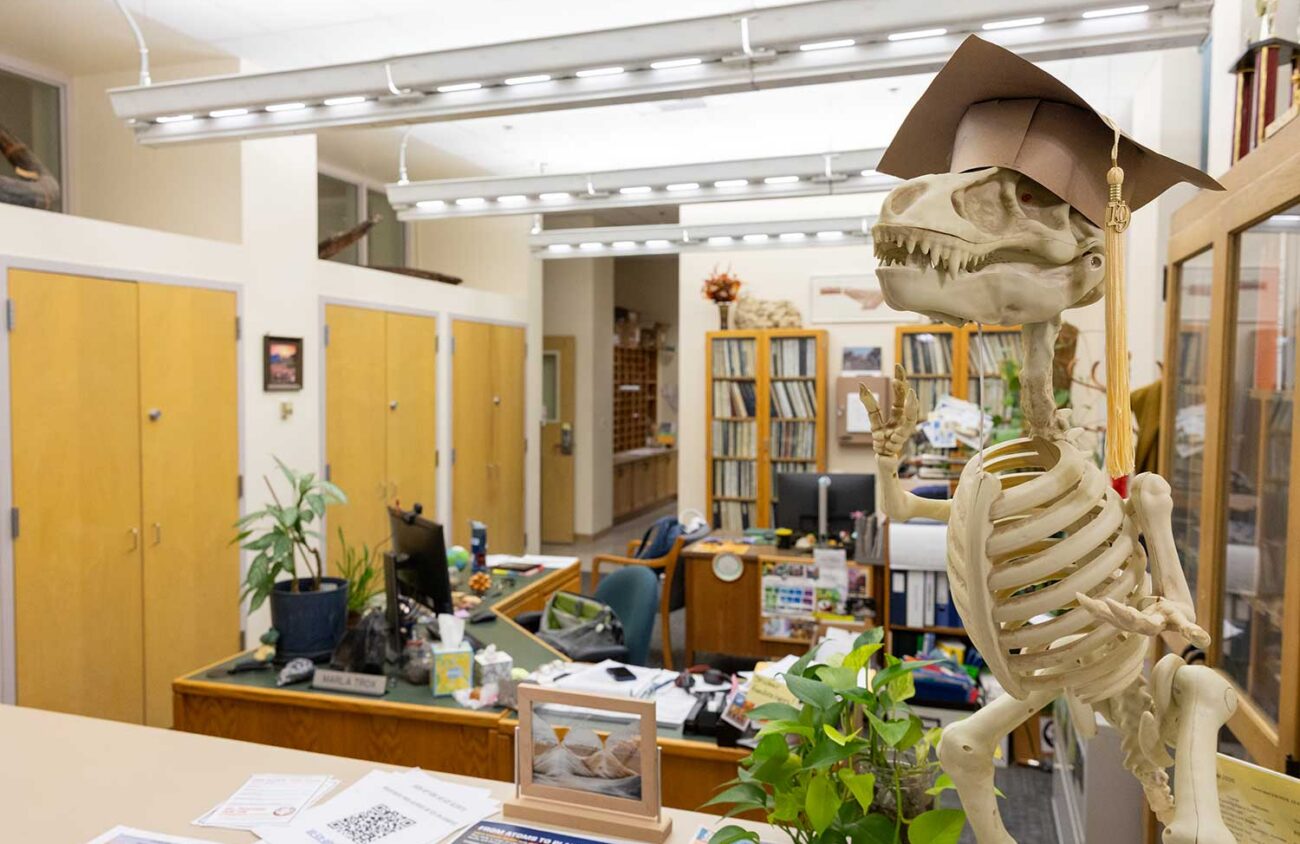
Faculty members say the University of Oregon is closing the Department of Earth Sciences office in Cascade Hall, a space they describe as a hub where undergraduate and graduate students meet with advisors, build community and manage internal administrative tasks with ease.
The office is being closed in line with a “shared services” model across the College of Arts and Sciences (CAS) that some describe as impersonal and filled with unnecessary corporate bureaucracy.
Faculty such as Earth Sciences professor Marli Miller tell Eugene Weekly that the office closure will erode the department’s sense of community and ability to support students. She says the shared services model is causing the loss of “institutional knowledge,” as staff members who’ve been working within one specific department for years are being moved into roles where they work with several departments at once, or they’ve left entirely.
In 2022, the UO formally began its transition to a shared services model of business operations within CAS. The college serves approximately two-thirds of the student body, offering more than 50 undergraduate majors and 25 Ph.D. programs. The Department of Earth Sciences is home to more than 40 graduate students and 24 faculty members. As of May 1, 103 undergraduates majored in earth sciences.
The UO is facing serious budget constraints. In 2025 the university saw a $30 million shortfall and in a May 14 message to faculty, staff and student employees, UO president Karl Scholz wrote that the university will need to cut $65 million from the budget to avoid an annual deficit.
The shared services model consolidated department functions like administrative support, student advising and more into several centralized units, called “academic support units.” Within the ASUs, staff report to an ASU director and associate director rather than their original department head.
The Department of Earth Sciences has moved ASUs three times since 2022, starting in ASU 7, then moving to ASU 8 and finally, ASU 4. Since the inception of the ASU program, at least two units have been consolidated further, bringing the number of ASUs down to six.
In an email to Eugene Weekly UO’s director of issues management, Angela Seydel, attributing a statement to CAS, writes that the purpose of the ASU program is to “sustain and strengthen administrative support across all departments, including Earth Sciences.”
Sandy Thoms, former Department of Earth Sciences business manager and graduate coordinator, left her job of eight years when the university rolled out the ASU program in 2022. She says the position the university offered her would force her to lose the portion of her job she enjoyed, which was working directly with faculty and students. Instead, the university wanted Thoms to work with five different departments rather than one.
“I didn’t feel like I was going to be able to create fulfilling relationships with the people I work with anymore in that situation,” Thoms says.
A recent UO job posting for an office specialist within ASU 5 expects the employee to work with departments, programs and a research center consisting of “Anthropology; Black Studies; the Center for Latino/a and Latin American Studies; Cinema Studies; Creative Writing; History; Geography; Indigenous, Race, and Ethnic Studies; Latinx Studies; Native American & Indigenous Studies; Queer Studies; Theatre Arts; University Theatre; and Women’s, Gender, and Sexuality Studies.”
When Thoms expressed her concerns to former CAS dean Bruce Blonigen, she was told the university would be moving forward despite staff concerns. Thoms decided to resign. She continued to work with the Oregon Hazards Lab as a grant-funded employee until she left the university completely in September 2025.
Samantha Hopkins, an Earth Sciences professor and former Earth Sciences department head, says when the university first announced its shared services transition, concerns from department staff were not being adequately addressed.
“We weren’t convinced that the structures they were building were going to be able to handle the issues we anticipated like building class schedules, managing finances and things like that,” she says.
She adds that when staff raised concerns about how business functions would operate without direct departmental supervision, they were told not to worry about it.
Hopkins says she’s unsure if the ASU program has actually saved the university money, as before the program, Earth Sciences had three administrative staff members and even with a higher number of staff in the ASU, Hopkins says “everything takes longer,” as requests now have to go through email chains instead of face-to-face interactions.
In its email to Eugene Weekly, the college writes that while the ASU program has resulted in some savings, “the primary goal has always been to improve service rather than reduce costs.”
Miller says, “We have a pretty close-knit department and we care deeply about our undergraduates and graduates.” Miller says when Earth Sciences had an office, the students “always had a place to go, and now they don’t.”
Instead, students will now have to go to Straub Hall, where the headquarters for ASU 4 is located. There, instead of an office focused entirely on Earth Sciences, it will share an office with psychology, linguistics and human physiology.
Mia Luscher, a senior undergraduate who has worked the front desk of the Earth Sciences office for nearly two years, says, “It’s really hard to watch all these people who are really important to our department build a new community and then have that get taken away from them,” she says. “The office, when I first got here, was a big part of bringing me into the department.”
Derek Zurenda, a Ph.D. student in Earth Sciences, says the only communication he received regarding the changes was an email from CAS Dean Christopher Poulsen that department staff forwarded to him. Emily Ferrence, an undergraduate within the department, says she did not receive any communication from the university regarding the changes and did not know about the office closure until Zurenda sent a survey asking students what they thought of the change.
In the anonymous survey, 44 students, 10 faculty and research affiliates, and three staff members rated the importance of having a department-specific office space as 5 out of 5. One hundred percent of respondents said keeping staff aligned with the department is important and 55 of 57 said staff members go beyond basic expectations.
Amelia Cuomo, a doctoral student, says department-specific staff help navigate grant funding, class schedules and field trips. She says that losing department-specific staff could harm students by preventing her from receiving timely responses to her questions and concerns.
“Having to send an email instead of being able to walk down a flight of stairs and getting all the information you need is a lot more time consuming,” she says, adding that, “having somebody there to put a friendly face to the department to answer questions from the public is enticing for people to want to come here.”
“We are committed to ensuring that students and faculty continue to have access to responsive, knowledgeable support under this structure,” the college writes. “The intent is to provide consistent, professional support while also creating a more supportive environment for staff — through better coverage, opportunities for training and growth, and the ability to work as part of a team.”
Cuomo says she worries that without an office and department-specific office staff, graduate students like herself won’t be able to get the support they need.
“It is moving from something that is more community based to something that is more transactional,” Earth Sciences professor Matthew Polizzotto says. “As an educator, you want to see your students succeed and that success is aided when students feel like they’re part of something.”
Polizzotto says trust with university leadership has dissolved because staff members feel like they are not being heard and changes are not being explained. “It’s made for a less than optimal working environment.”