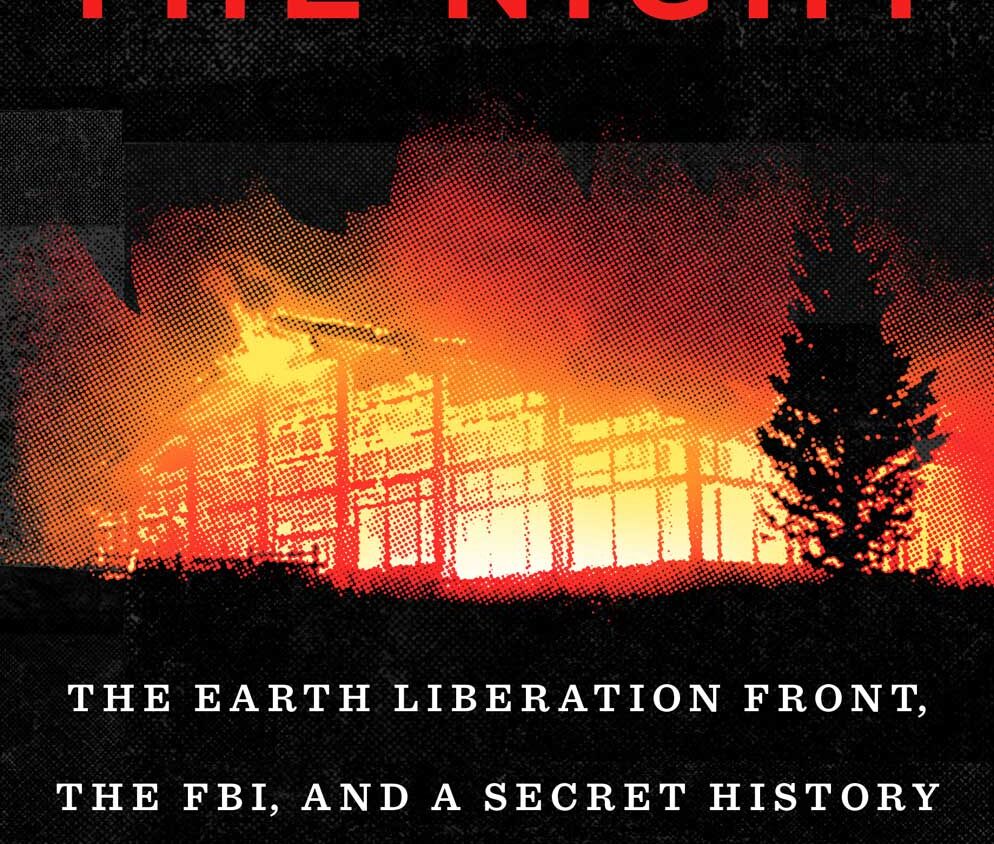
Burning the Forest Service ranger station in Oakridge, torching a ski resort, releasing wild horses, sabotaging powerlines and burning SUVs at what was a Joe Romania’s dealership on Franklin Boulevard in Eugene — the environmentally motivated sabotage took place from 1996 to about 2001 in Oregon, Washington and as far as Vail, Colorado. The sabotage caused millions of dollars in damage.
The eco-saboteurs sought to target those who were destroying the environment — and their ire is born out in these days of rising temperatures and the current prospect of a long, smoky wildfire season.
For years, the federal government and local police had no idea who was behind the incidents — only that a group calling itself the Earth Liberation Front took credit for them in anonymous communiques and letters ELF spelled out at the scenes.
“It has the arc of a classical tragedy,” author Matthew Wolfe says of the tale. “I mean, it’s a story about a number of people coming together to do something that they believe is just, and they work very hard at it, and they’re good at it, and they have these victories, and then everything falls apart, and they destroy themselves.”
The feds called them “eco-terrorists” and even the Mob-tinged “The Family.” After the elves were indicted and arrested in 2005 and 2006, the identities of those behind the ELF were revealed, and one by one, they were sentenced to prison.
Eugene Weekly covered the events in a 2006 award-winning series, “Flames of Dissent,” and media converged on the Wayne Morse Federal Courthouse for the sentencings in 2007.
Twenty years later, Wolfe has chronicled the rise and fall of the ELF in his wide-ranging book Fires in the Night: the Earth Liberation Front, the FBI and a Secret History of Eco-Sabotage. The book was released June 23, and Wolfe will give an author talk at Hodgepodge Books and Taps July 2.
Eugene — and the Whiteaker neighborhood — was the epicenter of environmental protest and dissent in the 1990s. Wolfe says he first heard about the ELF growing up in California and seeing the effects of climate change. “I remember this sort of massive scale of these cataclysms we were facing, and these very kind of humble solutions we were being told, ‘The rainforests are being demolished, so you know, make sure to take shorter showers.’”
And while he says he has real issues with the ELF’s methods and complex thoughts about what they did, “at the end of the day, I appreciated that they were taking action that felt commensurate with the scale of the problem we were facing, that they took it seriously.”
Wolfe’s deeply researched book draws upon interviews with several of the elves — Kevin Tubbs, Chelsea Gerlach, Stanislas Meyerhoff and Jacob Ferguson, the latter who wore an FBI wire and recorded conversations with his fellow eco-saboteurs. Longtime local videographer Tim Lewis’ work — currently being archived at the University of Oregon library — is another source, and Wolfe used court records, recordings and news articles, and he doesn’t shy away from the perspective of law enforcement and the victims.
“There had been a lot of really good kind of piecemeal coverage about them, but never, but nobody had ever sort of told this whole story, both from their perspective and from that of law enforcement, to try and understand sort of what what things looked like, both in the ELF’s view, and then from from the FBI’s view,” Wolfe says.
Tubbs’ arc from his Midwestern upbringing to the arsons to his arrest and imprisonment, and Ferguson’s troubled life, cooperation with the feds and his downfall at the hands of his heroin addiction are two throughlines of the book. It also touches on the effects the arsons, as well as the arrests and cooperation by some of the elves, had on the activist community.
Wolfe says of activism, “I think for every generation, there’s a kind of feeling about what’s going to move the needle or what isn’t going to move the needle.” As he was drafting the book during 2020 Black Lives Matter protests in Portland and other cities, “it was fascinating to see arson being used as a tool for political change again, and there’s a long history of that in the United States. It was interesting to see that come back into the conversation.”
For those for whom this is untold history, the book tells a gripping tale — the true story that was the basis of The Overstory, the 2018 Pulitzer-Prize winning novel by Richard Powers. For those who remember the wild activist times in the ’90s in Eugene, the arsons and the aftermath, Fires in the Night provides fascinating insights from the perspective of years later. And for those many people still in Eugene who knew the eco-saboteurs, some of whom still call Eugene home, the book and the conversation with Wolfe should be engrossing.
As of 2018, all the elves except one, Josephine Overaker, had been arrested and sentenced. Overaker remains at large in 2026.