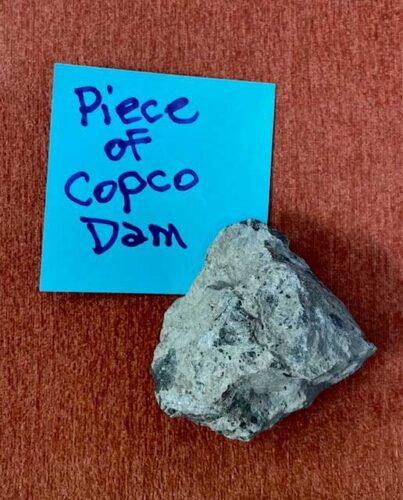
Question: When is a rock not a rock?
Answer: When it came from the Copco #1 Dam take-down in November 2023 on the Klamath River in California. Then, this piece of concrete becomes a treasure not unlike a piece of the Berlin Wall take-down by citizens on both sides of that structure. It is just as meaningful.
That wall trapped and separated people and families, as Copco 1, Copco 2, JC Boyle and Irongate — four dams on the Klamath River — prevented salmon from reaching their spawning ground, causing fish populations to plummet, greatly affecting those living downstream.
May 27 to 30, I saw in person this amazing feat of reverse engineering, along with 40 others from the Great Old Broads for Wilderness group. We had tours and lectures from a geomorphologist as well as the previous directors of community affairs, Ren Brownell and Dave Meuer, both of Resource Environmental Solutions, LLC and Dave Coffman, Klamath Project Manager, who described the choreography of the dam take-down. Over a two-year period of planning and execution, the process was intense, with many employees working 80-hour weeks.
On the reservoir side, the dams bred oxygen-sucking algae and when the algae died every year for over 100 years and dropped to the bottom, it became anaerobic, where nothing could live.
Scientists foresaw exactly what would happen and took all four dams down as carefully as possible, one at a time (Copco 2 November 2023, Copco 1 and JC Boyle August 2024, Irongate October 2024). When Copco 1 was drained, most of the 10 feet of dead algae along the lake bed came down the river, collapsing oxygen levels. Luckily and as planned, oxygen levels rose back to near normal within 24 hours. The river cured itself.
According to Oregon Public Broadcasting, following the total removal of the dams, a single continuous stretch of over 310 miles of the main stem of the Klamath River was successfully reconnected from the Upper Klamath Basin all the way down to the Pacific Ocean. It is the largest salmon restoration project in the world and the removal process gives a blueprint of valuable information to other countries wishing to remove dams.
OPB produced a documentary about Indigenous youth kayaking the 310 miles called First Descent: Kayaking the Klamath — educational, emotional and uplifting.
Two thousand eight hundred acres were returned to the Shasta Tribe, who served the land as the land served them for thousands of years, along with the Yurok and Karuk Tribes, who lived downstream and saw the salmon runs and water quality decimated by the dams. These dams were built mainly in the 1920s for hydroelectric purposes. It took 20 years of advocacy, negotiation and planning, involving federal, state and local governments, two tribal nations and nine conservation and fishing groups to take them down as the electricity generation was no longer cost-effective.
In April 2025, Eugene Weekly reporter Eve Weston did an in-depth story, “Drawdown,” about lowering water levels on dammed rivers in the Willamette Valley to make it easier for fish to pass. It is worth reading as, according to the 2022 Environmental Impact Statement by the Army Corps, “the high cost of hydropower will cause the dams to operate at a net loss of between $639 to $939 million over the next 30 years.” It seems to mirror what happened on the Klamath, where the dams outlived their usefulness and began costing taxpayers more money. They no longer make financial sense.
Contrary to what we have been taught about young salmon returning generation after generation to the same creek to spawn by imprinting the unique chemical scent of their natal stream, salmon are now migrating to tributaries of the Klamath River where no salmon has been in over 100 years. How do they know where to go?
Right after the Klamath trip June 2, I went to a lecture in Eugene, sponsored by McKenzie River Trust about worldwide rivers by best-selling nature writer, Robert MacFarlane. His latest book is Is A River Alive?
He closed his talk describing salmon attempting to return to spawning areas, by saying something simple and profound — and I am paraphrasing: “There will be logjams, beaver dams, human dams but the salmon will keep knocking at the door. For millennia, they keep knocking until they break through.”
Not unlike the human struggle to break free of separation and authoritarianism with the fall of the Berlin Wall in 1989. We all keep knocking at the door.
Kim Kelly has lived in Eugene for 19 years, has served on several nonprofit boards and coordinates Eugene Weekly’s Garden Palette.