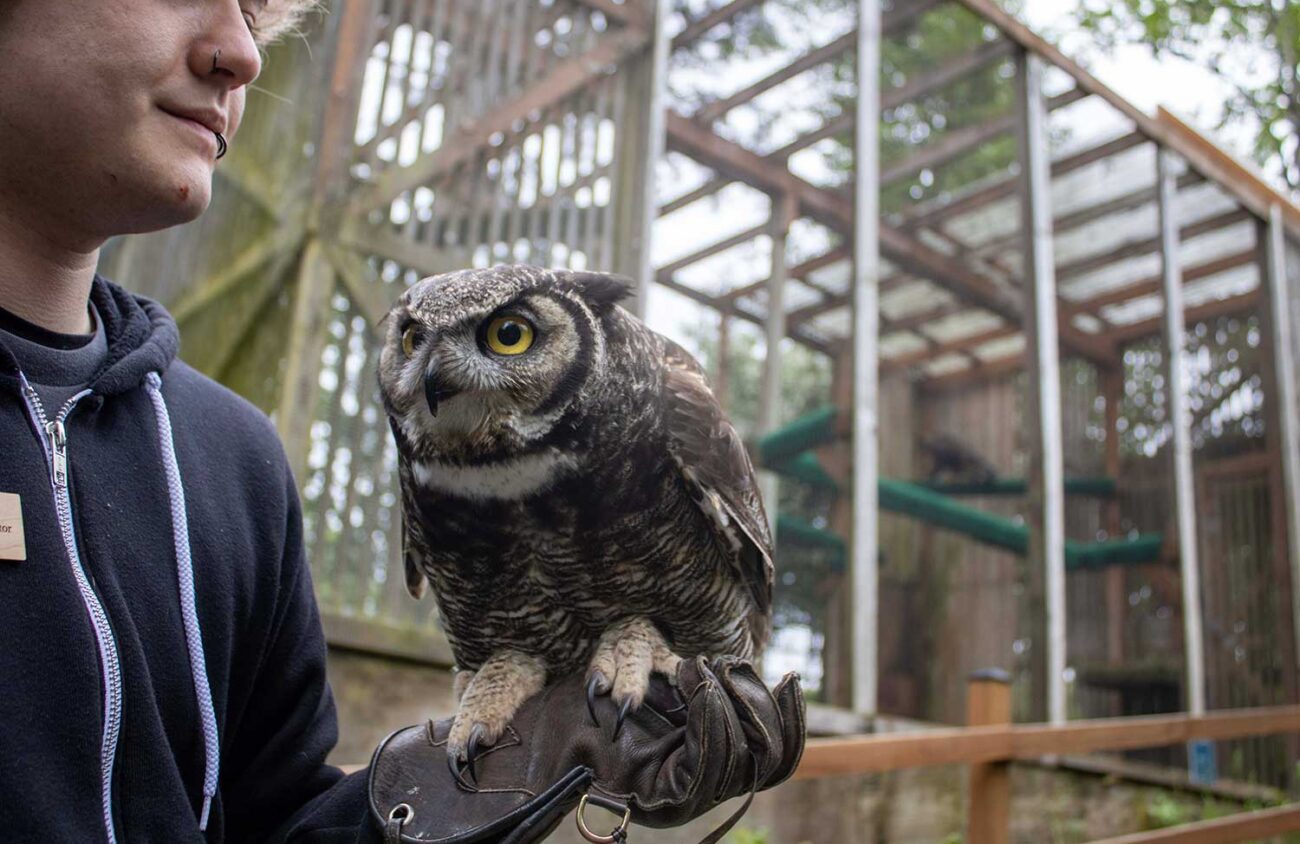
As dawn brushes through the trees on Spencer Butte, Valentino’s wings slice silently through the forest air, swooping low above crowds sipping wine from rotating featured vineyards and beer from Ninkasi Brewing. The great horned owl has lived at Cascades Raptor Center since fall 2009, when staff brought her to the wildlife hospital from the Mount Shasta region of Northern California. Now, Night at the Raptor Center returns for another season of after-hours encounters with some of Oregon’s most striking birds of prey.
The center added Valentino to its education team later that year, in 2009, and Valentino has since become one of its ambassador birds.
“It takes a special kind of bird to become an ambassador,” says Executive Director Julie Collins.
Guests can wander the center after hours, watch raptors soar overhead and experience an evening that mixes wildlife education with drinks, snacks and intimate encounters with birds of prey.
“These evenings really give us a chance to connect with our community in a more expansive way, but also, it feels special,” Collins says. “You come up here in the evening and you get a tour of the center after hours, you get to meet the raptors up close and personal. We fly birds over the crowds while they’re standing and visiting.”
The events began growing during the COVID-19 pandemic, when the center searched for outdoor ways to bring folks together while also maintaining social distancing.
“When we were looking for a way to connect with people when we couldn’t be in indoor environments and we had to keep our social distancing, we decided to increase the amount of Night at the Raptor Center events,” Collins says. “It was a really healthy way for us to get to the community together. “People in the community who just love what we’re doing and want a different way to connect with us.”
Guests walk through the center after hours and meet raptors perched on the glove while enjoying light refreshments and beverages. Collins says many visitors do not realize how interactive the experience becomes once the birds leave their aviaries.
“That wow factor really comes out when these birds are outside of their aviaries and flying in the open air, and you’re able to get up close to them and really see what they’re about,” she adds, “a lot of times their personalities even come out a little,” Collins says. “Our owls are quite chatty, so guests get to hear a lot of different calls.”
Collins says the tendency, known as anthropomorphism, attributes human emotions or behaviors to animals. While the practice can help people empathize with wildlife, raptor experts often discourage it because it can lead people to misunderstand an animal’s actual needs or behavior.
The center also trains its ambassador birds using a choice-based system.
“We let our animals make choices here,” Collins says. “We do not force them to come out and work with our trainers unless they are showing interest.”
During a recent Eugene Weekly visit to photograph Valentino, trainer and educator Alex Murphy allowed the owl to decide whether she wanted to leave her aviary. Had Valentino shown no interest, staff would not have forced her to participate. Instead, fresh rabbit convinced the owl to make a brief appearance for the camera.
Collins says trainers build trust with the birds through positive reinforcement and food-based rewards.
“These animals are given positive reinforcement,” Collins says. “When the trainers go out and they’re working with the birds, they have these little hip packs on that are full of food. Every time you’re watching us work with our animals, we are always making sure that we are paying them for it.”
For most of the center’s ambassadors, payment comes in the form of small pieces of meat. Nearly all of the birds at the center are carnivorous, with the exception of Frances the magpie, the center’s newest omnivorous ambassador.
Tickets cost $60 per person, or $50 for members, and include admission, food and drinks. Guests can expect cheese boards, fresh fruit, vegetables, desserts and both alcoholic and nonalcoholic beverages.
The 2026 “Night at the Raptor Center” dates are:
- June 26 (Queer Night)
- July 10
- July 24
- Aug. 7
All events take place Fridays from 6 p.m. to 8 p.m.
The June 26 Queer Night event returns for another year as part of the center’s Pride programming. Collins says staff introduced the event to create a more welcoming and comfortable environment for LGBTQ+ visitors.
“We try to be extremely equitable here at the Raptor Center,” Collins says. “We want to make sure that everyone feels welcome and that we make sure that we have opportunities, if there are groups of individuals in our community that need a little bit of assistance with, um, with having an evening to feel comfortable.”
The event has quickly become one of the center’s biggest draws.
“It’s a very popular night,” Collins says. “Last year we actually had two queer nights because it is such a popular evening.”
Night at the Raptor Center runs Fridays from 6 pm to 8 pm June 26, July 10, July 24 and August 7. Tickets cost $60, or $50 for members. More information is available at Cascades Raptor Center.