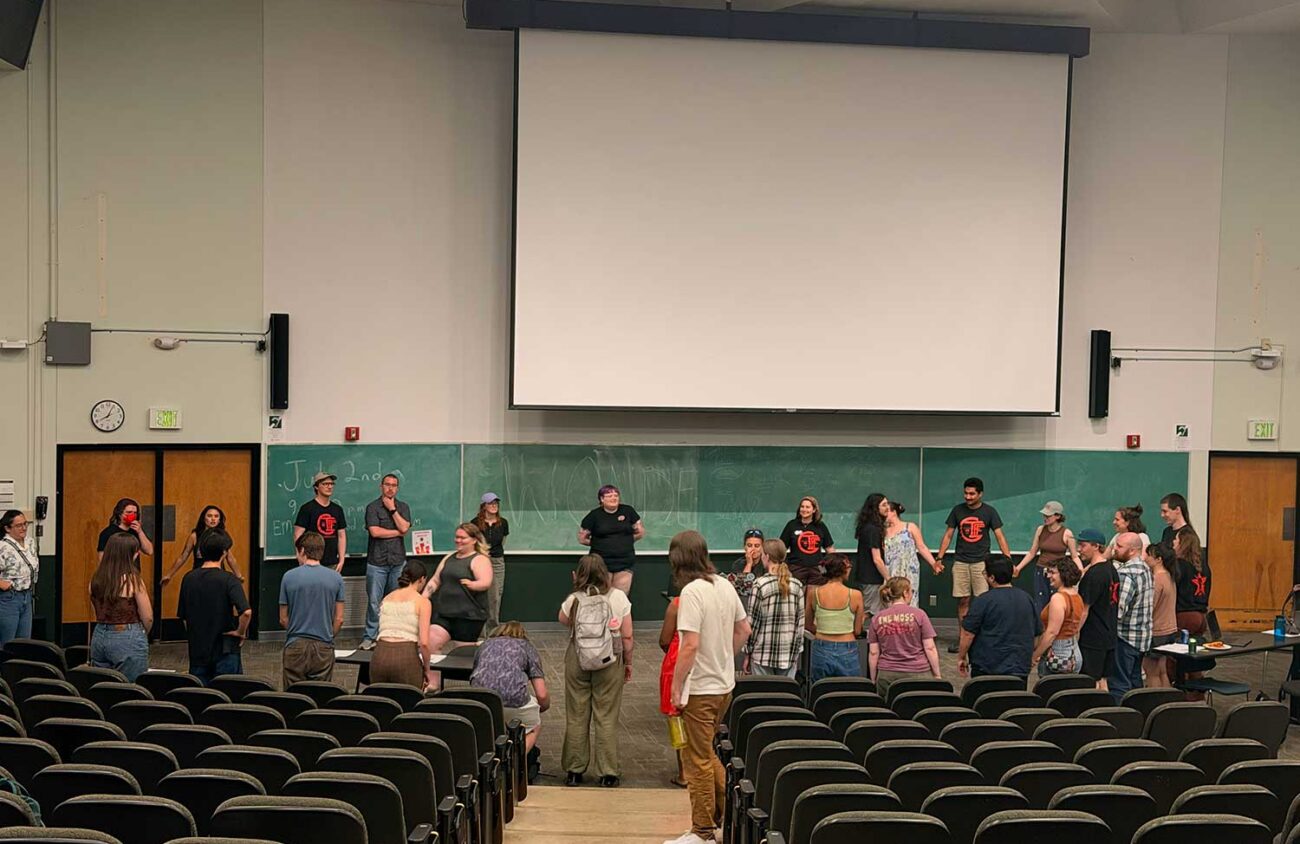
June 15 marked the end of the University of Oregon’s Graduate Teaching Fellows Federation contract, and also marked the start of tense contract negotiations; UO currently holds that there will be no raises for graduate employees the next five years, regardless of rising cost of living and inflation.
The union, representing around 1,400 grad student employees, is heading into the bargaining session with a $65 million budget deficit looming over the university’s upcoming five-year fiscal projection.
The GTFF began holding monthly general bargaining sessions with UO’s bargaining team March 9,; each meeting is to renegotiate proposals to the existing contract. The union has notably adopted a bargaining platform called “One Flock, One Flight,” to establish solidarity in bargaining with other campus unions, including UO Student Workers.
Carver Goldstein, the president of the union, emphasized the impact that the projected budget deficit will have on contract negotiations and that it will have an “impact on what we can win and what we think we can win.”
Goldstein followed up by saying that no contract point is “unwinnable,” however, and we can “win what [we] have built enough power to win.”
Goldstein addressed the projected budget deficit in the UO’s General Fund, which was largely calculated from out-of-state student enrollment projections. Oregon ranks 46th for state appropriations for higher-education funding, which increases fiscal instability and reliance on out-of-state tuition.
The university introduced a hiring freeze and a pay freeze in May, with many departments being asked to make internal cuts. But GTFF brought up in its June 24 meeting that UO has increased its internal administrative support yearly, leading to “admin bloat” — the growing number of noninstructional jobs at the school versus teaching positions.
In 2018, the university reported to have 1,441 full time employees under the “officer of administration” classification and in 2025, they increased to 1,662 FTE — a 15.3 percent increase. In the same time period GE positions have decreased by 7.5 percent and a 5.3 percent increase for faculty.
“If cuts have to happen and it seems that they do have to happen — it does only seem fair that the administration should also have to bear some of these cuts,” Goldstein says.
The university’s bargaining team proposed that graduate employees would receive no raises to their pay in the next five year period — a notable change, since the contract bargaining has been scheduled to happen every three years.
The UO has also proposed additional restrictions to the graduate employee tuition waivers, cutting unpaid family and medical leave and increasing out-of-pocket pay for healthcare. The university also proposed cutting every administrative graduate employee position.
Amelia Cuomo, the co-chair of the GTFF bargaining committee, says that UO factored in a 3 percent raise within their budget, which they shared at a Board of Trustees meeting. However, the “inconsistencies between the [proposals]” were concerning to the union, who were told they were unable to get raises.
According to GTFF, the GEs on average are paid a monthly income, before taxes, of $2,581; employees report spending around 36 percent of their salary on rent and 1.6 percent of paycheck on healthcare.
If UO’s proposed plan of no raise increases for the next five years were to pass, GEs are estimated to spend 48 percent of their paycheck on rent and 5 percent of their paycheck on healthcare. These projections estimated a 6% annual rent increase for the five years.
One of the members at the meeting said they made “less than [they] made in retail, [now] working 60 hours a week” for the university.
The GTFF’s initial proposal fought for an increase in minimum salaries by 10% annually and an increase in current salaries by 10 percent, increased protections for academic freedom and increasing childcare support from $1,000 to $2,000.
The university has yet to address the GTFF’s proposals regarding GE research protections, international student protections, nondiscrimination and anti-harassment policies and protections for academic free speech. Eugene Weekly reached out to Molly Blancet, the primary press contact at UO for a comment, but has not heard back yet.
The University of Oregon is the second largest employer within Lane County and generates significant revenue through the county.
“Even if it is a campus issue, it affects so many people in Lane County at large and even more when you think about the number of people that are married to those who work for the university,” Cuomo says. “Becuase then if you’re roommates with somebody and they can’t afford to pay rent, or your spouse’s health is being affected because of their working conditions — these are all things that have a broader impact that people don’t realize.”