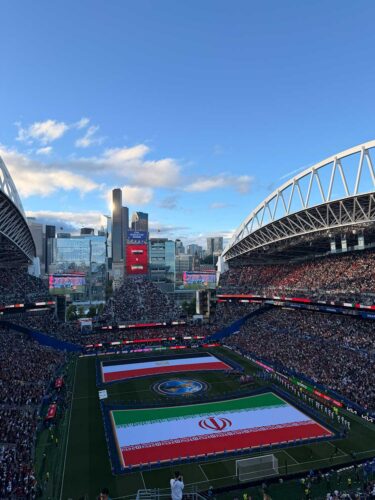
Rainbows were scattered in the sea of red and white jerseys, pharaoh hats and enthusiastic chants for their favorite soccer players. Although the highly anticipated June 26FIFA World Cup match between Iran and Egypt ended in a draw, there was another win for the allies and LGBTQIA+ members, who wore their rainbow gear in the stadium and celebrated Pride.
The game was on June 26, a date which notably marked the 11th anniversary of Obergefell v. Hodges, the Supreme Court ruling that legalized same-sex marriage nationwide, and Seattle is known for its Pride celebrations. But as match schedules were finalized, it was Egypt and Iran that were scheduled to play — two countries that have criminalized same-sex relations.
When the match was initially scheduled in December 2025, the Egyptian Football Federation sent a letter to FIFA urging it to prohibit Pride activities around the match saying they “provoke cultural and religious sensitivities among fans… these activities directly conflict with the cultural, religious and social values of the region, particularly in Arab and Islamic societies.”
The Iranian Football Federation also objected to the Pride game, arguing that it was against their Islamic religious values. FIFA acknowledged both federations’ requests but ultimately sided with the City of Seattle’s Pride celebration, and allowed fans to bring their rainbow merchandise into Lumen Field.
The game itself didn’t acknowledge the Pride festivities, however, the commentators for the match did hold a minute of silence for the victims of the earthquake in Venezuela.
Although the final result was a tie, the game itself was tumultuous. Egypt’s Mahmoud Saber scored the first goal for Egypt during the 5th minute, which was then followed by Iran’s Ramin Rezaeian scoring during the 14th minute. Iran was awarded a penalty kick during the 9th minute of the match, which Mehdi Taremi kicked on target but was saved by Egypt’s goalkeeper Mostafa Shobeir.
Iran’s Shoja Khalilzadeh scored a goal in the 93rd minute, which promptly led the entire stadium to erupt in cheers. However this was short-lived, after a controversial virtual assistant referee ruling disqualified the goal nothing that r Khalilzadeh was offside.
With the match ending in a tie, and the following group stage matches ending unfavorably for Iran, the team was eliminated without losing a single match. Group stage matches are for all 48 teams that have qualified, but only 32 advance into the second round of the tournament. Egypt advanced to the round of 32, and is set to play Australia.
After the game, the diehard Iranian fans and players left deeply disheartened. “I can’t see any luck in my team, because we deserve to win the game,” Iranian defenderRezaeian said at the press conference. “At the end, we are just apologizing to my people in Iran, because they deserve more happiness.”
Both Egyptian and Iranian players didn’t address the Pride controversy within their press briefings. However, Mehdi Taremi, an Iranian forward, said at the press conference, “Our religion doesn’t accept that, but we respect all of the LGBT people. That’s their own idea. It’s not about us, we are here to play football.”