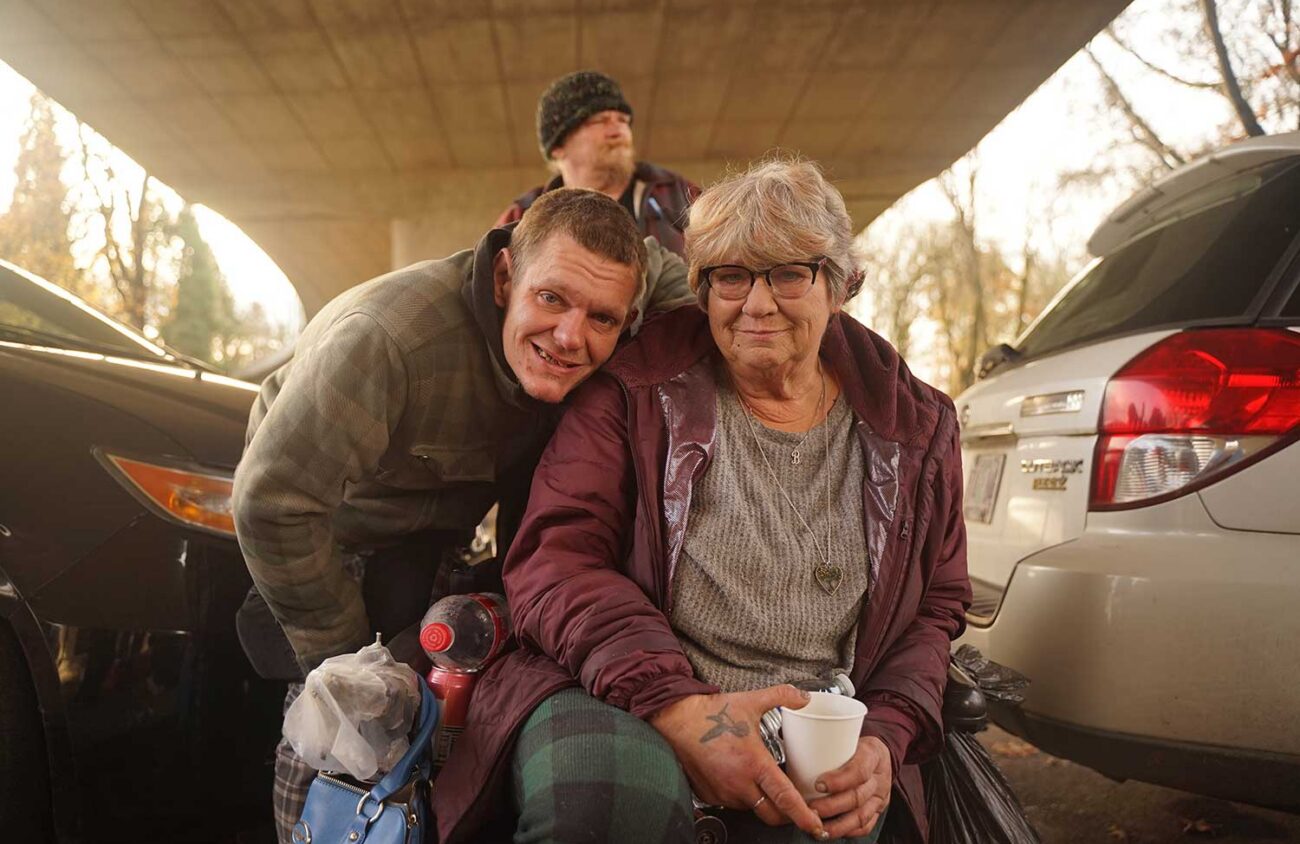
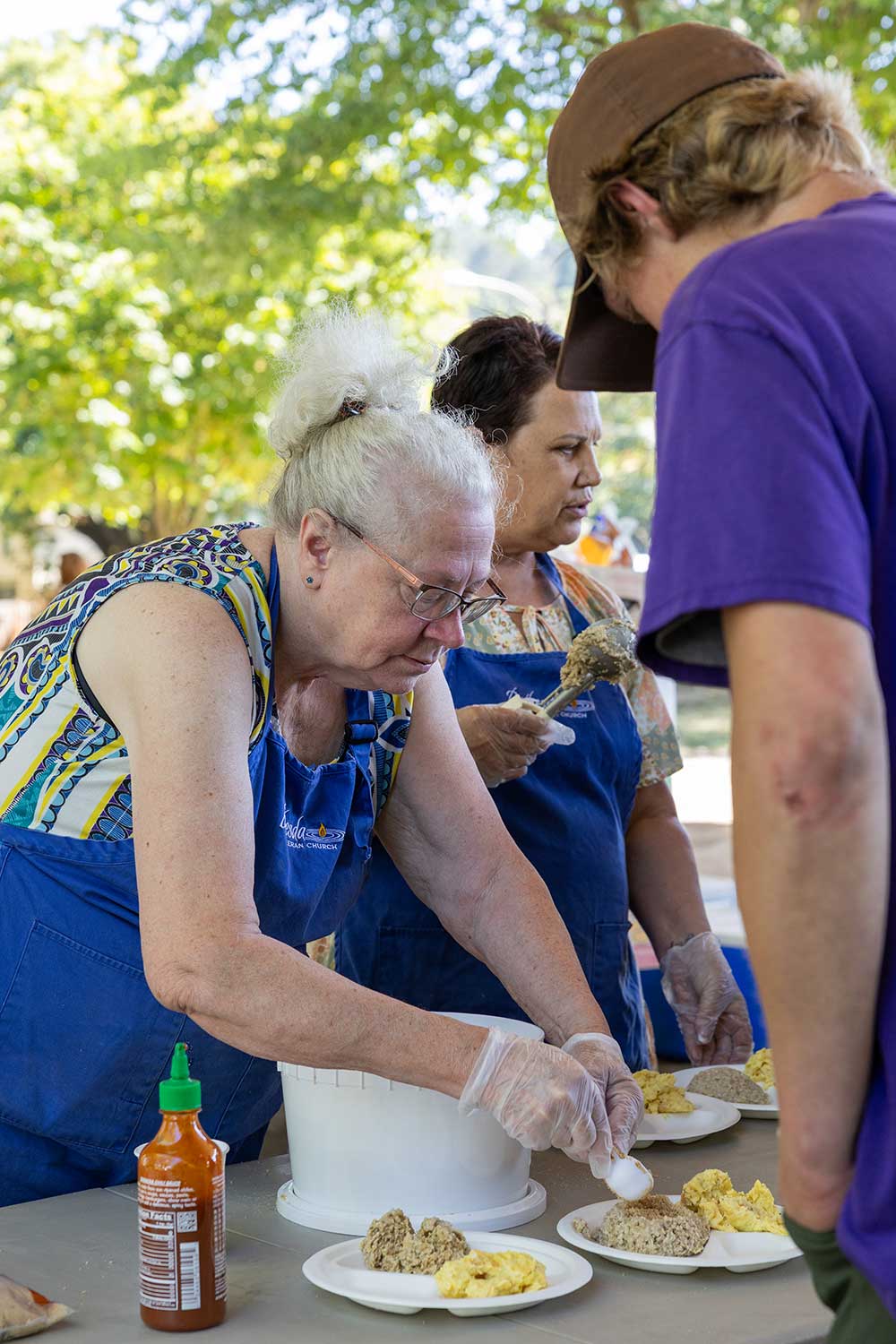
Lisa Levsen stands behind a folding table, with “Levsen” written in Sharpie across the side, piled high with breakfast foods. She scoops scrambled eggs onto plates and hands out bagged sandwiches.
She knows Crystal likes a specific type of yogurt, Alex is allergic to peppers, and Richard Stetson, who died on the street Nov. 7, 2025, had to eat fish four times a week due to his heart condition.
For a moment, she steps away from the line in a patch of dirt under the bridge in Washington Jefferson Park. Scott Stefnik approaches her, waving a citation from the Eugene Police Department.
Levsen takes pictures of various people’s citations for trespassing or violating park rules. Fines range from $200 to $750. She marks the court dates in her calendar — Stefnik’s is for 1 pm Christmas Eve — and says she’ll go with him.
Levsen helps get people experiencing homelessness to the next day, the next hour, the next meal.
“I would personally love to not have to do this anymore,” Levsen says, “because we found everybody a home, and they were off the streets.”
Across the street, a city of Eugene vehicle is parked on the side of the road. In the back are shopping carts, tents and belongings left in the park.
“I pray for them,” she says, nodding towards the vehicle.
When providing food to the homeless in Eugene, so many roads lead back to Levsen. Board president of the nonprofit Neighbors Feeding Neighbors, Levsen is responsible for the organization’s growth and is fully integrated into Eugene’s homeless communities. It’s her beliefs, formed by her own experiences with being surrounded by homelessness and those affected by it, along with the personal responsibility she feels, that keep her going.
She’s been up to a lot since appearing in 2024 headlines detailing the clash with the city of Eugene over proper permitting. EPD cited Neighbors Feeding Neighbors for blocking the sidewalk and violating park rules and pulled its special use permit. Eugene was part of a nationwide conversation about attempts to stop religious groups from feeding the homeless.
St. Timothy’s Episcopal Church v. City of Brookings set a precedent for religious groups providing food or services to unhoused people. The March 2024 case ruled the city violated the Religious Land Use and Institutionalized Persons Act by limiting the number of days the church was permitted to serve food to the homeless.
The case was consistent with a lawsuit filed by the Texas Civil Rights Project in January 2024, where a judge ordered the city of Houston to stop citing Food Not Bombs for violating Houston’s Anti Food Sharing Ordinance by feeding over five people at a time on city property.
According to Randy Hiroshige, staff attorney for the Criminal Injustice Program at Texas Civil Rights Project, federal efforts to block groups from feeding the homeless violate the First Amendment, and perpetuate a cycle of hunger, food insecurity and criminalization.
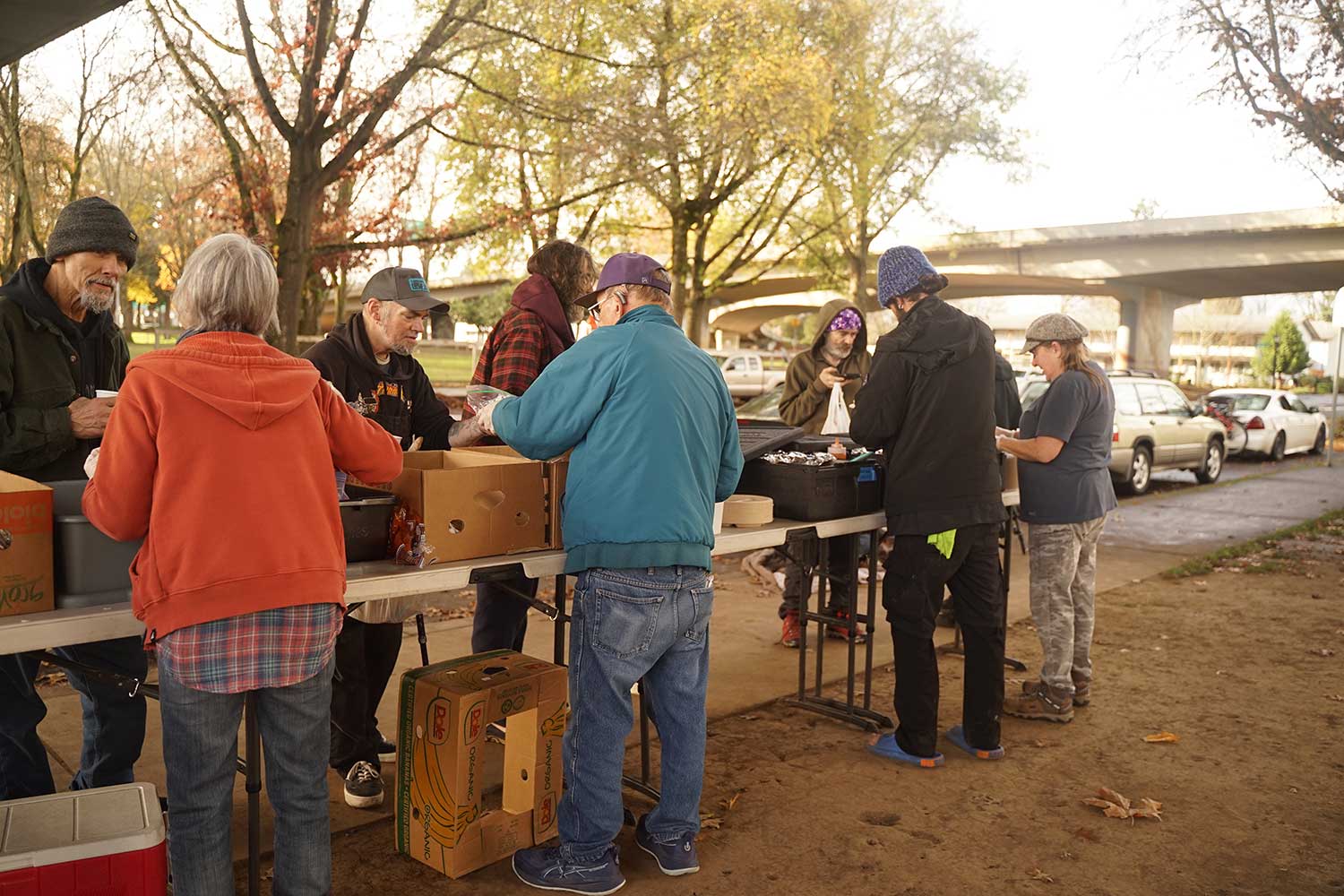
Levsen’s priority is meeting people where they’re at, with as many resources available. Neighbors Feeding Neighbors served 6,909 meals in June 2026 alone. In 2026 as a whole, Neighbors Feeding Neighbors is projected to serve 70,000 meals, compared to 52,489 in 2025 and 38,764 in 2024. Levsen is keeping track of volunteers, meals served, supplies and expenses more now than ever, and demand keeps growing. Levsen’s ambition for the park is also growing, as she hopes to bring a social worker and Wi-Fi to the park. Her term as board president will come to an end in 2027.
Under Levsen’s leadership, Neighbors Feeding Neighbors became a 501(c)(3) nonprofit, serving breakfast under the I-105 bridge in Washington Jefferson Park Wednesday through Saturday.
“She goes out of her way, giving people hugs or listening to their woes or helping them locate their tent and their stuff,” says Elene Gleason, a volunteer with Neighbors Feeding Neighbors and former program manager for Food for Lane County. “She will make efforts for them to try and help replace that stuff, just as her own person.”
Levsen does not fit the typical mold of someone devoted to helping the homeless. At 66, she’s carrying 40-pound containers to and from her car, in her brightly colored leggings, working a day job at her own software company and remembering the food allergies and other medical needs of the people she serves.
“It is so important to me,” she says of feeding the unhoused. “I’m doing a terrible job at doing my actual job that pays my bills.”
Levsen runs out in the middle of breakfast to buy more brown sugar, and she’s paid for a kitchen to cook in out of her own pocket when money is tight. When friends and coworkers ask what she is so busy with, she says she’s working on a big project with a demanding boss. When they ask who her boss is, she responds: God.
Levsen knows she might be in the minority with her political beliefs.
Neighbors Feeding Neighbors is a religious group with all the religious connotations of feeding the homeless — passages in the Bible call to feed the hungry — but all faiths are represented, volunteering at breakfast.
Carol Scherer, an atheist, says religion is no barrier so long as the guests are concerned, and she never sees clashes over beliefs or ideologies. Scherer’s Facebook page has posts promoting the right to protest ICE and calling attention to the genocide in Gaza. She’s a frequent face at protests at the Eugene Federal Building.
“We are very united in justice and humanity,” Scherer says of the Neighbors Feeding Neighbors volunteer group.
It feels like a personal responsibility to Levsen, who has little faith in the government or medical system. Her beliefs were formed by repeated instances of being let down and watching others be let down.
Aware and politically active, Levsen, a registered Democrat at the time, sent a letter to the Joint Interim Committee on Addiction and Community Safety Response in 2023. In the letter, she calls for the repeal of Measure 110, which decriminalized personal possession of small amounts of some controlled substances.
“I would have voted for RFK Jr. if we were allowed to have a Democratic primary. And I actually think that what they’re doing with Make America Healthy Again, is some of the best health care we’ve seen in years, and that does give me hope for the future,” she says.
Robert F. Kennedy Jr., the current U.S. secretary of Health and Human Services, has an approach to homelessness that includes a $100 million investment and support of faith-based groups to have equal opportunity for funding to help combat homelessness.
Growing up in Walnut Creek, California, Levsen says she experienced homelessness and abuse living with her mother, Virginia Levsen, whom Levsen says was diagnosed as a paranoid schizophrenic. They lived in Virginia’s car at times. Virginia always showed compassion to other people experiencing homelessness, washing clothes and cooking.
When Levsen was 12, her aunt saved up enough money to send her to church camp. Upon returning, Levsen ran to her father, Richard Levsen’s house, “my safe space,” as she called him. Virginia had sole custody of the children at the time, and the police came to collect her. Lisa says they told her the options were going back to her mother or going into foster care. She responded, “I’m ready to go to foster care. Can I bring my Bible?”
The police allowed her to stay with her father, with whom she lived throughout high school. Even after Levsen stopped living with her mom, Richard sent Virginia child support, keeping her off the streets. And when Richard died in 2003, Levsen and her sister continued to support their mother.
Richard was a Jehovah’s Witness and Virginia was a Seventh-day Adventist. Levsen says she became a Presbyterian out of self defense. Right now, a friend is teaching her to pray the Catholic Rosary.
“I just end up feeling like God has our back. And a lot of people don’t like writing about people of faith. But I am a person of faith,” Levsen says.
Levsen began volunteering with Neighbors Feeding Neighbors in 2020, when it was Eugene Catholic Workers. She stayed through its association with Burrito Brigade, when it was briefly called Breakfast Brigade, and became the board president of the newly minted Neighbors Feeding Neighbors.
“There are a lot of personal connections that call people to serve,” Levsen says. “It’s not got anything to do with a religious faith. It’s a humanitarian calling.”
The Future for Breakfast
In the park, Levsen is face-to-face with the medical needs of the homeless community. Occupy Medical runs a weekly Saturday clinic coinciding with the breakfast, and volunteers from the University of Oregon provide blood pressure screening and supplies.
Levsen and Dr. William Foster, the medical director of Occupy Medical, worked out a system in which he will write prescriptions, and Levsen will dole them out a week at a time — if someone loses their belongings to theft or a homeless camp sweep by city officials, they don’t lose access to a month’s worth of medication.
Foster says he’s noticed people are more receptive to medical care when Levsen sends them his way, just 20 feet from breakfast.
Bobbie Stevens, a regular at breakfast, had to get one of her legs amputated after getting a barbed wire puncture. She says if given the option again, she would not have gotten it amputated, but felt pressured to do it as she could not keep up with the care of an abscessed wound.
She hates sleeping in her chair and when her son, Gordy McClatchey, spends nights away from her or in jail, it’s impossible for Stevens to move herself or her belongings. McClatchey spent time in the Oregon State Hospital and received a citation that banned him from standing in the park. A video from Nov. 20, 2025, shows McClatchey being arrested in the park, with Stevens sitting nearby watching.
A young man, who asked to remain anonymous, and his dog, Princess, spent three months on Levsen’s couch while experiencing osteomyelitis, a bone infection. There, he was able to get in-home care, which Levsen would peek her head into and listen to the medical advice. June 13, this year, he celebrated one year of sobriety.
Foster says there’s little literature verifying the connection between homelessness and osteomyelitis, but the lack of available hygiene, trauma and foot infections make the unhoused community prime candidates for developing the infection. The treatment for osteomyelitis is six weeks of IV antibiotics — a very difficult track for someone experiencing homelessness, according to Foster. One important factor of healing is calorie and protein count.
A high-protein diet is also a rhetoric of RFK Jr.’s dietary guidelines for Americans.
“We changed our menu completely,” she says. “I want everybody to be able to have a glass of milk, a yogurt, a sandwich with a lot of protein, and then whatever we’re serving, we make sure it’s protein.” Some days they have French toast casserole, which has no nutritional benefit other than being delicious, according to Levsen.
On Saturday, May 2, six pairs of footsteps squeak on the linoleum floor of Bethel Community Church. After serving upwards of 200 people, around six volunteers, including Gleason, go back to the church kitchen to do the unglamorous work of washing dishes and packaging leftovers.
Levsen pulls into the parking lot in her minivan. The folded-down seats and trunk are filled with supplies, and the glove compartment with various pill bottles. Levsen sat in the driver’s seat, tears streamed down her face.
“I’m just crying for a minute,” she says.
This was the second day in a row Levsen had to call the paramedics. Jen, a regular at breakfast, had gotten a ring stuck around her finger. She screamed she did not want anyone to touch her, but gentle encouragement from her friends and Levsen allowed the paramedics to remove the ring before Jen lost her finger.
Levsen says she’d love to eventually hand off Neighbors Feeding Neighbors and to teach other places how to build a system of basic needs for the homeless.
“I recognize that we are providing food, supplies, and resources that help to keep them alive. But we are not improving their quality of life,” she wrote the letter to the Interim Committee.
When Gleason has to leave the Bethel church to go to work, Levsen stays behind.
Gleason says, “I don’t think one person can replace everything that Lisa does.”
More info on Neighbors Feeding Neighbors at Facebook.com/NeighborsFeedingNeighbors.OR, NeighborsFeedingNeighbors.or@gmail.com or call 541-513-5623.
This story was developed as part of the Catalyst Journalism Project at the University of Oregon School of Journalism and Communication. Catalyst brings together investigative reporting and solutions journalism to spark action and response to Oregon’s most perplexing issues. To learn more, visit CatalystJournalism.uoregon.edu.