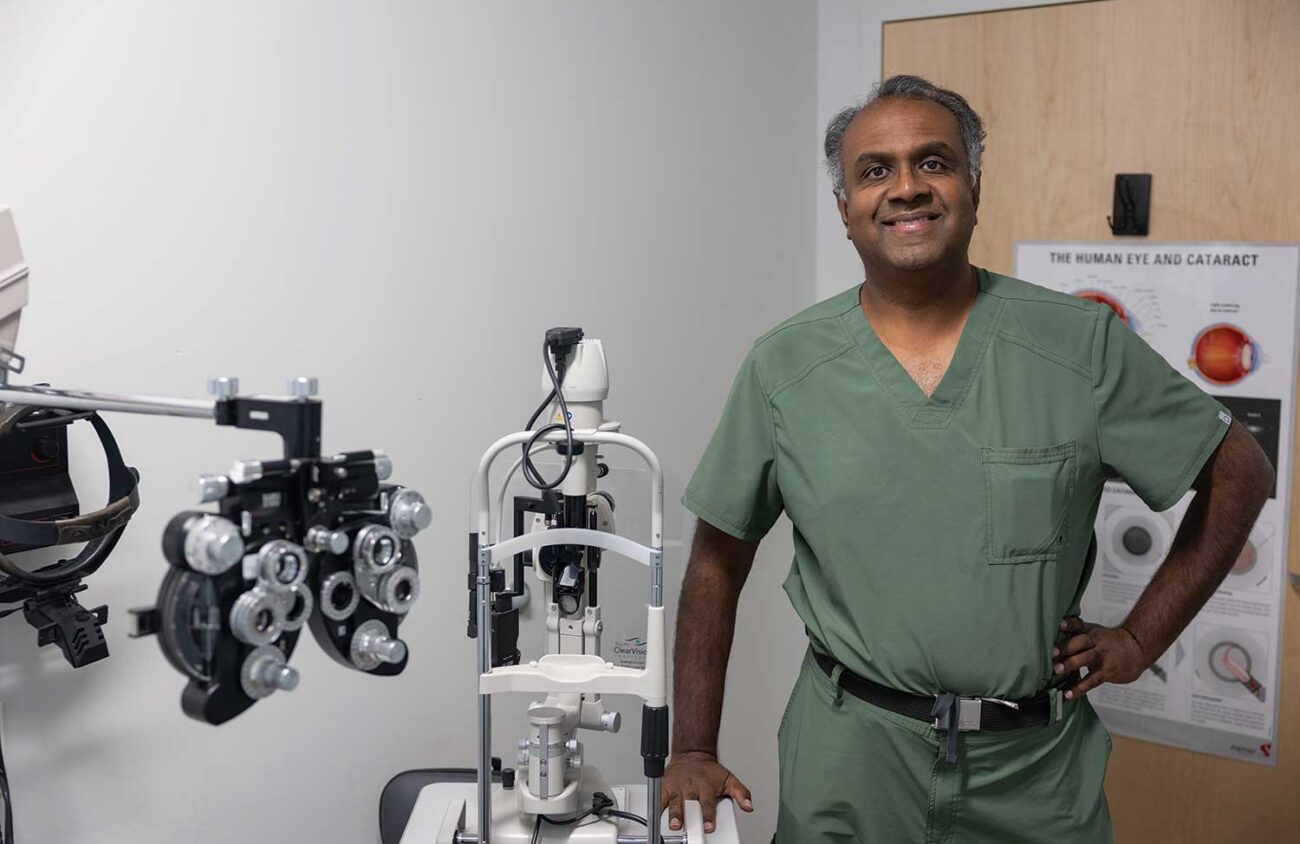
When Dr. Balamurali Ambati was four years old, he stood up on a chair in the kitchen to see what his mom was cooking. To get a better look, he tried to tilt the pot toward him — inadvertently spilling scalding hot water and rice onto his legs. He was taken to the hospital, where he stayed for three months. It was during this hospital visit that Ambati says he discovered his passion for helping others, which eventually led him to medicine.
Just 13 years later, at age 17, he would become a Guinness World Record holder for being the world’s youngest doctor. He would also go on to make important research discoveries, donate a kidney to a stranger and move to Eugene.
Ambati, now 49, entered first grade at age six like anyone else. But he says it only took him a few weeks to be moved up into the second. He kept up this pattern, skipping grades rapidly. “Basically every year I did two years of school,” he says. In 1989 he graduated from high school at age 11 in Baltimore, Maryland. During the same year, he co-authored a research book on HIV/AIDS titled AIDS: The True Story – A Comprehensive Guide.
Ambati and his brother, who is seven years older than him, were inspired to write the book after hearing the story of children in Arcadia, Florida, who had contracted HIV from blood transfusions and were subsequently ostracized from their community. “There was a lot of fear and misinformation about HIV and AIDS, so we wanted to educate people,” Ambati says. “So we wrote a book intended for high school and college students.”
Since Ambati completed college-level coursework during his time in high school, he was able to complete an undergraduate degree in biology at New York University by age 13. Despite being the youngest in his classes, Ambati says he was “used to it.” He adds, “I grew up doing this accelerated, and so I always had friends my own age and friends older than me, and it was fun.”
When Ambati entered medical school at Mount Sinai School of Medicine, he was just 14. “The first day of med school, the dean welcomed the class and let everyone know there was a wide age range in the class,” Ambati says. “The oldest student was 35 and the youngest was 14, and so there was a hunt for this little kid.” He says despite the hunt, many students didn’t know it was him because he was 5 feet 10 inches tall.
Once his peers and professors found out it was him, he says he was not treated very differently. “When you’re 80 years old, whether your medical student is 24 or 16, they’re still a kid,” Ambati says. “I think I had a really good medical school experience.”
During medical school, Ambati was working at Elmhurst Hospital in New York when a woman presented with multiple stab wounds, one of which resulted in her brachial artery being severed.
An arterial bleed is particularly dangerous due to loss of a high volume of oxygenated blood. As the medical student on the floor, Ambati was instructed to apply pressure to the woman’s arm. “It was probably only 20 minutes, but it felt like forever,” Ambati says. “My scrubs were covered in blood, and I grew up a lot that night.”
Ambati graduated medical school at 17 and chose to pursue ophthalmology, a specialty focusing on research, diagnosis and treatment of eye-related disorders. “I went into ophthalmology because I like eyes, but nobody dies and, generally, what you do works,” Ambati says.
On his second day as an attending physician at the Medical College of Georgia, where he also received his Ph.D., a woman presented with severe chemical burns to her face after her ex-boyfriend’s new girlfriend threw drain cleaner on her. Both of her corneas were burned, resulting in almost complete blindness.
Ambati says if it had occurred just a few years earlier, there would have been no treatment options for the woman. However, Ambati was able to perform an amniotic membrane tissue transplant, a stem cell transplant and a cornea transplant to ultimately restore the woman’s vision to 20/50, allowing her to see her daughter again and pass a driving test. “That’s one of my favorite stories in ophthalmology, the impact you can make on people who are blind,” Ambati says.
His combined passions for science and practicing medicine have helped him and his team make discoveries aiding in the treatment of corneal angiogenesis, a disorder that causes the abnormal growth of new blood vessels into the cornea, which can lead to scarring and cause vision loss.
“Being a scientist helps me be a better doctor because I stay current on the literature and I ask more questions,” Ambati says. “And then being a doctor helps me be a better scientist because I understand what’s important and I understand what’s feasible.”
In 2011, Ambati was in a dark place after his partner at the time refused his marriage proposal. “I needed to do something to generate positive energy,” he says. Ambati tried things like stand-up comedy, piano lessons and guitar lessons, but nothing seemed to work. That’s when he signed up for the organ donor registry.
Two weeks later, he got a call informing him he was a match with a 16-year-old boy in Idaho experiencing kidney failure and was on dialysis. After a flurry of tests Ambati went under the knife, donating his kidney. “I hope he’s living life and doing well” Ambati says.
In 2015, Ambati moved to Eugene with his wife and purchased Pacific Clear Vision Institute in 2019.
He works with Orbis International, a nonprofit nongovernmental organization that operates a flying hospital, traveling around the world to provide eyesight-saving surgery to those without access to advanced surgical techniques. Ambati is also a research professor at the University of Oregon and founder of The Ambati Lab at the UO Knight Campus.
If he had to live life all over again, Ambati says he’d still choose to be a doctor. “I’m proud of what I do. I’m proud of the people I work with.”