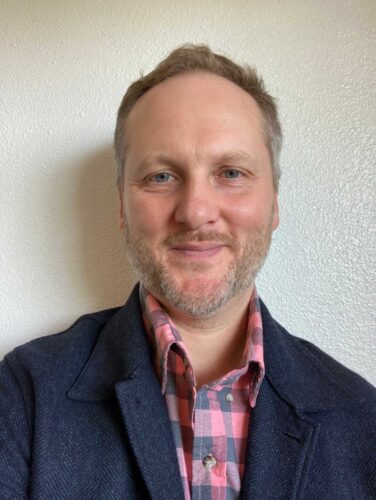
Daniel Dietz’s Rare and Used: Adventures of a Book Scout’s Apprentice is a delightful, uplifting page-turner that also poses significant questions central to the human experience, notably the notion of holding on versus letting go. Dietz grew up in the Willamette Valley, and after two decades away, recently returned to Eugene to connect with his aging parents and to raise his own sons in the place he considers home. Once settled in Eugene, Dietz found himself inexplicably drawn to the world of bookselling, a labor of love he learned at an early age from his stepfather, Michael Karn.
Part memoir, part quest, the book unfolds as a celebration of the books — and people — we hold most dear. Dietz’s writing is genuine and surprisingly wry at times, while his vivid character descriptions invite the reader into the hearts and minds of book scouts and sellers across the Pacific Northwest. Ultimately, the reader walks away most endeared to Dietz himself.
The book is now available from OSU Press, or ask for it at your local bookstore.
The conversation has been edited for length and clarity.
What have you learned about holding on and letting go?
The book is about trying to hold on to a material artifact, poet Diane di Prima’s This Kind of Bird Flies Backward. I’d been out of the book-selling world for decades with no intention of coming back, but during lockdown, I started thinking about this rare and valuable book that I’d once owned. I thought, what if I were to make something out of that feeling of “holding on”?
So, I started visiting bookstores and talking to people, and I discovered this whole universe that was much richer than I’d realized, with people who care deeply about their work and about each other — they’re searching and never quite finding, never quite knowing. It’s about finding that rare book, and also knowing that you never get to keep anything.
You write that you admire poet Joanne Kyger’s “detachment” and suggest that her poetry helped you to “set down the search.” What do you mean by that?
The book itself, the artifact, is critically important as it’s imbued with meaning. The book is the thing that you hold in your hands, but the life around the story is what makes it interesting. There’s a tension in that.
My story is about my family, and particularly my relationship with my stepfather, Michael. He’s like a great thrift store full of treasures. Maybe you take him for granted. You don’t think of him as being rich or valuable. But he’s this place where you find something special, you just don’t know what it is or what it’s going to be.
A central theme of your book is the need to understand where we come from. How have books helped you with this?
I’m not sure a lot of things in life matter more right now than our stories. When I became a parent, I looked back and thought, “Who are the people who raised me, and what kinds of choices did they make?”
Part of this question for me was figuring out what I wanted to pass forward to my two sons, who are 6 and 8. Books are a major part of that, and now they’re seeing this book come out into the world. They’re not learning how to buy and sell used books, like my stepfather taught me, but rather how to search for their own stories.
What I hope my sons take from this book is that love can look a lot of different ways, but really, it’s about showing up, however imperfect. That’s what I came to appreciate about Michael, and I hope that my boys, when they’re in middle age, afford that same grace to me.
Has your stepfather, Michael, read the book yet, and what’s his reaction?
He’s tickled. He bristled a bit about having so much of his life described for the world, but for a book person to be the subject of a book, what else is there? My hope is that the book makes its way to the community, the Eugene Public Library, the state archive. That our obscure family story, which is not normally the stuff of recorded history, will become part of Oregon’s story, and I think he senses that, too. And there’s a connection between us now, through this book, that can’t be undone.
I recently heard that within every writing endeavor, there’s a moment that unlocks the story. What was that moment for you?
Meeting Abe Richmond at Browsers’ Bookstore in Albany. I’d already had the idea to write the book, but meeting someone at an earlier stage of this parallel journey gave me perspective and language to describe my own experience — and an entry back into the book world.
Seeing the di Prima on his shelf was shocking. It’s still a huge coincidence, except it’s not because we were both incubated in this world that would have led us to her in some way. But it was the connection with Abe that made the book not just a reflection on Michael and my life, but about this other world and trying to figure out how Abe came to love the same book I did and who helped him on his journey.
Your pages offer deep sentiment without being the least bit sentimental. How do you achieve that as a writer?
The way I show up in the world is a little bit removed, a little bit analytical, but I wanted to be as close as I could to my reader and to bring them into this world as I knew it. I tried to write conversationally and to show the reader what I was feeling. I found the Fishtrap writing group. Being in community with these immensely talented writers who are trying to make meaning of the world through their stories gave me the chance to write with a group, and not for publication, not to impress anyone, but just to tell my story. That was my emphasis, and from there the story came to life.
Several used bookstores in Oregon are prominently featured in your book. What makes these places special?
A used bookstore continues to be a place that feels somewhat untouched by the digital world around us, and a lot of that is because people work tremendously hard and share their real gifts and deep knowledge. When you walk into a used bookstore, you get the expression of someone’s deep love for what they’re doing, and it’s shaped by who they are and where they come from.
I talk about Mother Foucault’s in Portland, and I describe it as walking around inside someone’s brain. I feel like I’ve met this very esoteric, strange kind of lost, wandering scholar across philosophy and literature and foreign languages, and it’s the same in Browsers’ Bookstore, but a different brain.
So, it’s this experience of being in close contact with people’s vision of the world, and they offer all of that to us for $5 for a paperback and $10 for a hardback. I hope this book sends people into a used bookstore with a sense of adventure and curiosity.
Rare and Used is available at Tsunami Books, which will host an author event in early 2027. Daniel Dietz is at Annie Bloom’s Books, 7 pm, Oct. 13, 7834 SW Capitol Highway, Portland, and Broadway Books 6 pm Nov. 19, 1714 NE Broadway, Portland.