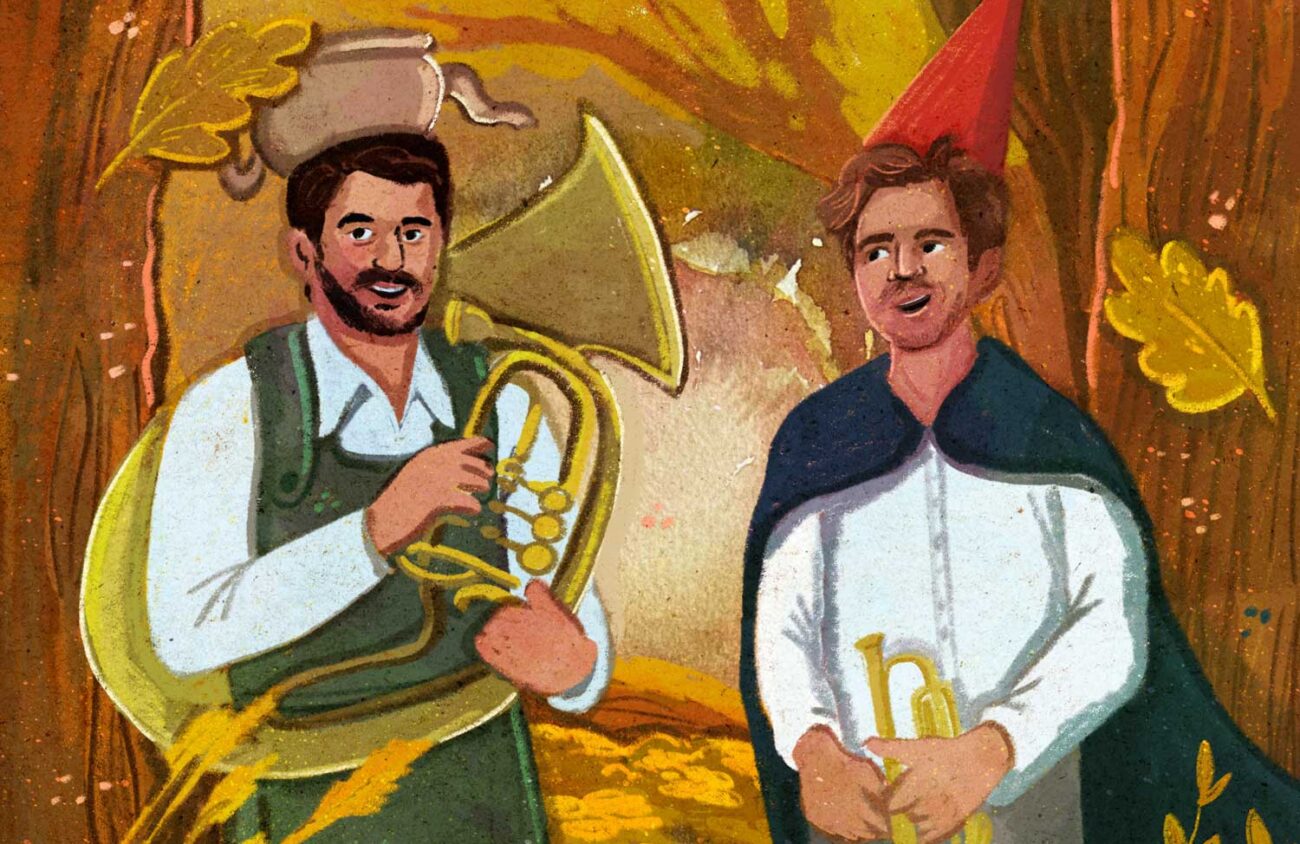
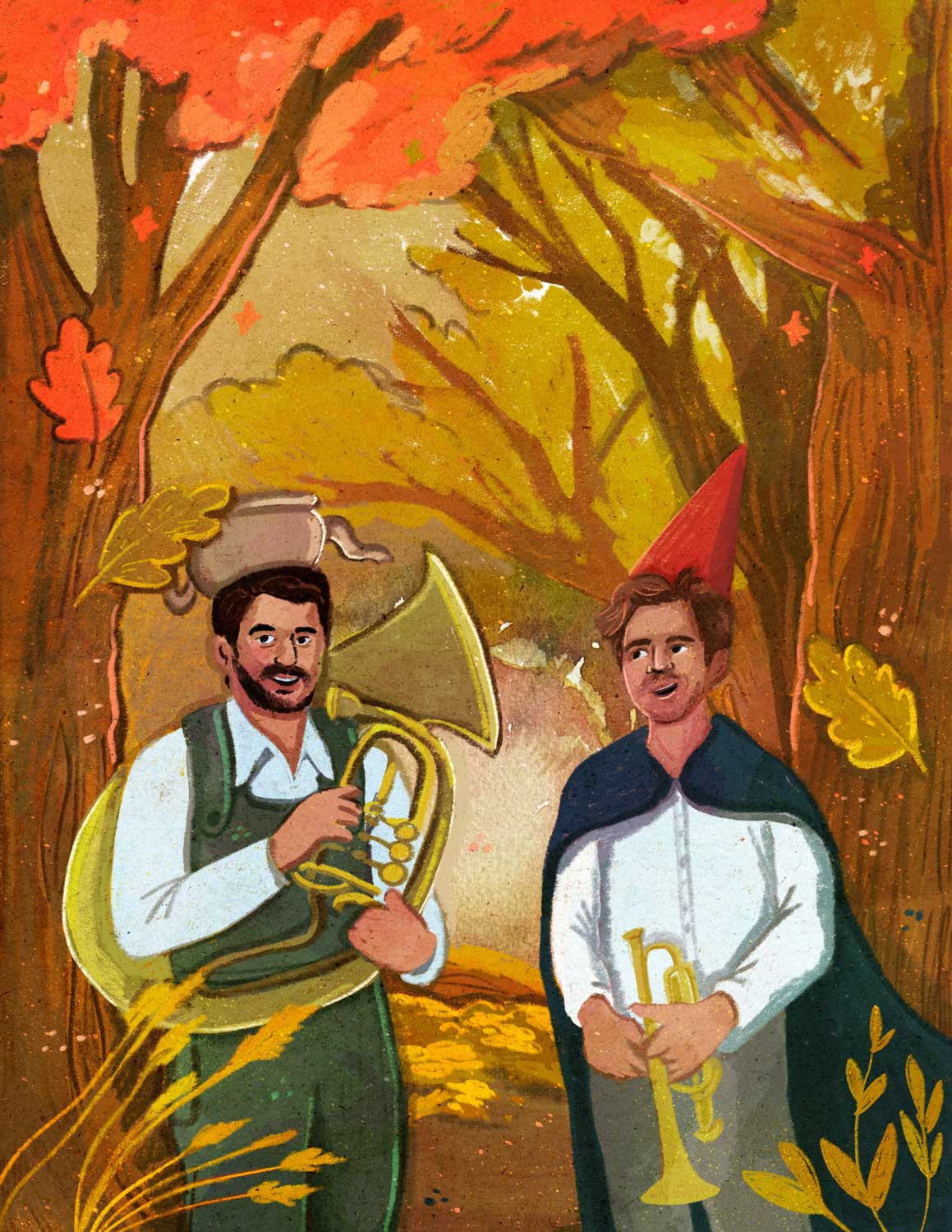
Do you feel the autumn wind and immediately picture the sultry tones of a singing frog? Do you hear the leaves crunch underfoot and begin craving potatoes and molasses? If so, you may be a fan of Over the Garden Wall, the 2014 Cartoon Network hit animated show with a cult-like fandom.
As a proud member of the cult myself, I couldn’t pass up the opportunity to sit down with the folk duo The Blasting Company ahead of their sold out Oct. 18 concert at WOW Hall. Justin Rubenstein and Josh Kaufman are the minds behind the soundtrack that makes Over the Garden Wall so magical.
The Blasting Company’s sound emerged over years of collaboration, a mix of American folk and Eastern European influences honed on the road as they busked their way to each new gig.
Their roots can be heard in each track of the Over the Garden Wall’s album, weaving together piano and accordion, harmonica and violin, as the show’s characters sing lyrics as uncanny, tragic and hilarious as their circumstances. “Into the Unknown,” featuring vocals by Jack Jones (the crooner known for songs like “Lollipops and Roses”) opens the first episode with a lilting preamble.
In another episode characters Wirt (Elijah Wood) and Beatrice (Shannyn Sossamon) sing the short duet “Like Ships” accompanied by piano.
“Yeah, we’re Wirt and Greg,” Kaufman says. “When Pat [McHale] first sent the pitch, it was just those two characters and Beatrice.”
But when Rubenstein and Kaufman saw the script, they thought, “Holy crap, they’re half-brothers. This one’s older and does poetry and is worrying all the time, and the younger one is irresponsible.”
As the show’s central characters, Wirt and Greg, venture down a twisting path of forest creatures and uncanny encounters, the soundtrack takes center stage.
Rubenstein and Kaufman know something about a meandering path.
Before Over the Garden Wall or The Blasting Company took shape, they were simply two brothers trying to make a little music.
“Justin bought a school bus from the public vehicles of Nashville auction,” Kaufman says. “He converted it at UT Knoxville to vegetable oil.”
Did Rubenstein have experience in car mechanics? “He might say yes, but he didn’t,” Kaufman laughs. Rubenstein shakes his head. “It was, uh, just a crash course from day one,” he says. “I knew my way sort of around the engine, but most certainly not around the entire engine.”
In the summer of 2006, Rubenstein, nearing the end of college, and Kaufman, a sophomore in high school, struck out in their vegetable oil school bus, busking with friends for money to buy more vegetable oil as they went. Their new band’s name? Albania Mania. Members played everything from trombone and trumpet to accordion, tuba and cowbell.
Rubenstein acknowledges (in case his parents are reading) that it “sounds like a nightmare scenario for parents. Their son joining their irresponsible older son, and quitting school and then living this life,” he says. He says, to his credit, they did visit universities — busking, of course.
Albania Mania traveled across America, their brigade changing members as they picked up fellow musicians on the road. “It was basically like joining the circus,” Kaufman says. “Whatever instrument you play, or whatever your skill is, you would come live on the bus with us, and we would go busking.”
But an auctioned-off school bus running on vegetable oil predictably will hit a breaking point, and a few months into their journey, they sputtered to a stop in Savannah, Georgia, which became Albania Mania’s home for the summer.
“In between busking and hanging out with friends, we would just spend most of the hot days under the bus.” Rubenstein says.
They say they have long been collaborative as siblings, describing calling each other across time zones to talk music before they ever actually formed a band.
“I had just been in southwest Hungary working on a farm,” Rubenstein says. Kaufman recalls busking around Nashville at the same time. “I was in Hillsboro Village, which is now extremely bougie, but at the time, in the early 2000s, it was the hip place.”
As they traded stories, they honed their collective taste in music, and their collaboration as a duo became just as much about the fun as the art. “Part of the game was just making each other laugh, and having lyrics that would be funny to say out in public on the street,” Kaufman says.
In 2008, the band landed in Los Angeles, and transitioned from Albania Mania to The Blasting Company (originally The Petrojvic Blasting Company).
They say The Blasting Company’s unique sound grew from what they had been doing from the start. “It was what we were already doing on the street — from the necessity of accordions and banjos being what you can bring on the street, because you can’t plug into anything.” Rubenstein says.
Busking in Los Angeles became their way of getting work. In 2013, it paid off when Over the Garden Wall creator Patrick McHale hired the band to compose the soundtrack.
The show’s musical leanings are often described as Southern Gothic, but Kaufman is quick to correct that assumption. “I can hear Patrick McHale correcting you in my head,” Kaufman says. “I think he would argue that it’s Northeastern Gothic.”
They say that whenever they began to sound more southern, McHale would ask them to “lean New England.” Rubenstein says the music “takes place where the Union was in control, not the Confederacy.”
The soundtrack’s production was a collaborative game of back and forth with McHale. “We fact check if something worked in his imagination,” Rubenstein says. McHale gave them creative freedom, simply saying “Let’s come up with stuff, and then I’ll tell you if it works or not inside of this world.”
At times, they say they had to take a few risks. They cite the track “Potatu et Molasu.”
Spoiler warning ahead.
At the culminating moment of the show, Greg becomes mired in the Beast’s trap. As Wirt races to rescue his brother, a haunting reprise of an earlier track, “Potatoes and Molasses” intones, children’s voices harmonizing in Latin. The mood is apt, a mix of childlike lyrics and haunting melodies.
“That was us being like, wouldn’t that be so funny if children are singing in Latin in a somber version?” Rubenstein says. “It’s also bad Latin,” Kaufman adds. “We’ve had people correct the Latin before, and my argument is that it’s Greg’s Catholic school idea of the Latin.” The song became an iconic addition to the album.
The music is so interwoven in the fabric of the show, that each character has their own defining instrument, the brothers say. “Wirt’s is obviously clarinet so listen for clarinet anytime Wirt is in the scene,” Kaufman says, “and Beatrice’s is piano.” They reveal others too: Greg is the tuba while Jason Funderberker (the frog version) is bassoon.
Since Over the Garden Wall, The Blasting Company has contributed to other projects they’re excited about. Early this year tabletop roleplaying game Legends of Avantris, released a soundtrack the brothers composed.
“Avantris really wanted to go balls to the wall. Full musical theater with duets and operatic things and big string orchestra,” Kaufman says.
Because the project was an entirely new experience after Over the Garden Wall, it allowed the brothers to think differently as musicians.
“I was excited to offer the D&D world actual music that musicians played,” Kaufman says. “It’s not a MIDI keyboard.”
As for what’s next for The Blasting Company, Rubenstein and Kaufman say that they want to expand their sound.
“We made a synth-pop album called Tiny Star that’s kind of adjacent to Over the Garden Wall,” Kaufman says. “And we’re excited to make more synth pop like that. It’s all organic, analog synths. We just had a lot of fun with that.”
Projects on their wishlist? “Some really moving, live-action drama film” Rubenstein says. “Like a Charlie Kaufman movie or something.”
But before any of that, the band has a nearly sold out tour to play. And they have high hopes for the audience’s experience at the show.
“I just want it to be like Rocky Horror Picture when I was a kid,” Kaufman says. “I didn’t even know Rocky Horror that well, but it was so moving to me to see all my fellow outcasts of society singing with joy.” He adds, “I really want Over the Garden Wall to be that safe space for people.”