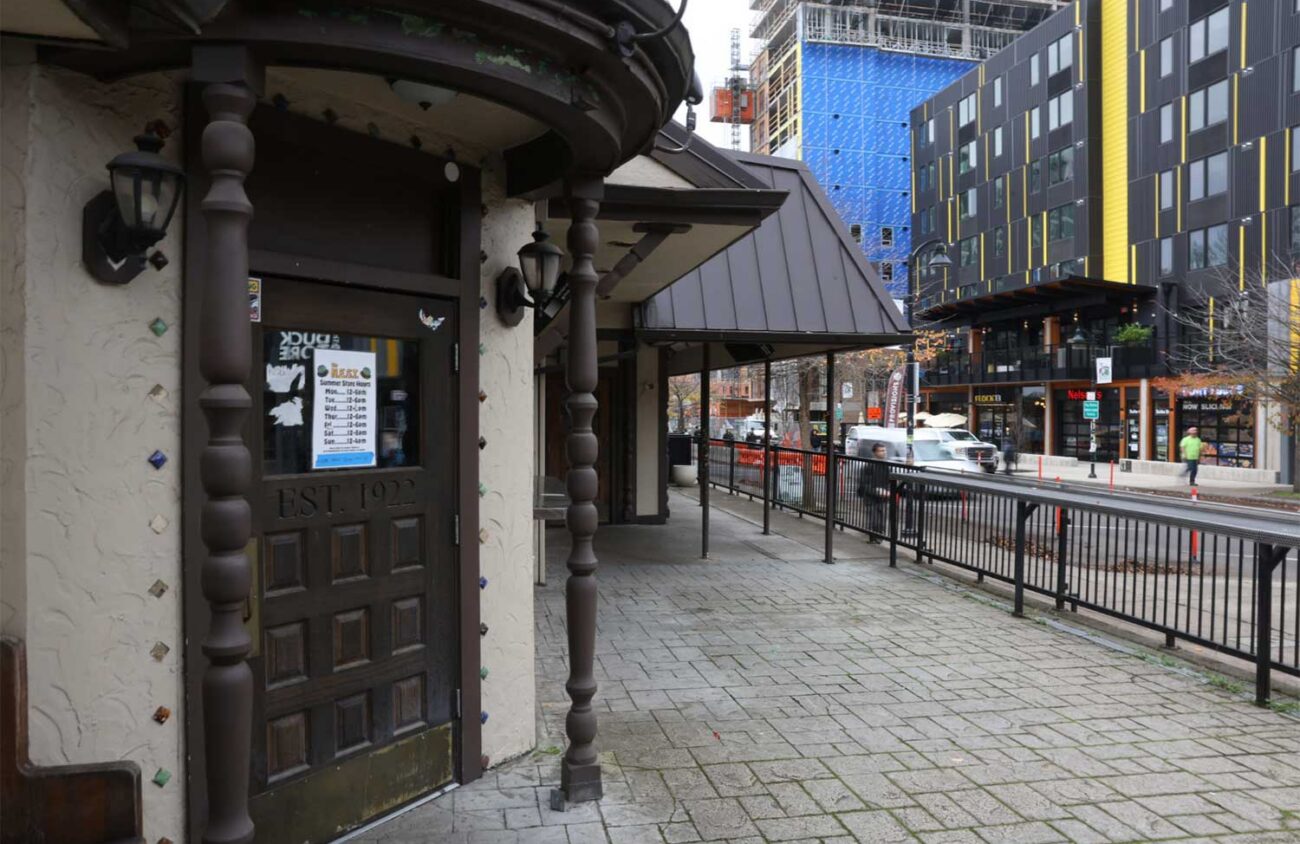
Despite a notorious reputation for years of alcohol-fueled trouble, Taylor’s Bar and Grill is on its way to becoming a national historic landmark.
The 104-year-old bar on the western edge of the University of Oregon campus, which closed six years ago because of numerous state liquor law violations, including allegations of drugged drinks and sexual assaults, was nominated Oct. 16 to the National Register of Historic Places. That’s an honor usually reserved for places that had major impacts on state, local or national history.
Taylor’s, at Kincaid Street and 13th Avenue, originally known as Old Taylor’s and Taylor’s Coffee Shop, was eligible for the national history list because of its role in an 18-year battle during the 1950s and ’60s against a state-imposed Eugene “dry zone” around the UO. From 1952 to 1970, you couldn’t buy a beer, or any alcohol, for blocks around the university.
Owners of Taylor’s and a handful of other taverns, restaurants and grocery stores inside the couple-dozen-block zone fought to overturn the prohibition.
Members of Oregon’s State Advisory Committee on Historic Preservation voted unanimously to forward the national history nomination to the National Park Service, which will review it before Taylor’s is named to the National Register, a process that can take months.
After that, owners of the old tavern could be eligible for federal and state tax breaks and some grants for repair and renovation. The building, which is not a city historic site, could still be demolished even if it’s on the National Register.
Is Taylor’s, with its controversial history, worthy of that national honor? Yes, says Robin Myers, executive director and curator of collections for the Lane County History Museum. Recognizing the bar’s place in local history could be “crucial to keeping what little original character remains in that area of Eugene,” Myers says.
“It has been a social hub for everything university-related since it was built in 1930 and is directly across the street from one of campus’ main entrances and thoroughfares,” she says.
Amalia Leifeste, director of UO’s Historic Preservation program, agreed, telling the state committee that Taylor’s should be recognized as an “important community place.”
“Speaking as an alumnus of the University of Oregon, Taylor’s is a place with a great deal of community familiarity and fondness,” Leifeste writes in a letter supporting the nomination. “I would venture that it rises to ‘icon’ status for the students on the UO campus — and has for many decades.”
She continues, “Preserving this site matters to our college town because of its history and place in the collective vision of the campus area of Eugene.”
Taylor’s Bar and Grill closed in February 2020 when Oregon’s Liquor Control Commission (now the Oregon Liquor & Cannabis Commission) canceled its liquor license. A years-long investigation outlined in a densely packed 528-page report turned up dozens of serious state liquor law violations.
In February 2022, the former tavern was sold to Alum Eugene LLC of Portland, a developer of Alum Clubs (condos and apartments) on eight college campuses across the nation. Today it’s The Nest, a retail store.
Plans to redevelop the site into a 13-story high-rise with condos and ground-floor commercial space were discussed with city planners four years ago, but little has been done since. ALUM Clubs lists a Eugene site as “coming soon” on its website.
Alum Eugene LLC initiated the historic site nomination process, hiring Alvin-Christian Nuval of Heritage Consulting Group in Sherman Oaks, California, to write an extensive 48-page report on the bar’s significant role in local history.
Herschel R. Taylor, the entrepreneur behind the tavern, opened Taylor’s Coffee Shop in 1922. In 1930, he moved the shop into a new Tudor-style commercial building constructed at 13th Avenue and Kincaid Street that included the Oregon Pharmacy and the 2,700-square-foot Taylor’s Fountain Lunch, which became Taylor’s Coffee Shop. In its early years, the building had several additions. It has remained mostly intact since the late 1930s.
Three years after Taylor’s moved into the new building, Prohibition ended in 1933, allowing Taylor and other restaurant owners a chance to sell beer and alcohol.
For years, the coffee shop was a student gathering place. After the dry zone was dismantled in 1970, Taylor’s Bar and Grill became a hot music spot, primarily for blues bands. The Party Kings, led by Eugene native harmonica player/singer Bill Rhoades, was the house band. Traveling blues acts also frequented the bar, including local legends Curtis Salgado and Robert Cray.
Don Campbell, a longtime blues bass player from Roseburg now living in the Columbia River Gorge, attended UO and spent time at Taylor’s as a student, hanging out with local musicians, sometimes playing gigs and drinking beer. He says Taylor’s became a “blues hotbed” in the mid- to late- ’70s.
“It was cool because there was definitely a scene,” says Campbell, who spent more than a decade playing bass for Portland’s Paul deLay Band. “I got to know everybody in that Eugene blues scene, which was pretty vibrant.”
Playing at Taylor’s could sometimes seem like the “seedy underbelly of the club scene,” he says. “It’s a little too dense and dark, but it just kind of had this cool renegade outlaw kind of vibe there.”
The dry zone controversy began in 1950, when underage college students were caught drinking beer at a homecoming bonfire in a vacant lot near the tavern. That touched off what local media called a “beer mug tempest.” State and local religious and civic groups, such as the University Mother’s Club, pushed officials to block alcohol sales around the campus.
On Jan. 1, 1952, the OLCC established a “dry zone” extending from the Willamette River south to 21st Avenue and Fairmount Boulevard, and from Patterson Street east to Villard Street. At the time, about 30 percent of Eugene’s population lived inside the dry zone. That included a half-dozen grocery stores and a handful of taverns and restaurants, all of which could not get state licenses to sell alcohol.
Owners of taverns in the dry zone pushed unsuccessfully several times to lift the alcohol sale ban. University students and faculty protested the zone. A 1958 opinion by Oregon Attorney General Robert Y. Thornton found that the zone was “clearly arbitrary, capricious and unauthorized by any existing provision of law.”
The zone collapsed in late 1969, when Art Stone, a former bus driver who owned Taylor’s at the time, came to a state liquor license hearing armed with petitions signed by 1,700 UO students and letters of support from university faculty and staff and from the Eugene police chief. Eugene’s City Council also backed Stone’s application.
Stone and his attorney threatened the OLCC with a federal restraint-of-trade lawsuit for blocking the application. The agency backed down, granting Stone a license to sell bottled beer after 4 pm each day starting in June 1970. Six months later, Taylor’s was approved to sell draft beer.
Kevin Harden is a retired journalist who spent nearly 50 years as a newspaper editor in Oregon and Southwest Washington.