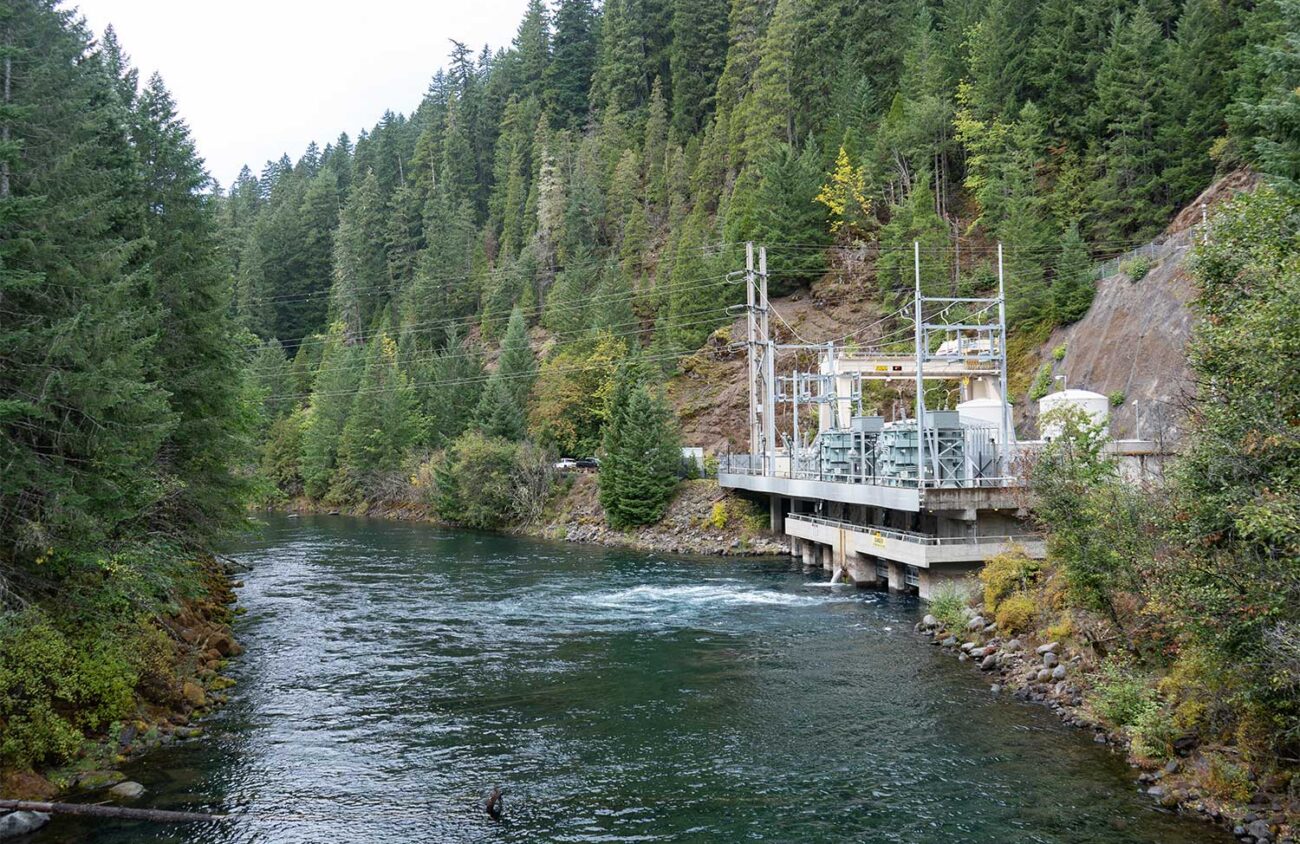
On April 1, a staff attorney at Cascadia Wildlands submitted two public records requests to the Eugene Water and Electric Board asking for records regarding the Trail Bridge Dam, part of EWEB’s Carmen-Smith Hydroelectric Project. Those requests were eventually met with a $31,000 estimate — way too costly for the environmental nonprofit.
EWEB and Cascadia Wildlands have gone back and forth on the cost for the records, which Cascadia says are necessary to see if the utility could spend less on a fish ladder than it spends on trapping and hauling fish.
For nearly two decades, Cascadia Wildlands has been pushing EWEB to improve fish passage at the Trail Bridge Dam, which serves as a complete barrier for native fish like Chinook salmon and bull trout moving upstream on the McKenzie River.
Currently, EWEB operates a temporary system where Chinook salmon are trapped, then moved by truck upstream and bull trout are caught via a fishing line, then moved upstream. Bethany Cotton, Cascadia Wildlands’ conservation director, says these methods cause undue stress to fish and are ineffective — fish migration coincides with wildfire season and wildfires can prevent workers from operating the system.
In April 2025, EWEB approved the allocation of an additional $3.3 million for the design of a new, permanent trap-and-haul system to comply with its Federal Energy Regulatory Commission license and the Endangered Species Act, which protects listed species like Chinook salmon and bull trout.
Attorney Peter Jensen’s first records request asked for records about cost estimates, quotes or financial analyses for a fish ladder and the second asked about the costs, funding and funding sources for fish passage at the Trail Bridge Dam from May 2019 to the present.
Jensen says he made the requests because Cascadia Wildlands believes the cost of a volitional fish ladder system could now be less than what EWEB has paid to date for trap-and-haul since fish passage was required in 2008 when EWEB entered a settlement agreement to relicense hydropower operations at the dam. This agreement included the construction of a fish ladder.
In 2015, the relicensing settlement was delayed when EWEB determined a fish ladder would be too expensive. In 2019, FERC authorized a 40-year license to operate the dam, which would use the trap-and-haul system for fish passage.
Since then, EWEB has yet to construct a permanent trap-and-haul system at the Trail Bridge Dam and instead has operated its temporary system. Currently, EWEB is asking FERC to amend its license to implement a new permanent trap-and-haul system for upstream passage by 2032.
Cotton says EWEB’s own license amendment request to FERC outlines a provision that if its trap-and-haul system does not work, it will have to try other options. “One would be a fish ladder, and the other would be decommissioning of the dam. Those are the only two other viable possibilities,” Cotton says.
EWEB did not acknowledge Jensen’s initial records requests until April 29, 15 business days past the deadline required by law. EWEB says it has no record of the requests until April 28, when Jensen re-sent them, but Cascadia Wildlands’ own records include emailed requests sent 7:59 am and 8:01 am April 1 to EWEB’s records custodian.
EWEB initially said the requests returned a high volume of documents, so Jensen narrowed both. After Jensen did so, EWEB returned with a cost of $4,674 and denied a fee waiver request. Aaron Orlowski, EWEB spokesperson, says the utility considers requests for waivers or a reduction of charges in cases where it deems the release of records primarily benefits the general public.
“Mr. Jensen did not sufficiently demonstrate how disclosure of the specific records would provide a broader community benefit that would outweigh the costs associated with the substantial staff time and legal resources required to review and produce them,” Orlowski writes to Eugene Weekly.
Cotton says that the records benefit the public because “the answers to these questions are extremely relevant for the public to understand EWEB’s decisionmaking in a significant financial decision.”
On Sept. 14, Cascadia Wildlands agreed to the cost, but the publicly owned utility told Jensen that the $4,674 figure was an estimate, and the actual price could change. On Oct. 19, Jensen asked EWEB for an update, and the utility responded by saying it needed “additional legal counsel review” for the requested records.
The price tag went up to $31,274.30.
“That was understandably cost prohibitive for a small organization,” Jensen says. Orlowski says the estimate has now been revised to $30,411.25. At press time, both Jensen and Cotton say they were not made aware of this $863 reduction.
Orlowski writes, “Given the breadth of the subject matter and the range of records requested,” the records required additional review by the law firm Troutman Pepper Locke because, “documents may contain information that requires additional consideration beyond a routine public records review.”
Orlowski continues, “Records containing references to key phrases and topics identified in the request may also include sensitive information related to EWEB’s security measures, physical and operational security, emergency preparedness and safety plans, critical infrastructure, internal advisory communications or other information that could affect the safety, security or operation of utility systems.”
Orlowski says the final cost for the records could be higher or lower and “will not be fully realized until completion of the review.”
Jensen says the utility initially did not give a detailed reason for denying his fee waiver request beyond writing that the records request was too large and would cost significant staff resources.
In an updated response on Nov. 17, EWEB’s enterprise risk management office tells Jensen that the increased price was due to EWEB having to retain the additional legal counsel to review potentially sensitive data and writes, “The costs related to the additional legal review were inadvertently left out of the initial estimate due to human error.”
Jensen says he thought EWEB had its own employees dedicated to reviewing records like this and did not understand why outside legal counsel was required.
Orlowski tells Eugene Weekly, “EWEB does not have internal staff attorneys dedicated to legal review. We rely solely on outside counsel for legal review. Depending on the legal matter, we work with several different law firms because specific questions require different legal specialties.”
EWEB’s public records policy dictates that it has a “responsibility to comply with public records requests in a manner that minimizes costs to all customer-owners.”
Cotton says Cascadia Wildlands is looking into its options for appealing the approximately $30,000 price tag.