
Third Rock from the Sun
The amazing is everyday in Another Earth
by Rick Levin
ANOTHER EARTH: Directed, filmed and edited by Mike Cahill. Written by Mike Cahill and Brit Marling. Music by Fall on Your Sword. Starring Brit Marling, William Mapother, Matthew-Lee Erlbach. Fox Searchlight, 2011. PG-13. 92 minutes. Four Stars.
 |
The sprawling slum of science fiction has always been overrun by big metaphors and grand analogies. The genre itself seems to beg this abuse. Like ten pounds of shit stuffed into a five-pound bag, the category of sci-fi — considered a sub-literate cesspool by the arbiters of high culture — is a yeasty receptacle that causes its flood of crazy ideas to bulge into bombastic allegories. Symbolism blooms, parallels multiply and tangle.
Among the more recognizable sci-fi tropes are the apocalyptic and prognostic (The Terminator); the manifested destiny (Planet of the Apes); the cautionary and dystopic (Minority Report, Idiocracy); the cowboy crusade (Star Wars, Star Trek); the speculative scientific spook (Jurassic Park); the immigrant invader (Alien, District 9); and Eden lost (Avatar), to name but a few.
Of course, there is a lot of bleed and cross-pollination among sci-fi’s standard themes and, oftentimes, grasping critics fall victim to overdetermination and forced fancy; sometimes a light saber is just a light saber. As with any of the more pulpy cinematic genres — Westerns, horror, noir — it seems these days that sci-fi movies are all used up with no place to go. No place to go — except inward, into the infinite universe of the human psyche and the bottomless abyss of the unconscious.
Recently, a smart, daring crop of young filmmakers has begun injecting the tired old ways of science fiction with a new sense of urgency. By paring back or entirely foregoing the phallic gadgetry and overblown imagery of special effects, these directors are replacing spectacle with speculation, swapping their Arthur C. Clarke for Camus. Because sci-fi, almost by definition, should be relevant.
Director Duncan Jones’ 2009 film Moon, starring the cosmically talented Sam Rockwell, is the best exemplar of this trend: A deeply unnerving study of memory, doubleness, identity and isolation set on a desolate lunar landscape, Moon is a piece of existential theater that portrays limitless space as a prison of solitary confinement. It treats its sci-fi prop as something more than a device, but less than a raison d’être. The film is quiet, claustrophobic and visually unremarkable, yet it’s as riveting and suspenseful as anything by Cameron or Spielberg.
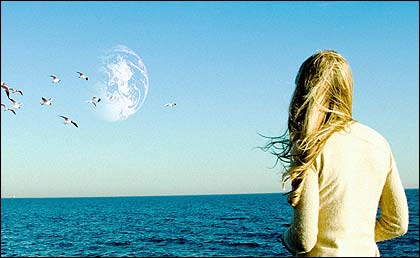
Another Earth, currently playing at the Bijou, is another excellent entry into what might cautiously be termed existential sci-fi. Directed by newcomer Mike Cahill — who co-wrote the film with his lead actor, the stunning Brit Marling — this extraordinary independent film is an exercise in economy and constraint. The premise is simple, and wonderful: An exact replica of our planet suddenly hews into our immediate orbit, hovering as clear as a harvest moon in the daytime sky, and it’s discovered that Earth 2, as it’s cheekily dubbed, is populated by us, our doppelgangers. Meaning, for every you, there is an Earth 2 you.
Framing this conceit is one of Hollywood’s most patently ham-fisted and egregiously overused narratives, the one where the otherwise good person who accidentally kills your family wheedles his/her way into your life as an unidentified good Samaritan, hoping to make things better, then falls in love herself/himself, creating tragic complications of Shakespearean proportions. What saves this hackneyed love story — aside from the subtle, moving performances of Marling as Rhoda, the brilliant stargazer paralyzed by guilt, and William Mapother as John, the widower adrift in a galaxy of grief — is a fillip worthy of the Twilight Zone: Rhoda writes an essay that wins her a flight to Earth 2. Will she go? What will she find?
Despite the entirely literal appearance of an alternate reality, Another Earth is a small, modest sleeper of a movie that raises big, eternal questions through the deployment of everyday gestures full of humor and human fallibility — such as the scene where Rhoda, just freed from a four-year prison term, watches as a man wearing a plaid shirt and green alien mask passes her casually on the street.
This quiet, grainy, twilit film evokes an intimate atmosphere of melancholy and fleeting hope, and it develops with the economy and staccato clip of a Raymond Carver short story. Another Earth eschews grandeur, and even when something called the “Broken Mirror Theory” hints at redemption, the movie never grows ponderous. Life is always sad and hope springs eternal, no matter how many Earths dot the horizon. Lessons remain unlearned. As Rhoda tells John when he asks her what she’d say if she were to meet herself on Earth 2: “Better luck next time.”
Another Earth is playing at the Bijou; bijou-cinemas.com
A Note From the Publisher

Dear Readers,
The last two years have been some of the hardest in Eugene Weekly’s 43 years. There were moments when keeping the paper alive felt uncertain. And yet, here we are — still publishing, still investigating, still showing up every week.
That’s because of you!
Not just because of financial support (though that matters enormously), but because of the emails, notes, conversations, encouragement and ideas you shared along the way. You reminded us why this paper exists and who it’s for.
Listening to readers has always been at the heart of Eugene Weekly. This year, that meant launching our popular weekly Activist Alert column, after many of you told us there was no single, reliable place to find information about rallies, meetings and ways to get involved. You asked. We responded.
We’ve also continued to deepen the coverage that sets Eugene Weekly apart, including our in-depth reporting on local real estate development through Bricks & Mortar — digging into what’s being built, who’s behind it and how those decisions shape our community.
And, of course, we’ve continued to bring you the stories and features many of you depend on: investigations and local government reporting, arts and culture coverage, sudoku and crossword puzzles, Savage Love, and our extensive community events calendar. We feature award-winning stories by University of Oregon student reporters getting real world journalism experience. All free. In print and online.
None of this happens by accident. It happens because readers step up and say: this matters.
As we head into a new year, please consider supporting Eugene Weekly if you’re able. Every dollar helps keep us digging, questioning, celebrating — and yes, occasionally annoying exactly the right people. We consider that a public service.
Thank you for standing with us!
Publisher
Eugene Weekly
P.S. If you’d like to talk about supporting EW, I’d love to hear from you!
jody@eugeneweekly.com
(541) 484-0519