The way I feel about running can be summed up in one tiny word: No. No, no, no; no to being sweaty and uncomfortable and having aching knees and feeling like I can’t breathe. (I blame high school gym class for all of this, by the by.)
The way I feel about running doesn’t, apparently, extend to movies about running, especially not the sweet and straightforward Hood to Coast, a documentary about Oregon’s ginormous annual relay race, which someone describes, early in the film, as a 197-mile-long party. The film backs this slightly outlandish claim right up: There are runners in tutus, in superhero costumes, in wildly decorated vans and very small shorts. Runners sport lightning-decorated headbands, top their support vehicles with coffins and come back year after year after year.
The Hood to Coast race starts, somewhat obviously, at Mount Hood, traveling across the state and through Portland to end in Seaside. Teams of 12 runners take three legs apiece; the race goes on through the night, the runners sleepless and cheerfully discombobulated, as the film shows. Filmmakers Christoph Baaden and Marcie Hume smartly chose four teams to follow, focusing on certain personalities within those teams: The veterans are represented by Dead Jocks in a Box, a bunch of long-time Hood to Coast runners who are half endearing and half patronizing as they form “power arches” for fellow runners (always women) and track other teams’ fashion statements.
On the heartstring-tugging side, Baaden and Hume found two teams with emotional stories: Heart and Sole, who had a teammate collapse the previous year, and R. Bowe, a team formed of the friends and family of a man who passed away unexpectedly a year before. These runners’ stories are emotional and heartfelt, and Hume and Baaden let them spill out naturally, as the Bowe family toasts their missing member, and as Kathy Ryan, who’s run countless marathons and won’t be slowed down by her near-death experience, greets the women who revived her on the route last year.
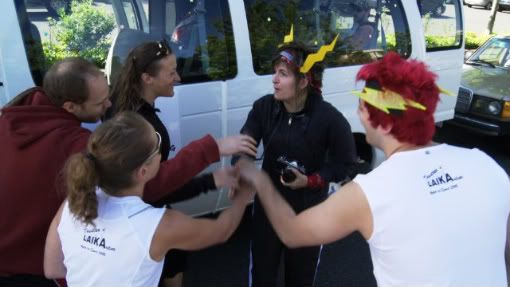
The fourth team is the one this non-runner found the most amusing: A team of animators from Laika, the Portland studio that made Coraline, decides to do the race with no training. Beer-drinking right up until the race is the plan, says Rachel, whose tousled hair and permanent bandanna make her a camera favorite. The Laika team is goofy and ragged, but they’re not just there for laughs; they make the point that Hood to Coast, while a serious race for some (the film stops to chat with the race favorites at a few points), is fairly accessible; kids and seniors run it right along with terrifyingly fit athletes.
Lovingly pieced together from a patchwork of stories, Hood to Coast is gorgeously shot — swooping through Oregon’s mountains and forests, following runners so closely you hear every footfall and tired breath — and cheerfully sincere. It’s not out to convince anyone to race, or to delve too deeply into the backstories of those runners it follows, but to get, a little bit, at what makes people do things like Hood to Coast. Rachel, exhausted, can’t stop saying that her difficult leg was awesome. The Dead Jocks come back year after year, clearly in it for the camaraderie and the competition. The sense of accomplishment, when each team crosses the finish line in Seaside, is palpable: For two days, these runners are outside their ordinary life, doing something extraordinary with just their bodies, their teammates and their willpower. As one runner says, the race is epic, and you can’t do epic by yourself.
Hood to Coast shows at 8:30 and 8:31 pm tonight, Tuesday, Jan. 11, at Cinemark.