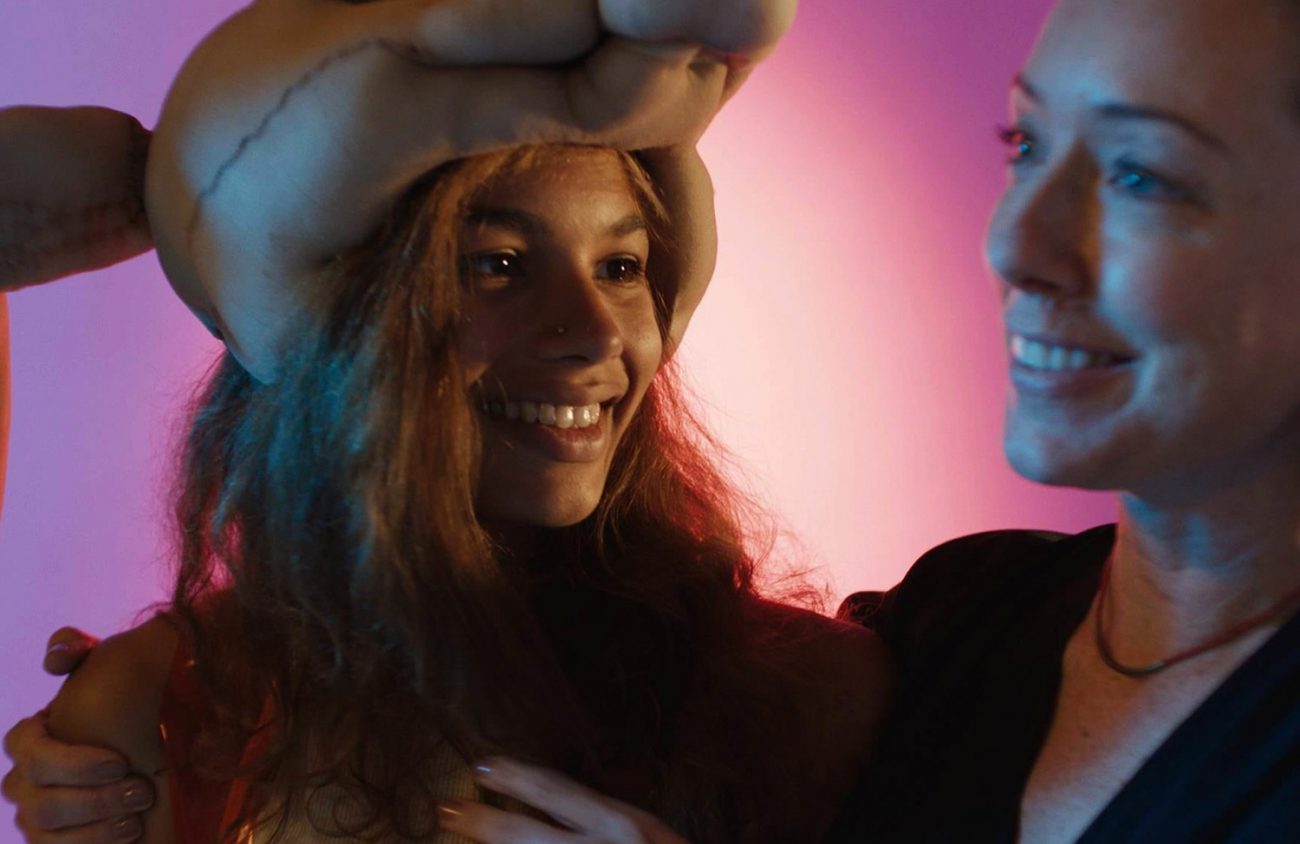
At first, Madeline is a cat.
Cats sniff things; they curl up in strange places; they pounce; they rub their faces on their people and want scritches. Madeline (Helena Howard) does all these things. Her mother, Regina (Miranda July), is disconcerted, but goes along with it well enough. Madeline’s being a cat is not really all that unusual.
Madeline is 16, biracial and an actress; Regina drives her to rehearsals where she is the youngest member of a diverse theater troupe led by Evangeline (Molly Parker, a master at atypical maternal roles). Madeline becomes a sea turtle on the lip of the stage; she watches the other performers intently.
Often, in Josephine Decker’s third feature film, focus is unsteady, unpredictable; the camera stares just at a person’s eyes or through the eyeholes of a mask, leaving important things blurry or shifting more often than you expect.
From the first frames, Decker shows us her visual language, which isn’t like any other, and she leaves us to translate it as we will. It’s exhilarating — and a little scary, given how hand-holdy mainstream films are — to feel that trusted as a viewer.
Madeline’s Madeline creates a strangely immersive film experience, which is fitting: Evangeline is trying to create an immersive theater project. She cozies up to charismatic yet quiet Madeline, asking her about her relationship with her mother, her history, her feelings, beginning to build the show’s narrative around the young woman. Things seep in from reality: a cat, an iron, Madeline’s mother’s floral sweater, Madeline’s stint in a psych ward.
But Madeline’s life is her own — she makes unwise choices, she stares blankly at adults, she shifts from excited to surly faster than her bewildered mother can follow. One of the wonders of Decker’s film is that Madeline’s mercurialness feels so normal; watching her is remembering the way feelings can drown out everything else when you’re young. Her self-consciousness is vibrant; her confidence is breathtaking. The way she expresses the range of existence between those things adds up to one of the most nuanced depictions of teenagerhood I’ve ever seen.
So many insistent feelings fit in the swirling frames of this film. July plays up Regina’s seeming fragility. The scene in which she temporarily joins the troupe for a round of improv is painful to watch, all that insecurity artfully mirrored.
Parker is distressingly good at the careful tightrope walk of the teacher in a close teacher-student relationship, her face saying everything she probably shouldn’t say to a child not her own: I’m disappointed in you, you’re scaring me, why do you act like that and how can I use your story?
But this film belongs to Howard, and in more ways than it would be fair to explain here. She lets us see the exploration that performance can be, the way she stretches herself, chooses new ways to interact with her reality and reclaims stories she’s been told about herself. When she takes back her narrative, the movie flips, or eats its own tail, or inverts itself.
I wish I could read about every viewer’s experience of the film’s end, in which Decker faces the questions her own film raises about who a story belongs to, who gets to tell it and how it gets told. These questions aren’t answered, but reconceived, presented anew: Madeline’s Madeline is not a statement but a fiercely curious exploration of the dense relationships between artist and viewer, art and life, story and teller, and the different ways we perform ourselves every day. (Broadway Metro)