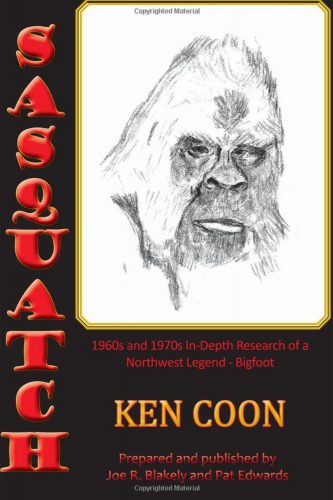
Joe Blakely remembers the day he saw sasquatch. Well, he says, he feels like he saw him.
Early one morning in 1990, he was out to plant trees in Alsea Falls. The bed of his pickup truck was filled with seedlings, and his dog, a Labrador named Rosebud, was sitting next to him.
“Out from the woods pops bigfoot about 30 yards ahead of me and crosses the highway,” he says.
Blakely says he was new to the idea of bigfoot at the time — he doesn’t even know if he had seen the famous Patterson-Gimlin film footage at that time, and he didn’t think of checking for footprints.
Decades later, after writing several fictional works about bigfoot, a surprise landed on his lap: a plastic box containing a manuscript of in-depth research about bigfoot.
The manuscript, held together by rusted paperclips, looked like it had been in a closet for 50 years. The box also contained rejection letters from publishing companies, Blakely says.
The manuscript once belonged to Ken Coon, a former Los Angeles County sheriff’s deputy. Coon’s book is based on 13 years of research, during which he interviewed people who saw bigfoot and examined footprint casts. Oregon authors Blakely and Pat Edwards edited the manuscript and published the book.
After Blakely received the manuscript, he scanned it and reformatted some of the book’s structure. He then handed the manuscript off to Edwards, who’s the owner and managing editor of Groundwaters Publishing — a Lane County company that publishes local authors.
The result is Sasquatch: 1960s and 1970s In-Depth Research of a Northwest Legend – Bigfoot. The book serves as a good introduction to bigfoot, Blakely says, because it covers the origins of sasquatch and looks at a time when sasquatch phenomenon was bigger than it is now.
Coon conducted his interviews and research during the 1960s and 1970s, back when the Patterson-Gimlin film was still big news. Using interview techniques learned from years working for the L.A. County Sheriff’s Department, he talked with people who had encounters with bigfoot.
With his interrogation skills, Blakely says Coon had a good sense of how to filter out the truthful testimonies from the lies.
“He would corroborate his stories by going to other people to assess the character of the person he just interviewed,” he adds.
Edwards says Coon, with his law enforcement experience, could get someone to talk.
“A lot of people he had to drag the story from because they were too embarrassed,” she adds.
Blakely says he hears from a lot of people about their interactions with bigfoot. In fact, he had 30 to 40 people approach him about bigfoot sightings. Edwards says she now has an open mind about bigfoot after finishing the book. What’s compelling for her, she says, is a chapter in the book in which Coon addresses some of the hoaxes surrounding bigfoot.
In that chapter, Coon refutes reasons that someone would use to dispute the existence of a bigfoot. He writes that not enough cases of falsifying bigfoot tracks have emerged.
Despite retiring from the L.A. County Sheriff’s Department to spend 13 years to research bigfoot, Coon never saw any.
“He put all of this down in a book form and was never able to publish it before he died,” Edwards says. “After I finished the book, I felt that his work should be honored in some way because he truly put a lot of time and effort into it.”
Joe R. Blakely and Pat Edwards will have Sasquatch: 1960s and 1970s In-Depth Research of a Northwest Legend – Bigfoot for sale during the Lane County Fair (Wednesday through Monday, July 24-29) and Art in the Country Fine Art and Wine Festival (Saturday and Sunday, July 27-28). The book is also available at Tsunami Books, located at 2585 Willamette Street.