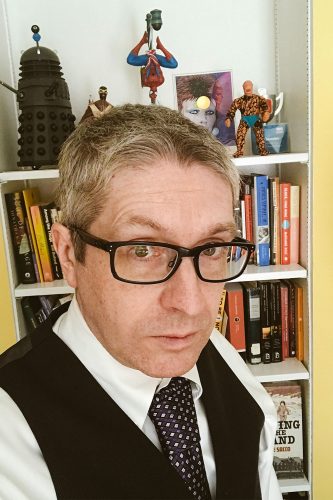
1. Ben Saunders University of Oregon.
2. Brian Haimbach Lane Community College.
3. TIE: Andre Sirois University of Oregon.
3. TIE: Jerry Rosiek University of Oregon.
What does 16th to 17th century poetry have in common with comic books? To the average reader, maybe not much. But to Ben Saunders, English professor at the University of Oregon, there’s little difference.
“I think poetry and comics actually have something fundamental in common in that they are representational forms that often draw attention to their own status as representational forms,” he says.
Teaching comics was an experiment that took off because of student demand. “This is all a function of working in a department which encourages strong teaching,” Saunders says. “Somebody with less imagination could easily have said, ‘No, you know, we didn’t hire you to do that.’”
A great teacher — and Saunders says there are many in his department — doesn’t just want to get their students excited about a topic. Rather, Saunders says, the goal is to give students the tools and appreciation to want to pursue it on their own time. “What a good teacher is trying to do is make themselves unnecessary,” he says.
Saunders points to a class he took as a teen called the Invention of Shakespeare, about how the works of William Shakespeare transformed from “the second most successful playwright in Elizabethan England” to “this cultural truncheon that you can club people with.”
“Ever since that moment, I’ve been equally fascinated not just with the art, but with the claims that this is good or this is bad,” Saunders says. “And the moments people are telling me, ‘This is bad art,’ I actually become interested.”
A Note From the Publisher

Dear Readers,
The last two years have been some of the hardest in Eugene Weekly’s 43 years. There were moments when keeping the paper alive felt uncertain. And yet, here we are — still publishing, still investigating, still showing up every week.
That’s because of you!
Not just because of financial support (though that matters enormously), but because of the emails, notes, conversations, encouragement and ideas you shared along the way. You reminded us why this paper exists and who it’s for.
Listening to readers has always been at the heart of Eugene Weekly. This year, that meant launching our popular weekly Activist Alert column, after many of you told us there was no single, reliable place to find information about rallies, meetings and ways to get involved. You asked. We responded.
We’ve also continued to deepen the coverage that sets Eugene Weekly apart, including our in-depth reporting on local real estate development through Bricks & Mortar — digging into what’s being built, who’s behind it and how those decisions shape our community.
And, of course, we’ve continued to bring you the stories and features many of you depend on: investigations and local government reporting, arts and culture coverage, sudoku and crossword puzzles, Savage Love, and our extensive community events calendar. We feature award-winning stories by University of Oregon student reporters getting real world journalism experience. All free. In print and online.
None of this happens by accident. It happens because readers step up and say: this matters.
As we head into a new year, please consider supporting Eugene Weekly if you’re able. Every dollar helps keep us digging, questioning, celebrating — and yes, occasionally annoying exactly the right people. We consider that a public service.
Thank you for standing with us!

Publisher
Eugene Weekly
P.S. If you’d like to talk about supporting EW, I’d love to hear from you!
jody@eugeneweekly.com
(541) 484-0519