In a few months, the COVID-19 pandemic will hit its two-year anniversary, and according to a union report, educators at Eugene School District 4J are feeling exhausted and stressed — some are even considering leaving the profession.
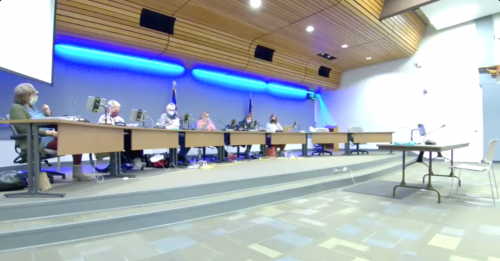
Eugene Education Association (EEA) President Sabrina Gordon delivered a report on the state of 4J educators at the Nov. 3 Eugene School District Board of Directors meeting. Board Member Gordon Lafer called it shocking, and interim superintendent Cydney Vandercar recommended increasing the number of no-instruction days for educators.
EEA had conducted a survey last week, Gordon of EEA said. “We did this survey to gauge educator exhaustion and stress because we’ve heard cries for help daily since this year began and have had an alarming number of conversations with members who are asking how to resign, retire early or take a leave of absence,” she said.
Gordon reported that the union heard from one educator who said she cries in her car every day after school, “so that when she comes home, she can be as present as possible for her own family.” She added that one special education teacher whose students want him to co-teach algebra so his students can learn it at their speed but he has too much paperwork to do.
The survey had 800 responses, Gordon said. Ninety percent of respondents said workload this year was difficult or unmanageable. More than 80 percent said workload and stress is more extreme this year than any other past year. And almost half reported that stress was so severe that it’s impacting their physical and emotional health.
“More than 250 educators are considering leaving the profession,” Gordon said. “Imagine the impact that would have. How many would it take before some schools or programs would have to shut down?”
The greatest stress for the respondents was increased student needs, lack of time to plan and prepare and added work requirements, as well as one-on-one time with students and collaboration with peers. “They have less time this year, often due to sub shortages that require teachers and support staff to step in and cover during their planning time,” she added. “The only way to meet the heightened needs of our teachers while also coping with a staffing shortage is to remove unnecessary tasks and give educators more time to do the most critical work.”
Before EEA’s presentation, 4J Interim Superintendent Vandercar recommended that the board approve no-instruction days on Nov. 24, the day before the Thanksgiving holiday, and Jan. 14, the Friday before the Martin Luther King Jr. Day holiday, which was approved by the board. She added that the district will still meet instruction time requirements, except for a couple of hours for current high school seniors.
“We recognize that calendar changes can create difficulties for some families, so they aren’t made lightly,” Vandercar said. “We need to give some time to our staff members who have worked nonstop since the pandemic began, doing extra work and not getting to their everyday duties.”
Gordon said 4J leadership has been quick to respond to educator needs in some ways. She urged the board to keep thinking how to provide educators with adequate planning time. “Providing quality education takes time,” she added. “When we don’t have the capacity to provide the quality and quantity of instruction that our students deserve, which will you deserve is more important? My vote is for quality. I hope yours will be too.”
Board Member Lafer later said at the meeting that the state of teachers right now is an existential crisis for the district. He said the most important thing the board can do right now is to improve areas where it doesn’t have a big price tag, but there’s no way to do it without insight from the educators who work with students every day.
“We have no systematic program for doing exit interviews.” He said that since he came to the board in 2018, he’s asked for more union-conducted surveys like the one EEA did. “We have to hold ourselves accountable to this in the same way we do for test scores and graduation rates,” he added. “We need to measure the rate at which educators are leaving our schools and develop strategies to improve that.”
Board Member Laural O’Rourke said as a parent, she finds it difficult to find the time to arrange childcare with two weeks’ notice for the no-school days. “With my kid on this new day that’s off, it really only works for those parents who can deal with that,” she said. “The reality is that we’re going to have a lot of little kids at home on their own because parents are trying to figure out what to do and they really won’t be able to do it.”
O’Rourke said the district should consider applying an equity lens when announcing no school day decisions. She said she would like the five or six days off so educators can have time away from instruction, but would prefer to see if they start in December to provide more of an advanced notice for working families.
This discussion occurred during the section reserved for comments from the board members and only Lafer and O’Rourke commented on the EEA report and no-instruction days. More discussion is likely to occur when the board votes on the no-instruction school days at the Nov. 17 meeting.