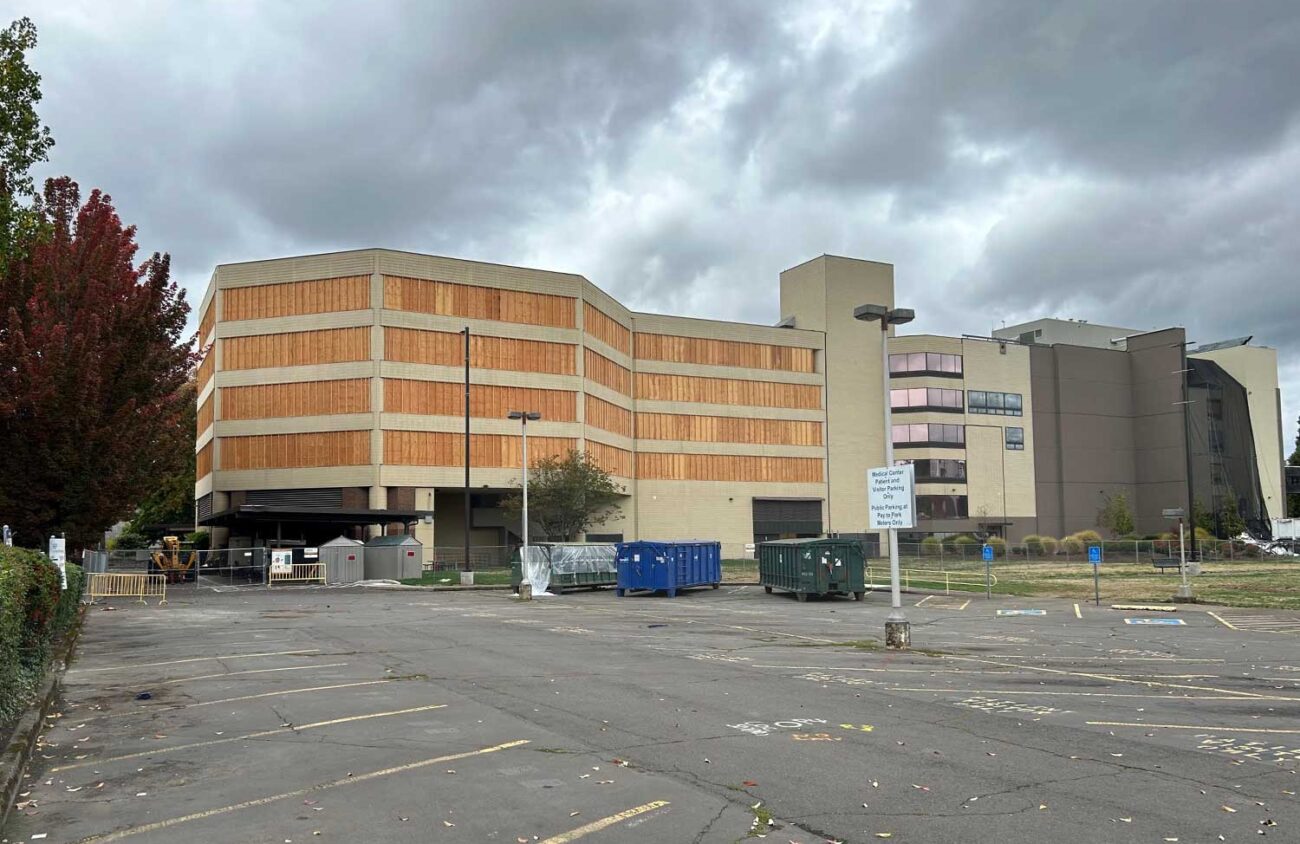
The shuttered PeaceHealth University District hospital in Eugene contains extensive hazardous asbestos that will take months to remove before the place can be demolished and replaced with student housing, records show.
The 60-year-old Hilyard Street main hospital building has asbestos throughout its fifth and sixth floors: in pipe insulation, floor tiles and sheet vinyl, and on other surfaces onto which asbestos-containing cement-like material was sprayed or plastered, according to the asbestos removal permit application PeaceHealth’s contractor filed with the Lane Regional Air Protection Agency. Plus, in much of the building, window caulking and fire doors also have asbestos, says the application.
It’s the biggest demolition-related asbestos removal project in LRAPA’s history, says agency spokesperson Matt Sorensen.
PeaceHealth is on the hook to pay for the cleanup and demolition before developer Landmark Properties of Georgia accepts the site, local real estate experts say.
Initial work — the removal of the window caulking — is visible to passersby. The contractor has torn out hundreds of windows on floors three through six and covered the openings with plywood sheathing.
Asbestos-containing materials cover a whopping 371,000 square feet of surfaces in the hospital, the application states. That’s enough to cover more than six regulation football fields. Plus there’s an additional 6,658 linear feet — about 1.2 miles — of pipes covered in asbestos material.
The project tops the demolition of North Eugene High School last year, which required removal of 300,000 square feet of asbestos materials, Sorensen says. In 2012, at the Eugene Clinic building downtown, 141,000 square feet of asbestos materials were removed prior to demolition and the construction of the Capstone student housing complex (now The Hayward).
LRAPA regulates the removal of asbestos, an insulation and fire prevention material that is now largely banned. Tiny asbestos flakes, if inhaled, can cause asbestosis, a severe lung scarring. Asbestos was widely used in construction from the 1960s onward, but phased out in the 1970s and ’80s.
Tricky work
Removing asbestos is expensive because the material must be carefully handled to minimize release of fibers into the air. The work is done by specialty firms.
PeaceHealth has hired Performance Abatement Services of Vancouver, Washington, for the job.
The permit application shows the company will use a standard approach: The areas of the building with asbestos are sealed off, typically with thick plastic sheeting; vacuum systems and HEPA (high efficiency particulate air) filters are installed to create negative pressure in the sealed area and prevent the escape of asbestos particles; asbestos-containing materials are wetted down and then cut or ripped out; the materials will be double-bagged and trucked for burial at either Lane County’s Short Mountain Landfill or the Wasco County Landfill.
Since June, Performance Abatement has been evaluating the scope of the job, LRAPA records show.
The removal work will be completed by mid-January, the application estimates.
The building, constructed in 1965 and remodeled at various times, can’t be demolished until the asbestos is gone.
Student-housing developer Landmark has a tentative deal to buy the site plus a nearby parking garage from PeaceHealth, real estate records show. The price hasn’t been disclosed.
PeaceHealth declined to respond to Eugene Weekly’s questions about whether it is responsible for abatement and demolition, the timeline, and what the work will cost.
Landmark won’t comment, a spokesperson said. The company has filed initial planning and design documents with the city seeking approval of elements such as the exterior appearance of the student complex and bicycle storage.
Bricks $ Mortar is a column anchored by Christian Wihtol, who worked as an editor and writer at The Register-Guard in Eugene 1990-2018, much of the time focused on real estate, economic development and business. Reach him at Christian@EugeneWeekly.com.