The walls were closing in. Years of lies hidden behind a veneer of trust had left a beloved community newspaper on the brink of collapse. Employees lost their jobs, the presses stopped rolling and in late 2023, Eugene Weekly went dark for the first time since it started publication in 1982. It seemed there was no way forward until readers, donors and supporters across the community rallied to save the paper they loved — the same paper people wept for outside the doors of its bright red office.
Now, more than two years later, the final accounting has arrived.
The numbers line up.
Five felony convictions. One ex-bookkeeper seated at the defense table. A yearslong fraud case finally coming due.
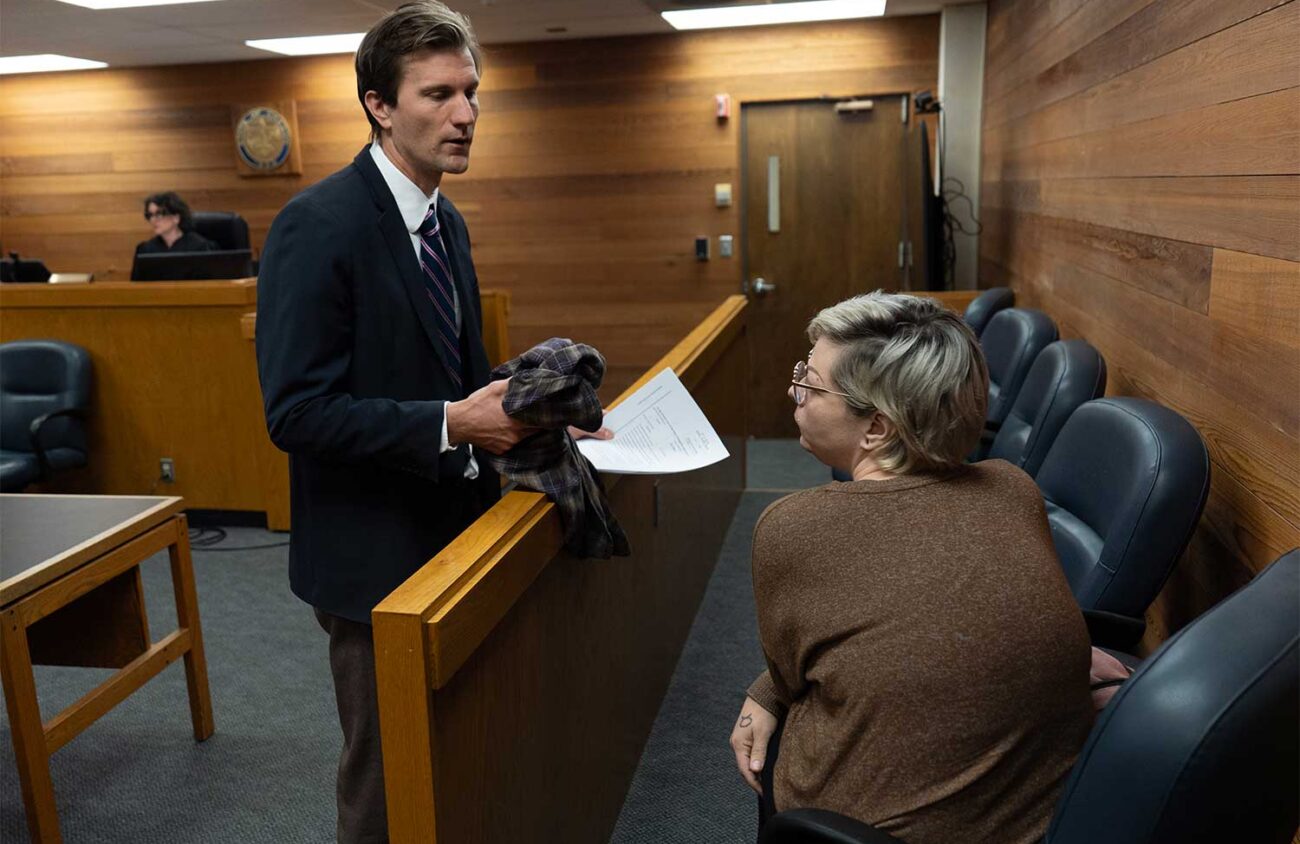
As former Eugene Weekly bookkeeper Elisha Young sat trembling in Lane County Circuit Court on May 27, dabbing tears from her eyes, attorneys debated addiction, remorse and restitution.
Then came the words that made the outcome real.
“You are not free to leave, Ms. Young,” Judge Erin Fennerty said from the bench.
Moments later, two Lane County Sheriff’s deputies stepped forward and took Young into custody, bringing to close a criminal case that began with missing money and ended with a community newspaper fighting for its survival.
Young pleaded guilty March 24, 2026, to two counts of first-degree theft and three counts of first-degree aggravated theft. In a press release, Lane County District Attorney Christopher Parosa says she stole more than $138,000 from Eugene Weekly between 2021 and 2023 through unauthorized checks to herself, deposits into personal accounts and a more than $30,000 salary increase. Two months later, May 27, Fennerty sentenced Young to 36 months in prison followed by two years of post-prison supervision.
The road to sentencing was anything but straightforward.
Young was arrested in Ohio in May 2025 after a Lane County grand jury returned a five-count felony indictment. She was released days later when Gov. Tina Kotek’s office initially declined — twice — to fund her extradition, prompting criticism from prosecutors and public outcry from supporters of the newspaper. After extensive media coverage and appeals, the state reversed course. Young was arrested a second time and ultimately extradited to Oregon to face charges. “This was a good learning experience for my office, because, to be honest, I didn’t have a lot of transparency on how we were doing all the extradition requirements,” Kotek said to Eugene Weekly in an April 15 interview.
At the May 27 hearing, before Young was officially sentenced, court-appointed defense attorney Brian Walker asked Fennerty to postpone to a later date, saying Young needed time to arrange care for her 14-year-old son while serving her sentence. Walker told the court that plans for the child’s father to travel from Ohio to Oregon had fallen through because of probation restrictions.
Records show Brandon Young was indicted in February in Ohio on drug charges.
David Mintz, deputy Lane County district attorney, opposed the request, arguing that the sentencing date had been scheduled months in advance and postponing the hearing would only create additional hardship for the victims.
Fennerty agreed.
The judge said Young had ample time to address her circumstances before sentencing and denied Walker’s motion.
Mintz then told the court that Young’s actions had a significant impact on Eugene Weekly and its employees.
Camilla Mortensen, Eugene Weekly editor and soon-to-be owner, delivered a victim impact statement describing what she calls a yearslong betrayal of trust.
“Day-in, day-out, for years, you were stealing money from a newspaper that you know works to make this community and world a better place in which to live,” Mortensen told the court. “You were in a powerful position, entrusted with the newspaper’s finances — and you betrayed that trust.”
Mortensen said Young’s actions forced Eugene Weekly to suspend publication for the first time in more than 40 years, damaged the newspaper’s reputation and left employees without jobs just days before Christmas. Thanks to an outpouring of community support, the paper was able to resume printing six weeks later.
Still, Mortensen said, the consequences extended far beyond the missing money.
“You sought to destroy Eugene Weekly in myriad ways,” Mortensen said. “You cancelled the company’s insurance, stopped paying bills, halted payments on loans and stiffed the printing company that prints the paper. You left the newspaper bleeding with debt.”
The losses extended beyond what prosecutors could prove had been stolen. When the embezzlement was uncovered in December 2023, Eugene Weekly discovered more than $200,000 in unpaid bills, including roughly $80,000 owed to its printer.
Former Eugene Weekly copy editor Dan Buckwalter recalled those first chaotic days after the theft was discovered. “I remember it was just Camilla and I at the office. And Biggie and Aksel [Mortensen’s dogs], of course,” Buckwalter said after the hearing. “All the big outlets showed up — The Register-Guard, KEZI, KVAL, you name it. We had also gotten the yellow slip from the gas company on the door, and boy was it cold in that office.”
The newspaper returned to print only after readers, advertisers and supporters contributed more than $200,000 to keep it alive.
“Eugene Weekly made it through the devastating financial loss — as well as emotional betrayal — thanks to a community that cared deeply about local news and this little weekly in particular,” Mortensen said when charges were filed against Young in 2025.
Mortensen also spoke in her statement about the embezzlement’s impact on former owner Anita Johnson, who repeatedly invested tens of thousands of dollars of her own money in the newspaper based on Young’s representations about its finances.
“For years, you looked Anita in the eyes and told her she needed to put more of her money into the paper,” Mortensen said. “And when she did put more money into the newspaper, believing you were an honest person, you stole the money.”
She continued, “Anita spent the last year of her life in the wake of your selfish and destructive actions,” Mortensen said. “And yet, Anita lived to see that you, Elisha, had failed to destroy Eugene Weekly and the spirit that it inspires.”
Mortensen also described how employees suddenly found themselves without jobs just days before Christmas. “One day our copy editor had a job,” she said. “The next he was accepting a food box at his church.”
Young declined to speak, but her attorney read a statement she provided. Walker told the court that Young accepted responsibility for the thefts and expressed remorse for the harm caused. He said that addiction and personal trauma contributed to her actions, saying she developed a cocaine addiction following bariatric surgery in 2021 and later sought treatment and recovery services.
Walker also suggested that publicity surrounding the case helped generate community support and fundraising for Eugene Weekly, and said Young was grateful it was “only out of print for a short time.” The paper didn’t print for six weeks.
Addressing Young before imposing sentence, Fennerty noted the extensive damage caused by the theft and addressed Young’s claims. “You might be grateful for the community rallying around and providing support,” Fennerty said, “but it was support that never should have had to have been provided.”
Near the end of her statement, Mortensen contrasted Young’s future with the newspaper’s recovery.
“Elisha, you will soon be led off in cuffs to a prison cell,” Mortensen said. “Or, you can take the path followed by your victims — Eugene Weekly, its employees and the entire community — who chose to emerge from the wreckage you created and go forward toward renewal.”
Outside the courthouse, Buckwalter reflected on the irony of a case that transformed a local embezzlement into national news. “Pro tip: If you’re going to embezzle from somebody, don’t make it a media outlet,” Buckwalter said.
Young’s 2025 arrest, then her March 24 guilty plea, began the process of closure. Last Wednesday’s sentencing brought the criminal case to an end — though the process of rebuilding, and the question of restitution, continue.
The newspaper Young nearly destroyed remains in print — rebuilt by readers, donors, advertisers and a community that refused to let it disappear.