The trailhead host for Bagby Hot Springs has to be tough and yet genial. Mona Pearson fits the bill.
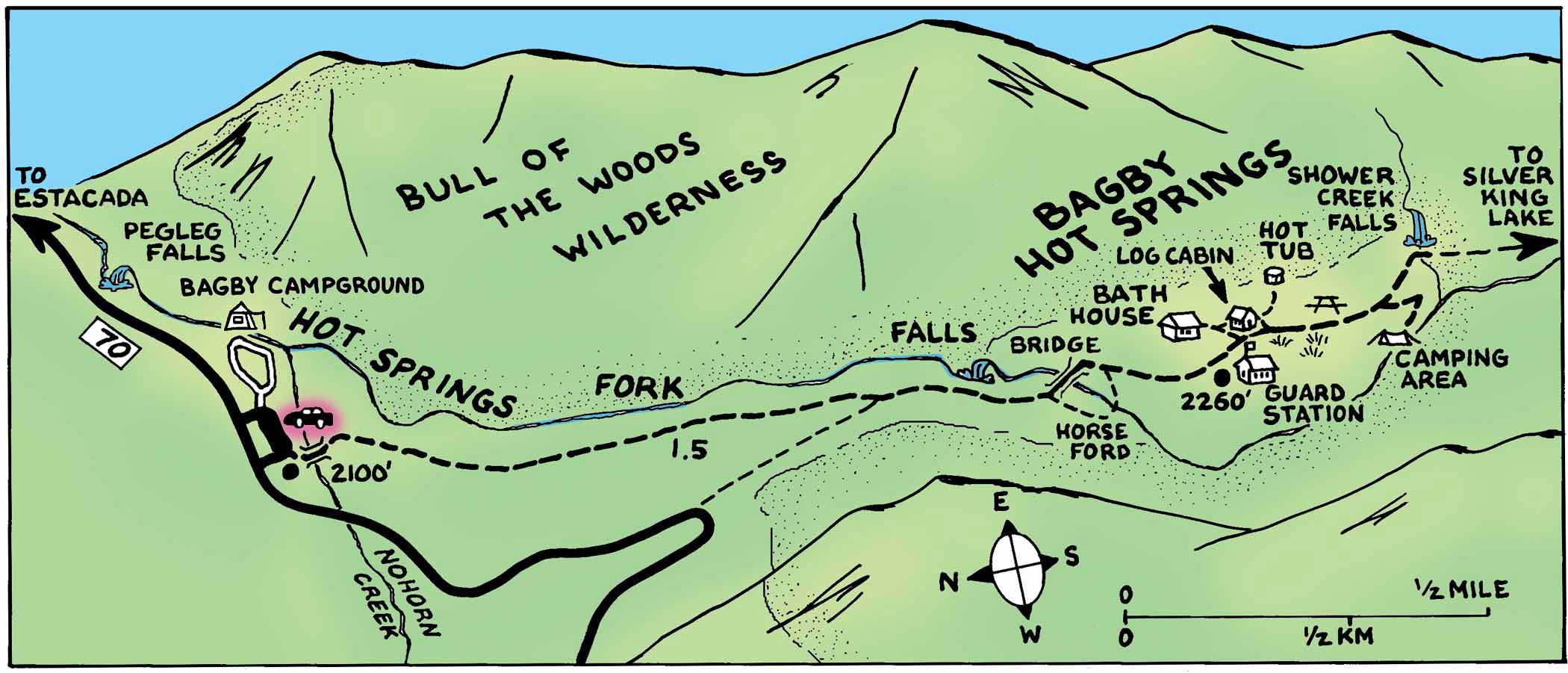
If you thought Lane County’s Terwilliger (“Cougar”) Hot Springs drew a motley crowd of visitors, try the 1.5-mile hike to the state’s most popular forest hot springs, in the Clackamas River headwaters an hour and half’s drive southeast of Portland.
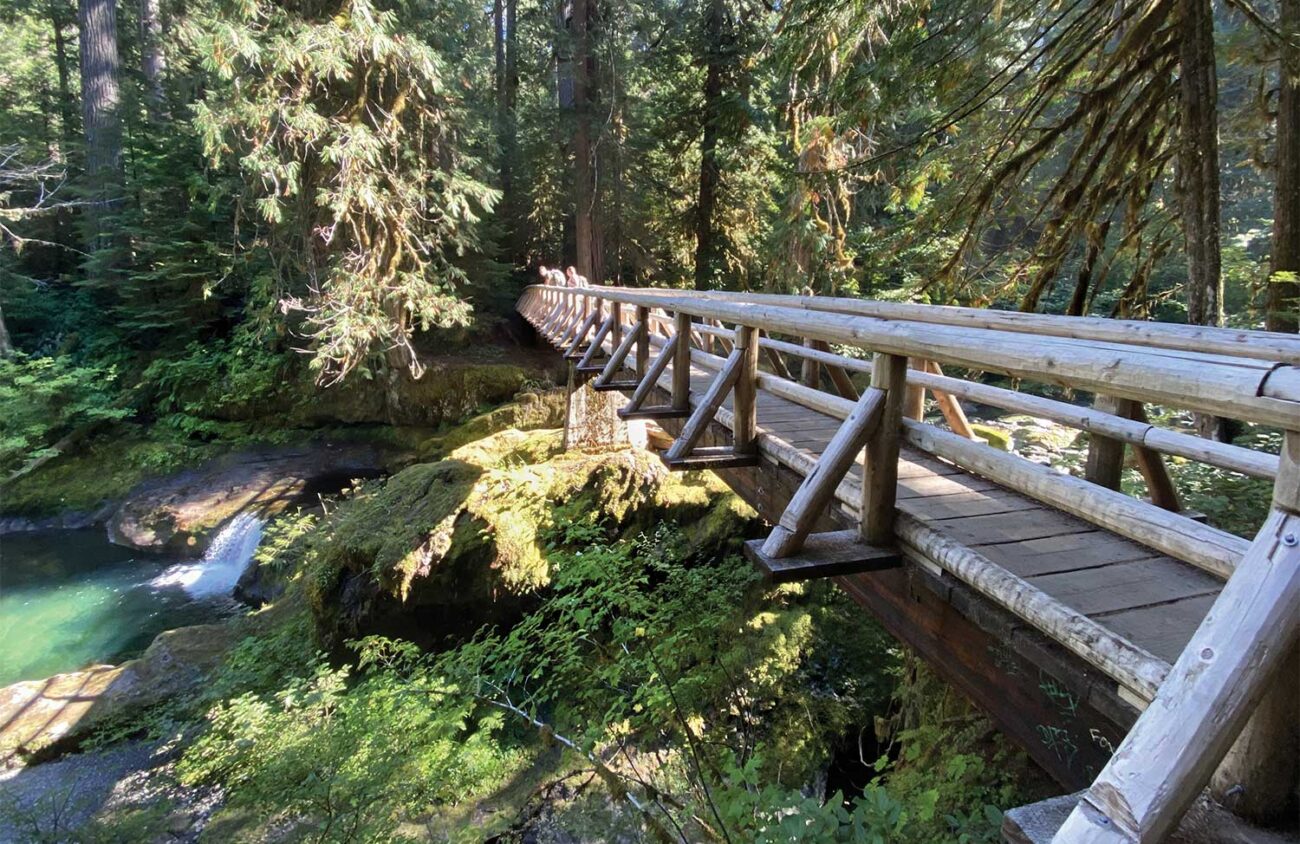
The trail to Bagby is so easy it’s almost wheelchair accessible. Giant trees 6 feet in diameter line the path. You cross two spectacular bridges, one above a churning waterfall. The hot springs itself has five cedar tubs with steaming water straight from the source. Public nudity, long banned here, is once again allowed, so you’ll see all varieties of flesh in the tubs.
People wear clothes on the trail. You’ll meet shy young couples on first dates, tie-dyed New Agers with crystals, Portland techies in dress shirts venturing into the wilds for the first time and a few hard-core druggies.
When I first visited Bagby in 1965, it was a Forest Service outpost with an unstaffed guard station built of logs. Nearby, a shake-walled bathhouse had five little rooms in a row. A wooden trough carried boiling water from the spring alongside the building. Inside each room was an 8-foot-long tub carved from a giant cedar log. To fill it, you unplugged a bung-hole in the wall, allowing hot water from the trough to pour in. Then you added buckets of cold water to get the temperature low enough for bathing.
No one was using the baths on that early visit, and neither did I. I was only 12 years old, on a family backpacking trip. We marveled at the place and hiked on.
Portland discovered Bagby in the years that followed. By 1979 it was so heavily used that someone fell asleep in a tub at night with a candle burning for light. The bathhouse burned to the ground.
Volunteers rebuilt the bathhouse. The old cedar tubs were so waterlogged that they had survived the fire and could be used again. In the years that followed an annex was added with five more tubs, and then a separate gazebo was built with yet another tub.
The next time I visited Bagby, in 1991, I noticed little piles of broken glass beside each of a dozen parking spots — evidence of smash-and-grab break-ins. Nearby was the burnt-out shell of an SUV. A ranger at the scene told me someone had driven a stolen car to the hot springs and torched it to cover their tracks.
Crime became such a problem that the Forest Service turned over management of the area to a private concessionaire. Uniformed staff at the trailhead charged $10 for a wristband.
And then came 2020. The COVID pandemic shut down the entire area for a year. A huge wildfire narrowly missed Bagby, but burned the nearby roads, blocking access for another two years. By then the old guard station and bathhouse had rotted so badly that they were declared unsafe. The future of Bagby looked bleak.
Enter the knights in shining armor. Mike and Tamarah Rysavy had already rescued Hot Lake Springs Resort, a 120-year-old sanitarium near La Grande. The gigantic, rambling hotel at that historic spa had already required so much work over the years that it had consumed the fortunes of two previous wannabe restorers. I have no idea where the Rysavys have amassed their resources, but they obviously have deep pockets — and a deep love of getting into hot water.
The Rysavys founded Bagby Preservation. It’s technically a for-profit company, but according to Pearson, the $5-per-person day-use fee she collects at the trailhead doesn’t come close to paying for the restoration projects now underway.
With funds from the Rysavys, and with volunteer help from longtime Bagby fans, the derelict log cabin guard station is now being reroofed and rebuilt as a staff center. Using that building as a base, crews plan to start rebuilding the old bathhouse next year. New cedar tubs carved from giant logs have already been ordered. Yurts and tiny cabins are being installed at the trailhead campground. Bagby Hot Springs is now open 24/7, year-round.
Meanwhile, there are job openings for additional hosts to make sure the area stays safe. Pearson says it’s hard to find applicants. For one thing, they have to be willing to “boondock” — to live out in the woods an hour’s drive from the nearest coffee shop. And then they have to deal with all kinds of visitors.
Pearson herself hikes the 3-mile round-trip to the hot springs at least three times a day, checking on visitors. When they bring firearms, she asks them not to frighten anyone. When they bring drugs and alcohol, she asks that they comply with laws and not use them at the hot springs itself. When they don’t listen, her only weapon is a phone with satellite coverage.
“I tell them I can call 911. Before they can hike out, people will be waiting for them at the trailhead.” She says that’s usually enough to calm down all but the most belligerent visitors.
Pearson admits that working at Bagby is not like volunteering at a state park, where campground hosts usually expect no more serious trouble than kids bicycling on the path to the restrooms.
While we were talking, a van full of scruffy-looking teenagers pulled into the parking lot. She stopped to welcome them and recited the rules. I could sense that the kids had come looking for a wild, toga-less party, but that they were going to be on good behavior after all.
There’s a steely glint in Pearson’s eye that says you don’t mess with Mona.
Bagby Hot Springs is open all winter, but if it’s snowed recently at low elevations the roads may be slick or even blocked for a few days. Start by driving to Estacada, which takes a little over two hours from Eugene. Take Interstate 5 north to Woodburn exit #271, follow signs east for Molalla, and continue straight on Highway 211 to Estacada. Then turn right on Hwy 224 for 26 miles to the store at Ripplebrook. Continue straight on what becomes paved Road 46 for 4.1 miles. At a large junction, fork to the right past a “Yield” sign onto paved, two-lane Forest Road 63. Follow this road straight for 3.4 miles, and finally turn right onto paved Forest Road 70 for 6 miles to the trailhead parking area on the left. Here you can pay the $5-per-person fee by cash or card. Sites in the adjacent campground are $27.
William L. Sullivan is the author of 27 books, including The Ship in the Ice and the updated “100 Hikes” series for Oregon. Learn more at OregonHiking.com.