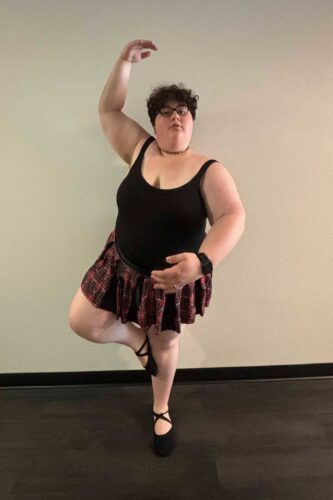
I have always been plus-sized. Even as a child, I learned how quickly shame can attach itself to a body — not through lectures, but through glances, expectations and the quiet understanding that certain spaces weren’t built for someone who looked like me.
Music was the one thing that cut through that shame. I danced everywhere: to church hymns, wiggling in the pews, and later at my first concerts — Trans-Siberian Orchestra and Elton John, both at Matthew Knight Arena — letting rhythm take over in the dark. I loved movement. I loved music. But loving it didn’t mean I felt welcome taking up space.
Ballet, especially, felt off-limits. With its mirrors, leotards and precision, it carried the message that bodies must be perfected before they’re allowed. Still, years later, I found myself hovering over the registration button for Ballet I at Lane Community College.
I registered.
Then unregistered.
Then registered again.
Then unregistered again.
The fear wasn’t the choreography. It was the eyes — and the uniform listed in the syllabus.
Instead of disappearing quietly, I sent an email to the instructor, Florabelle Moses, asking whether a leotard was required. It felt embarrassing — like admitting I didn’t belong before anyone had told me I didn’t.
Her response was simple and kind.
“A leotard is not a requirement. You can wear any comfortable clothes to move in. I would like to see the joints, so not too loose.”
That term, Moses returned to the same message again and again: Anyone and everyone can dance. When a movement didn’t work, she offered modifications instead of judgment. On the final day of class, she invited students to bring a partner and taught salsa instead of ballet.
After class, she mentioned Friday night salsa and bachata socials at the Vet’s Club Building — beginner-friendly nights built for bodies of all kinds. At $6 with a student ID, my husband, Robin Tabor, and I could actually afford to go.
Those nights made something click for me. The feeling I’d found in a college ballet class wasn’t rare — it was showing up in other studios, too.
That philosophy of real, intentional welcome doesn’t stop at college classrooms or drop-in bachata at the Vet’s Club.
Lillith Chiddix is a choreographer and instructor at Xcape Dance Company and performs with its 18-plus dance company. She first took a class there in 2017, returned the following year and has remained with the studio since. A former competition dancer, Chiddix now teaches dancers in the same competitive track she once trained in.
“I was a competition kid and now I teach those kids. It’s a very full circle moment for me.”
Chiddix teaches three adult classes a week and is deliberate about who those classes are for — and just as importantly, who they are not excluding.
“I have three classes a week for adults open to anyone and everyone 16+. Any size, religion, sexuality, race — all welcome into Xcape’s space.”
She adds, “I make it my top priority to make a safe space for everyone, especially new alternative queer fat dancers. It’s all about sexy movement and loving the body you have now how it is and not how it ‘could’ be.”
Chiddix says, “I’ve accepted being sexy and fat and I want everyone who’s plus size to know they are the sexiest people alive and everyone should see how sexy they are. Everyone deserves a safe space with other people who look like them.”
Accessibility, Chiddix says, isn’t optional — it’s necessary. Her choreography accounts for different mobility needs without treating them as limitations.
“Some days we do floor work, but I’ll always have choreography fillers for people who don’t go on the ground because I know some people can’t roll or do certain moves. It’s not a want but a need to have everyone be comfortable enough to dance.”
For Chiddix, dance is deeply personal — a way of reconciling identity, queerness and self-acceptance.
“Dance is the reason I finally fell in love with my body,” she says. “I’ve struggled my whole life being bullied or hiding my body, but dance brings out a part of me that connects to my queerness as well. When I dance, it feels right.”
I feel the same way, especially since I started opening myself up to the art form. You really have to dig to find plus-size bodies in the spotlight at all. There are more now than there were when I was growing up — and yes, I’m saying that at the ripe old age of 21.
I remember being genuinely excited when Melissa McCarthy was cast in the 2016 Ghostbusters movie — I was 12 when it came out. I’d grown up watching her in endless reruns of Gilmore Girls and Bridesmaids with my mom on our old boxy TV, and seeing her step into a Ghostbuster role felt huge to me. At the time, she was the only plus-size person I truly saw myself reflected in and looked up to.
Now, with the rise of the Ozempic trend, we’re seeing fewer and fewer plus-size bodies represented, replaced by a push toward conformity with narrow (waisted) societal standards. Don’t get me wrong — Ozempic is the right and necessary choice for some people, especially those managing diabetes or working toward specific health goals, and there is nothing wrong with wanting to be healthier or using medication as intended. But the broader fad surrounding the drug has increasingly framed plus-size bodies as something to be “fixed,” often labeling those who don’t — or can’t — use it as lazy or uncaring about their health.
That’s why dancing matters so deeply to me. It’s how I care for my body, stay healthy and stay connected to myself — without shame. I don’t dance to be skinny. I dance for my soul.
Chiddix says, “I want everyone to understand that feeling. You’ll be feeling yourself by the end of each of my classes, I promise you’ll leave the room being more connected and grounded than when you entered.”
That mindset carries into something as simple — and as loaded — as what dancers wear.
“Typically wear any size sweat pants or leggings and a T-shirt or hoodie. Especially for hip-hop-based classes.”
She says, “Comfort is very important when preparing for a dance class and you need to be able to fully extend without too much restriction.”
For people who have spent their lives being told — directly or indirectly — that their bodies are problems to be fixed before they’re allowed to be seen, spaces like these matter. They turn dance from something you have to earn into something you’re already allowed to do.
I didn’t stop being plus-sized when I stepped into a ballet studio. I didn’t become fearless overnight. But I learned something quieter and more lasting.
Dancing isn’t about fitting into a shape.
It’s about moving anyway.
To find out more about Lane Community College’s dance offerings, go to LaneCC.edu. For XCape Dance Company visit XcapeDance.FreeByrd.Pro. For information on Salseros’ salsa and bachata social dance and drop-in class, visit Salseros.com.