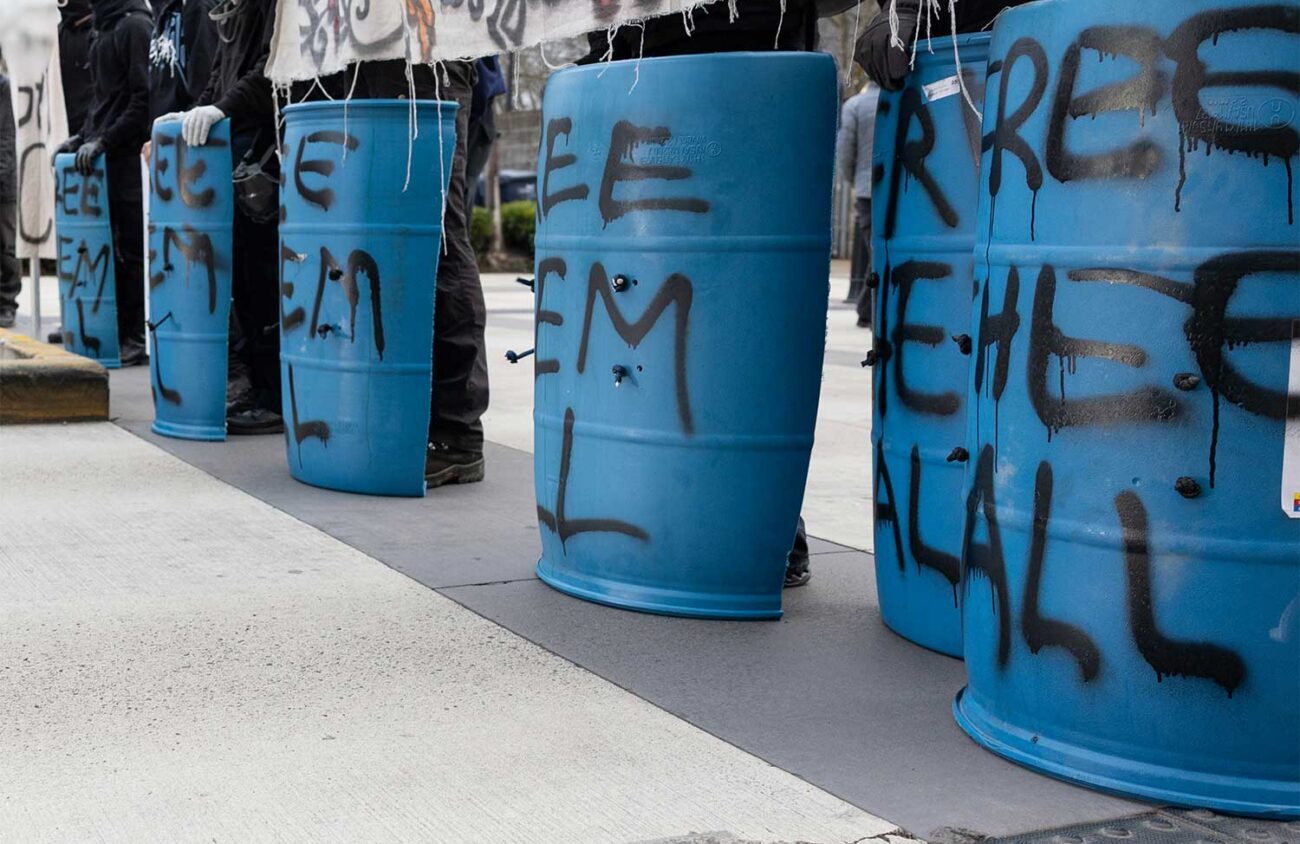
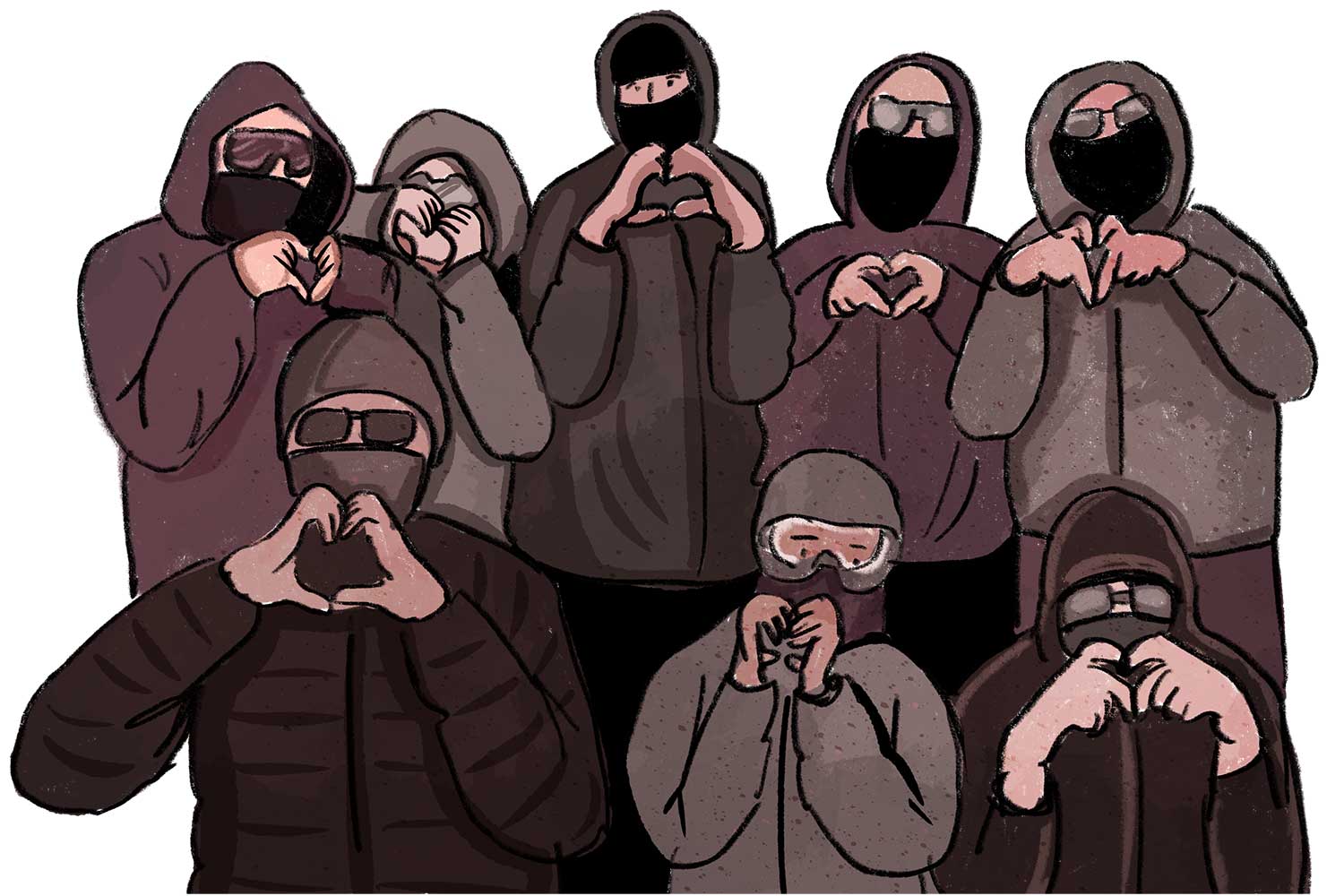
The sight of people in black bloc attire at recent anti-ICE protests might bring thoughts of violence and vandalism. Eugene black bloc protesters say this is a misunderstanding. Black bloc is a tactic used to conceal one’s identity from surveillance and law enforcement, and the protesters say their primary goal is to protect civilian protesters from fascist attacks through more militant tactics.
The protesters tell Eugene Weekly that the community must become more militant in response to the mass incarceration of immigrants and the increasingly violent crowd control tactics used by federal law enforcement in the wake of President Donald Trump’s immigration enforcement surge, which the group describes as fascist.
Protests in Eugene escalated in January after the Immigration and Customs Enforcement and Border Patrol killings of Renee Good and Alex Pretti in Minneapolis. On Jan. 27, a local protest ended in tear gas, flash bangs, pepper balls and several arrests as federal agents pushed back protesters from the front of the downtown Eugene Federal Building. On Jan. 30, the Eugene Police Department declared a protest a riot after several windows were broken. The next day, Jan. 31, federal agents used more tear gas and pepper balls against a smaller group of protesters. On Feb. 28, agents used pepper spray and pointed loaded guns at unarmed protesters.
Black bloc tactics first gained attention in the U.S. in 1999 during the World Trade Organization protests when black bloc protesters from Eugene were alleged to be behind much of the property damage in Seattle.
Eugene Weekly met with a group of six anti-fascist protesters wearing all black to discuss the group’s intentions and tactics when responding to what they call fascist violence at the hands of the government.
Eugene Weekly is using one-time pseudonyms for each source to protect anonymity due to the group’s use of disruptive protest tactics that could result in charges of riotous behavior, criminal mischief, disorderly conduct or impeding traffic.
“Most of our operations around this are just defensive and protecting people who were not prepared to deal with chemical agents,” says Jessica, one of the protesters.
With the recent uptick in the use of less-lethal munitions and other crowd control methods by federal agents at the downtown Eugene Federal Building, the group says they’re prepared to continue their fight against state-sponsored violence and unjust ICE practices, even if it means protesting in a way that pushes back harder than just waving a sign.
“There’s a lot of history of people earning the freedoms, autonomy and powers that we have as people,” protester Kathleen says. “Not a single one was earned by being kind to the politicians and doing what they wanted.”
“Condemning more militant protest tactics is an extremely effective way to divide large movements,” Jessica adds.
They say Trump doesn’t need an excuse to be violent, and discouraging protesters from taking more direct action is a form of “peace policing” that is ultimately counterproductive to the anti-fascist movement. “The only way you can stand up to the government is by organizing, because they’re organizing too,” Walter says. “We’re not giving him a reason to attack us other than organizing and he’s scared of that.”
Because of escalation from the federal government, the protesters say they’re prepared to be arrested for the sake of their cause. “I would much rather get arrested and have my community back me up than get kidnapped by mass murderers in the streets,” says Amy, another black bloc protester.
While preparedness and acceptance of risk is important, the protesters say they employ a number of tactics to avoid being arrested or identified.
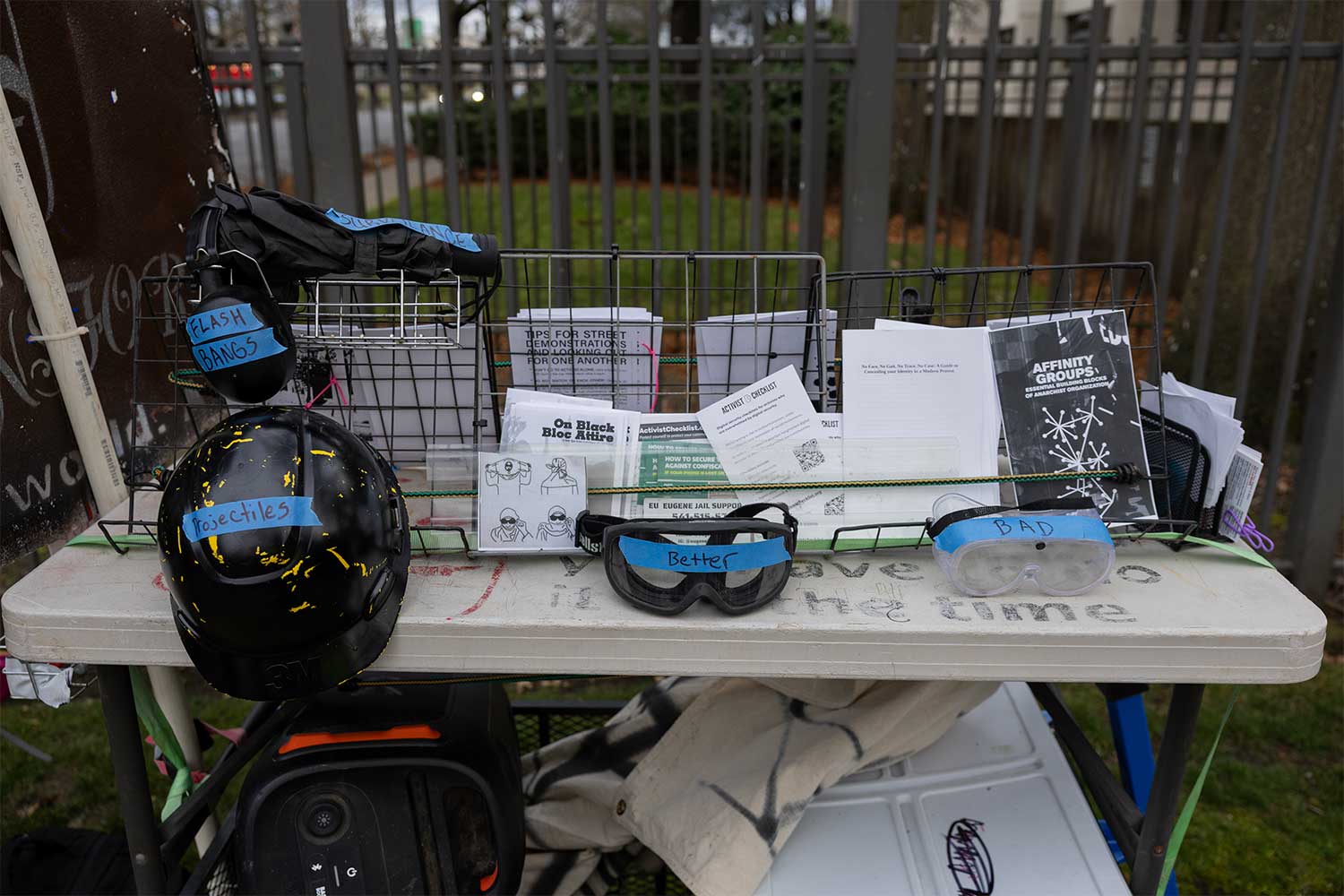
“Identity concealment is not optional,” Jessica says. “Black bloc does not mean a gray sweatshirt and a N95.” The protesters say people new to black bloc often neglect to cover areas like the bridge of the nose, eyebrows or reflective items on clothing. Other mistakes include wearing an identifiable pair of gloves or a backpack. “Never wear the same black bloc outfit twice,” Jessica says.
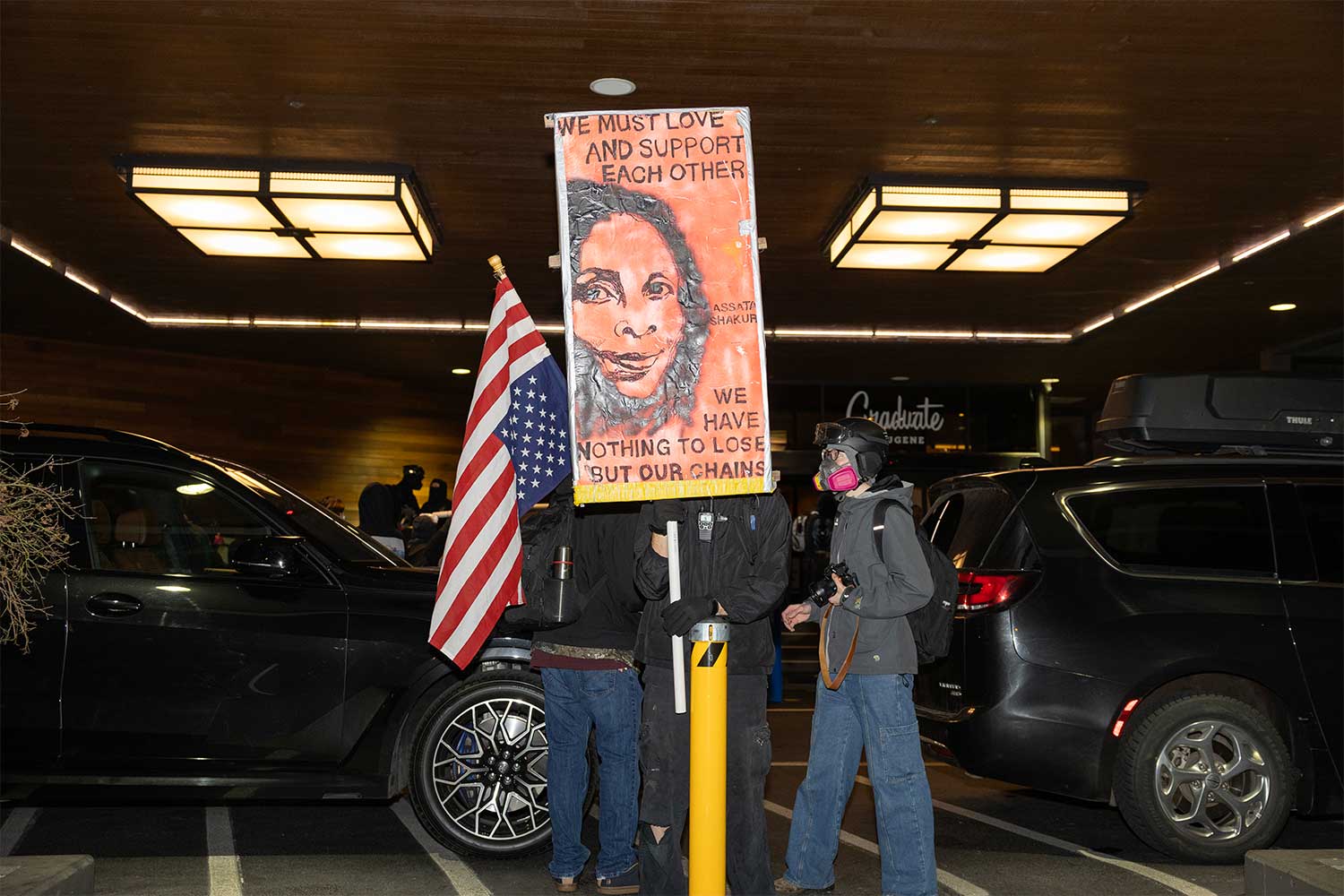
The protesters say the goal of black bloc is to be nondescript and move as a unit rather than as individuals. This makes it harder for law enforcement or others to identify an individual from the crowd. “Assume there’s a camera watching you at all times as you leave functions,” Jessica says. “Wear multiple layers of different outfits, different masks and different outerwear.”
The protesters say drones are known to follow protesters, but walking around a block enough times or heading to a secure location to “de-bloc” can be useful to find a way to leave a protest without being surveilled. During a Feb. 28 protest, Lane Community College’s The Torch editor-in-chief Agostinho Da Silva was followed by a drone while leaving the protest he was reporting on.
De-blocing simply means changing out of black bloc clothing.
Maintaining anonymity extends to online spaces as well. The protesters say Signal, a messaging application, is more secure than text messages — but it’s not perfect. “Do not say anything online that you don’t want read back to you in court,” Jessica says.
“Your phone is a cop, and you can’t trust it,” Amy adds.
But there’s more to protect at a protest besides your identity.
“Protect your head, protect your face,” Kathleen says. “These are dangerous people and they want to hurt you,” they say of federal agents. On Jan. 31, federal agents shot a protester in the mask with a tear gas canister. Several journalists, including Eugene Weekly journalists, were struck by impact munitions as well. Other protesters reported being struck in the head and face by pepper balls, causing injuries.
In order to prevent being injured by projectiles, the black bloc protesters say they use “sturdy protest signs,” and wear gear like nondescript helmets and goggles. A sturdy protest sign could mean something made from plywood or anything other than paper and cardboard. Other tactics include making shield-like signs from plastic 55-gallon barrels, carrying umbrellas to block faces from cameras and using leaf blowers to blow back tear gas.
“The line having something to put between federal agents and the masses shows that the people have their back, which is important,” Norm says. Oftentimes, anti-fascist black bloc protesters will create a line of bodies, sometimes holding shields or signs, to serve as a protective barrier between protesters and law enforcement who may advance with tear gas, pepper balls, flash bangs or even batons.
For things like tear gas, Jessica says their primary objective is to protect the civilian areas, like sidewalks and streets. “We watched a car with multiple children in it have a gas canister directly underneath it,” Jessica says. Eugene Weekly has posted footage of tear gas being fired into the street by federal agents on multiple occasions during the January protests.
“When you get surprised gassed, it’s really scary, you panic and it’s really hard to resist running away,” Kathleen says. “Just tell yourself, it gets better, it goes away.” Protesters add that the current location of protest activity at the Federal Building, the risk of agents “kettling” protesters is real. Kettling is a tactic used by police to encircle protesters to make mass arrests.
The group says this is where pacifist protesters can aid operations by warning the crowd of advancing agents. “Being a body in bloc, regardless of what you’re doing, is always going to help other people in bloc,” says Kayla, another protester. “Even if your intentions are to sit on the sidewalk with a sign peacefully, that helps protect the people who are willing to take a more serious risk.”
The Feb. 28 black bloc “No Business as Usual” protest resulted in injuries as protesters blocked the intersection of East 6th Avenue and Pearl Street. “Blocking streets and sidewalks to disrupt normalcy in the face of governmental repression is a time-honored protest tactic commonly referred to as ‘non-violent civil disobedience,” the group writes in a post-protest statement to Eugene Weekly.
Another, non-black bloc, protester, identified by EPD as Shane Novak, was injured by a vehicle as it attempted to drive through the line of protesters. According to EPD, the woman driving the vehicle was also injured and taken to the hospital after protesters allegedly punched her as she drove through the crowd.
Novak was charged with criminal mischief and disorderly conduct. No charges have been filed against the woman driving the car. It was one of three incidents involving cars making contact with protesters that night. Novak was not associated with the black bloc protesters interviewed by EW.
“The violence against protesters last weekend in Eugene should be widely condemned regardless of the allegations that a couple of teenagers ‘Souped the Chuds,’ which allegedly happened much later in the night,” the protesters write. “At the time that cars were running over pedestrians, people were simply holding signs in a crosswalk. The City of Eugene charging the victim with a crime is truly diabolical.”
Chud is an internet slang term used to describe foolish and unintelligent right-wingers, often directed toward law enforcement.
Later in the evening, two minors were arrested for allegedly throwing cans of soup toward the parking area of the Federal Building. Soup has become a symbolic tool protesters sometimes use as a projectile after Trump popularized its use by claiming protesters bring soup to throw at law enforcement, then say it is only “soup for my family.”
Black bloc activists told Eugene Weekly that the purpose of the Feb. 28 protest was to show the community that there is “no business as usual” as long as ICE is active in Eugene, in Oregon and nationwide.
“I remember when I was a very young person hearing about Eugene being the anarchist capital of the world,” Kathleen says. “It’s inspiring and Eugene is really dope. People should believe in that and they should continue those legends and make federal operatives afraid to be in these cities.”
“We’re a movement based in love, and we share the same hope for a better world,” Kayla adds.