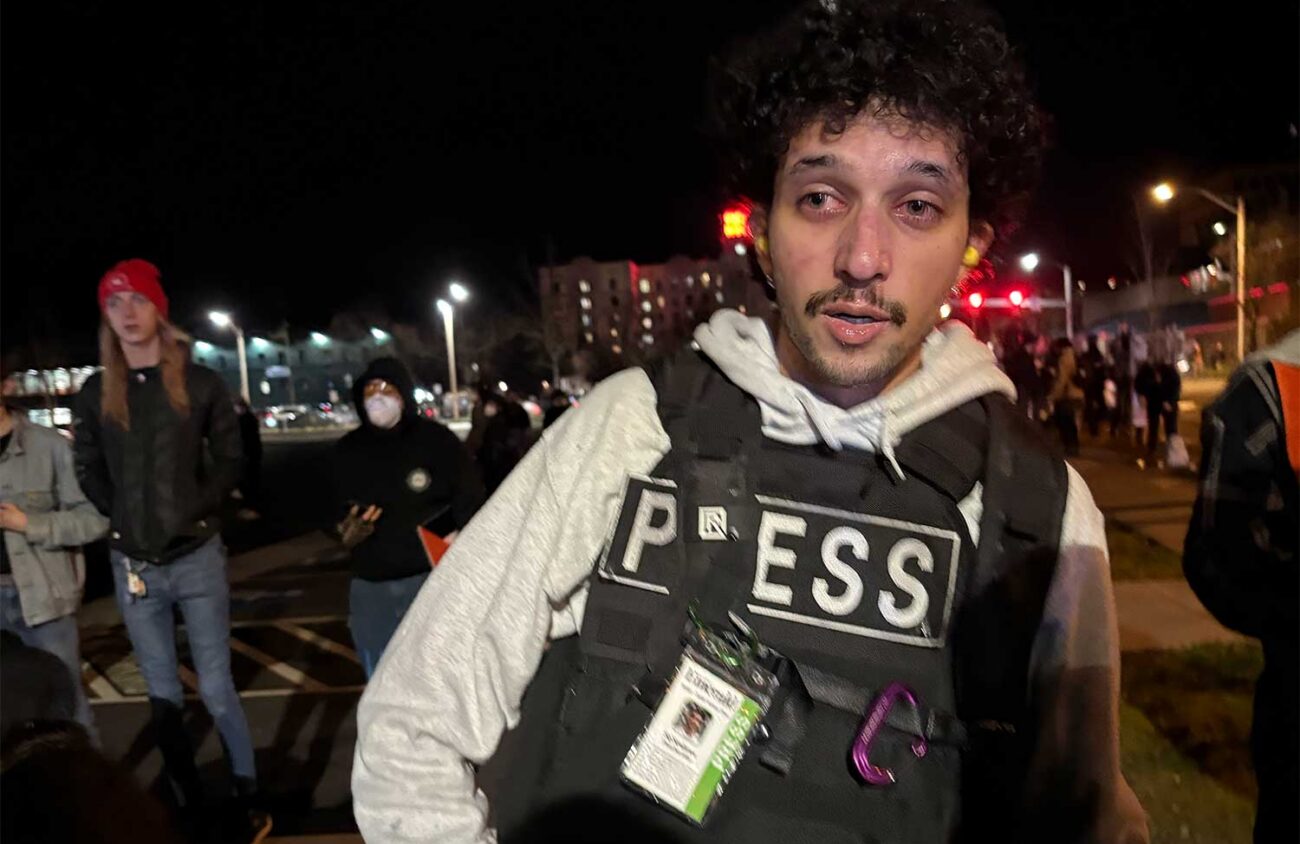
Saj Sundaram suits up for political protests with his Doc Martens, black jeans, a black long sleeve shirt and a gas mask he bought on Amazon. It’s been his attire for all the protests against the Trump administration’s immigration policies that he’s covered at the Eugene Federal Building.
Sundaram, fourth-year journalism student and photo editor for The Daily Emerald, has worked to document the Eugene protests. He’s learned that being a journalist doesn’t protect him from the harsh response from federal agents who have targeted demonstrators.
On Jan. 27, Sundaram and Agostinho Da Silva, editor-in-chief of Lane Community College’s The Torch, backed away while yelling “Press!” as federal officers raised pepper ball guns and fired. Sundaram was hit multiple times on the right side of his body and officers shot Da Silva three times in his chest, once on each ankle and once on the thigh — both were documented by the U.S. Press Freedom Tracker.
Three nights later, officers again fired on journalists, even though reporters waved their press identification as agents emerged from the federal office building. Sundaram got tear gas in his eyes.
“Every single time I go shoot, I tell somebody, ‘Hey, I’m getting called in. You’ll know if I get arrested if you don’t hear from me for a couple of days,’” Sundaram says.
Journalists expect their First Amendment rights to protect them when covering protests that turn violent; that they are allowed and entitled to be close to the action, so they can document what is happening. Journalists do not receive special exemptions, nor can they break the law to get a story.
Local journalists say that despite their press credentials, they are being targeted by federal agents in the same way as protesters. For student journalists, it’s a balance of following the law, maintaining personal safety, and staying long enough to document.
“We’re also getting gassed alongside the protesters. The perception is we’re viewed just as large of a victim as they are,” says Tarek Anthony, editor-in-chief of The Daily Emerald, the University of Oregon’s independent student-run media organization. “It’s just different in that sense.”
Portland Mercury reporter Jeremiah Hayden has covered many ICE protests at the federal agency’s Portland center. He’s learned to gear up for work wearing a ballistic helmet and a gas mask.
“I recognize that while I may be legally protected as a reporter at a protest, I’m not actually physically protected,” Hayden says.
Following the arrests at the Eugene Federal Building Tuesday, Jan. 27, Anthony wrote a 16-page safety protocol and sent it to surrounding schools. He says student newsrooms do not have a budget line item for gas masks nor the mental health capacities for reporters compared to larger newsrooms.
Anthony recommends his reporters try to remain as neutral as possible and exercise their Fourth Amendment right by not handing their phones or pictures to any enforcement officer who may ask for it.
“You’re always risking us by being out here, but keep your mouth shut and not participate in the crowd and just be a bystander as much as possible,” Anthony says.
Student journalists do not have a precedent set other than the potential for protests to turn violent and threats to their personal safety for doing their jobs.
Sundaram has been a freelance photographer since 2020 and with The Daily Emerald since 2024. Since covering Black Lives Matter protests in 2020, he says he’s developed his situational awareness.
“I do think that student journalists should be covering dangerous protests. Because it gives them experience,” he says. “That is not to say that anyone and everyone can just go kind of balls out. You really have to know how to keep yourself safe.”
Covering the Jan. 27 protest at the Eugene Federal Building was the first time Da Silva, The Torch editor-in-chief, reported on and covered a protest for an official publication.
Previously, he photographed and reported on the March for Our Lives walkout in Washington, D.C., the Women’s March on D.C., and in downtown Chicago in 2020.
“I’ve experienced literally every kind of anti-crowd device,” Da Silva says. “I’ve been hit by the big 40 millimeter canister, rubber bullets, I’ve been beaten with wooden batons, I’ve been tear gassed, pepper sprayed and shot with pepper balls.”
On Jan. 30, with Da Silva was The Torch journalist Remi Steeves. Before reporting, The Torch staff used Sharpies to write the phone numbers on their arms for Da Silva, their advisor, Eugene Weekly Editor Camilla Mortensen, and a lawyer. Steeves says she was instructed by Da Silva to always keep the protesters between them and the DHS officers.
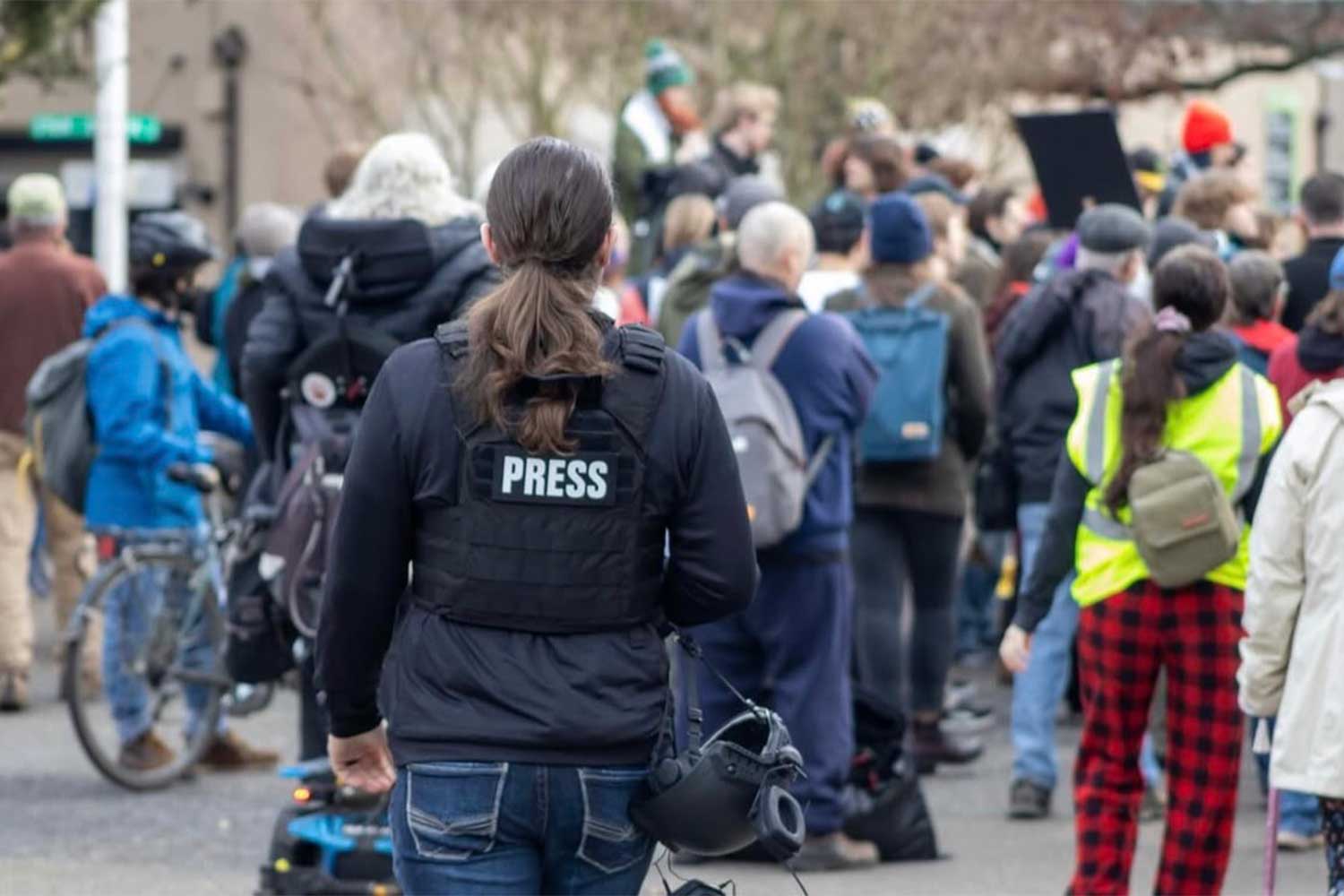
Steeves was initially disappointed with the instructions to stay in the back, but realized she had never done this before and wouldn’t know how her body or mind would react in the event of escalation. This was a learning experience.
“That’s the whole point of being a student,” Steeves says. “To hear the people’s voice and hear the emotions behind that voice.”
Robin Bailey attended protests on Jan. 28. As the editor of The Knightly Ruby, an independent student-run publication focused on abolitionist, anti-fascist journalism, Bailey received photos from community and student journalists from the protests. “I’m left to grapple then with this question of like, OK, does using this footage, using these photos, trying to establish relationships now with these new people who I want hopefully to contribute to this publication, am I now in charge of their safety?”
The people contributing to The Knightly Ruby, according to Bailey, are not all journalism students and are more openly political, contributing to the risk of being targeted by federal officers. He said he’d like to see students involved in the conversations happening at the administrative level.
Journalists are supposed to comply with police orders of dispersal. The force used by law enforcement, according to Gabe Rottman, vice president of the Reporters Committee for Freedom of the Press, ought to fit the situation they are acting in. Journalists are not exempt from dispersal orders in order to document.
“Journalists’ rights are often employed retroactively,” Rottman says.
Kevin Foster, a Portland-based freelance journalist with bylines in the Portland Mercury, Mother Jones and Eugene Weekly, got started covering pro-Palestine protests in 2023. This past June was the first time he was teargassed and shot at with rubber bullets while actively covering ICE protests in Los Angeles and Portland.
After that experience, he started wearing a bike helmet for protection.
“There is a level of kind of just developing that situational awareness,” Foster says.
While documenting at the ICE facility in Portland, Foster saw counterprotesters yelling slurs and trying to agitate protesters. At the time, he wished the protesters would not engage with the counterprotesters or give them any attention.
“I have the luxury of not paying attention to that,” Foster says. “I’m not trans or Indigenous or a Black person or a brown person. And it’s like, if they’re out there for hours having slurs yelled at them. What am I to say to that?”
The University of Oregon’s School of Journalism and Communication debated on how best to equip its students.
On Jan. 30, the SOJC released an email to students with a list of guidelines for covering protests compiled by faculty. On April 2, the SOJC department released a communications article by award-winning student journalist Julia Boboc.
Photos of Sundaram were featured in the article and Instagram post. Despite asking Sundaram for permission to use the photos, he was not asked to comment.
Dan Morrison, professor of practice at the SOJC, has been a photojournalist since 1982. He previously covered conflict in Israel and Afghanistan and protests domestically.
When he first started out, Morrison did not have any mentors to tell him what or what not to go cover. In the past, Morrison has taken student journalists to protests when they have asked for his guidance. The recent advice from the SOJC comes from its concerns of liability. When students ask him to help them learn, he says he is partially responsible for their safety.
“Yes, it’s exciting, but it could also get you killed,” Morrison says. He and fellow professor of practice Lori Shontz developed a list of guidelines for students covering the Black Unity protests in Eugene and Springfield six years ago.
The SOJC story quoted Anthony, the Emerald editor. Boboc says she wished she had included more student voices, but faced time and length constraints. The experience of writing the story gave Boboc new insights into students covering protests that might turn violent.
“We’re so new in this career, but we’re also so committed to it,” Boboc says. “It’s kind of a hard balance to strike, admitting that you’re inexperienced or admitting that you are not prepared for something, while also feeling responsibility to do it nonetheless.”
Boboc focuses her reporting on people detained by ICE, rather than covering protests. She goes to the scene while demonstrations are relatively quiet, finds people to interview, and will leave if things get crazy.
“I do it in a very different way that gives me a very different result,” Boboc says.
Even with the complete compliance of journalists, adherence to the guidelines established by the collaboration between police and journalists, and the protection from the First Amendment, working as a journalist is a contested and vulnerable position.
As Sundaram enters the professional journalism space, he’s entering a different one than most of the SOJC faculty worked in and is trying to figure it out.
“I definitely kind of fucked around when I found out,” Sundaram says. “So this time was a little bit less fuck around to find out and more just, find out.”