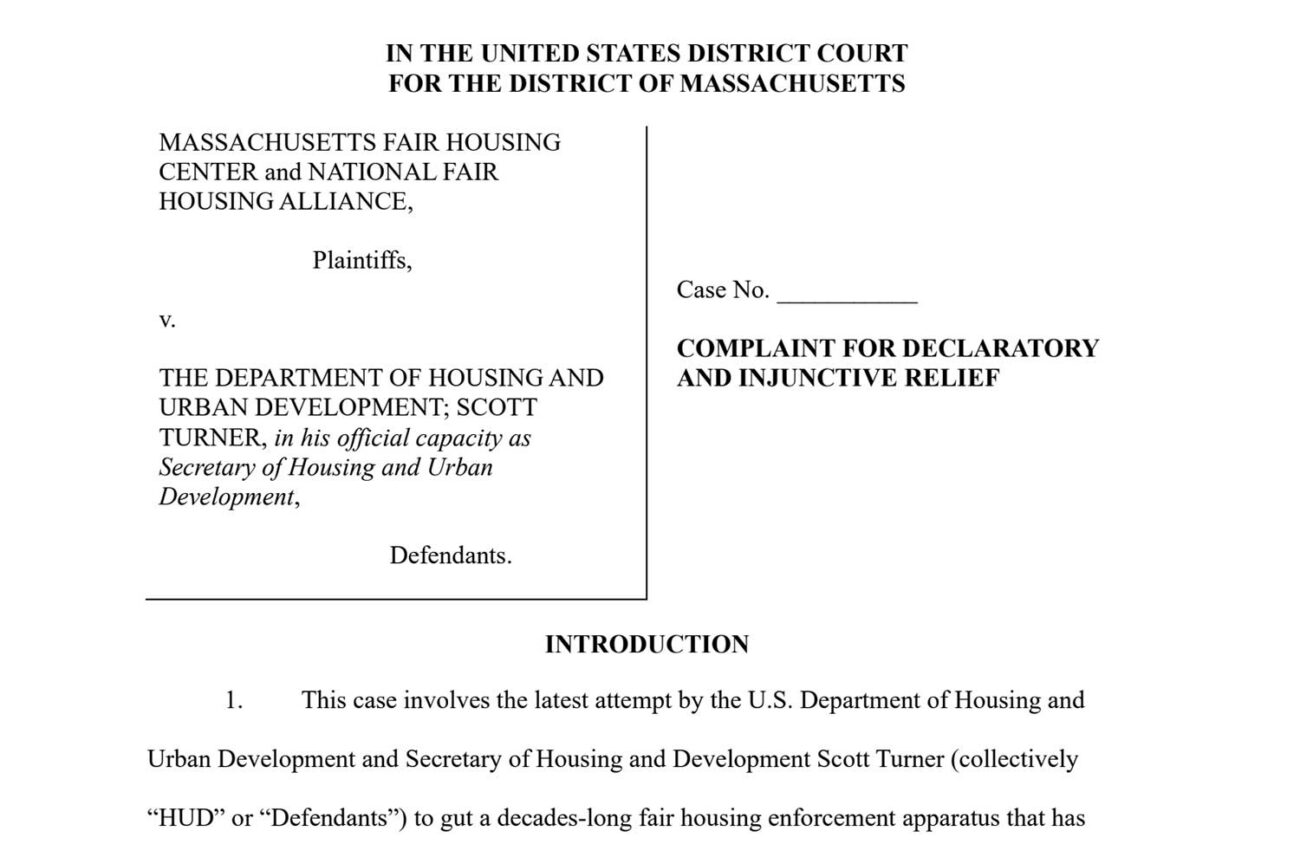
A lawsuit filed in Massachusetts is going to determine the future of fair housing grant funding nationwide, a program created by the Fair Housing Act of 1968 to protect tenants and potential homeowners from housing discrimination.
Housing discrimination continues throughout the U.S., with the number of filed complaints rising steadily. Of the 32,321 housing discrimination complaints filed in 2024, 54.6 percent involved disability and complaints based on national origin rose by 8.45 percent.
Although the discrimination rates are rising, the federal government carried out mass layoffs in the U.S. Department of Housing and Urban Development’s Office of Fair Housing and Equal Opportunity. The FHEO now has a third of its staff due to ongoing cuts.
“Congress directed HUD and allocated funding to organizations like ours, but then HUD is making it pretty much impossible for organizations like ours to apply,” says John Miller, executive director of the Fair Housing Council of Oregon.
FHCO currently has a service contract with the city of Eugene, which means it can do educational training on housing discrimination, they do further testing and some enforcement activities. They have similar contacts in 11 other jurisdictions around the state.
“It’s left a huge vacuum, so we’re not able to serve people,” Miller says. “We don’t have any funds to work with people in Springfield, so if somebody feels like they’ve had their rights violated, they can talk to us but we often don’t have the resources to respond.”
Miller says the most common complaints they have received in Oregon are related to disability discrimination, discrimination based on nationality or citizenship status and Section 8 voucher discrimination. In Oregon, a landlord can’t deny a tenant tenancy based on where their money is coming to pay rent, and Section 8 is meant to protect that right.
Eugene Weekly reached out to the city of Eugene for a comment and was redirected to information on housing ownership rates by Amy Cameron, the rental housing analyst. Cameron writes that the FHCO responded to 85 hotline service requests and hosted four educational outreach activities in 2025.
Cameron shared the HousingStats infographic which shows the ongoing racial disparity in homeownership in Eugene. Cameron also provided Eugene’s Equity Atlas: Selected Stories in Eugene’s History of Displacement which uses historical research and community testimony to show the local impacts of exclusionary state and federal legislation, exclusionary zoning and displacement that have impacted Eugene’s marginalized communities.
The lawsuit challenges HUD’s decision to issue federal grant money, which plaintiffs say radically and unlawfully restructured the FHIP. According to HUD’s July memo, there were no funding opportunities for private enforcement initiatives or education and outreach initiatives and HUD created new eligibility rules that effectively excluded nearly all existing fair housing organizations.
“HUD’s objective is straightforward: enforce the law as written, protect the civil rights of Americans, and responsibly steward taxpayer resources without imposing additional burden or cost on homeowners and renters,” a HUD spokesperson writes to Eugene Weekly, without providing a name. “HUD has issued a comprehensive funding opportunity package to provide overdue reforms and reassert our commitment to protecting the seven characteristics defined in the Fair Housing Act. Secretary Turner has been clear that HUD will root out unlawful discrimination, and the Office of Fair Housing and Equal Opportunity will ensure that federally funded civil rights organizations protect the rights of all Americans.”
HUD also issued new award conditions for all fair housing organizations to comply with executive orders on DEI, immigration and gender identity — which plaintiffs argue conflicts with the Fair Housing Act’s own antidiscrimination mandates.
“Every year we get about 1,500 fair housing complaints that we personally investigate and follow up with if it is a fair housing violation,” Miller says. FHCO then files the response with Oregon’s Bureau of Labor and Industries, which takes further legal actions to remedy the situation. “HUD used to enforce fair housing law as well, but that has really stopped its fair housing work. We don’t send them anything anymore because they never respond.”
FHEO offices nationwide are nonprofits, and they work on investigating discrimination claims and help file legal complaints to find a solution to an ongoing discrimination case. Since 1992statewide agencies were eligible to receive three grants.
The private enforcement initiative (PEI) is the program’s core, and is responsible for funding investigations and enforcement, receiving around 62 percent of funding. The education and outreach initiative (EOI) is the public education fund, around 24 percent of the funding. Fair housing organization initiative grants, which focus on capacity-building and opening new organizations nationwide, cover around 11 percent of funding.
This wasn’t the first attack on HUD funding for the Fair Housing Initiatives Program.
“About a year ago, right after the Trump administration got into place, HUD canceled about 78 fair housing grants around the country. There was a temporary restraining order put in place to have those orders reinstated,” Miller says. “The reason why they cancelled them a year ago is because they didn’t align with the administration’s values.”
Miller argues that limiting funds based on DEI or gender identity would go against congressional intent. “That’s why they give organizations such as us the money to uphold the law not based on what the administration thinks.”
For nearly 40 years, federal funds were used to handle 74 percent of the nation’s fair housing complaints, compared to around 21 percent by state agencies, 5 percent by HUD and 0.14 percent by the Department of Justice.
“We’re in pretty big financial distress — we’ve been sort of limping along waiting for this HUD money to come back and become available again,” Miller says. “And now that’s off the table. So we have had to lay people off, and we just started doing a second round of layoffs now and cutting back hours for all staff.”
FHCO currently has 14 staff members looking at housing complaints around Oregon. Miller says they might have to continue doing more layoffs in six months. Miller says that previously when HUD played a more active role in funding, nearly 70 to 80 percent of its funding came from federal sources.
“We’re not holding our breath for any federal funding coming back our way and anytime in the near future,” Miller says. “We are going to start talking with the state legislature to see if they can step up and help maintain a robust fair housing function within the state.”
Plaintiffs are asking the court to declare that the new funding criteria are unlawful, and order the HUD to spend FHEO funds lawfully.
“If fair housing laws are no longer being enforced, then all the other housing issues will continue to get worse,” Miller says.