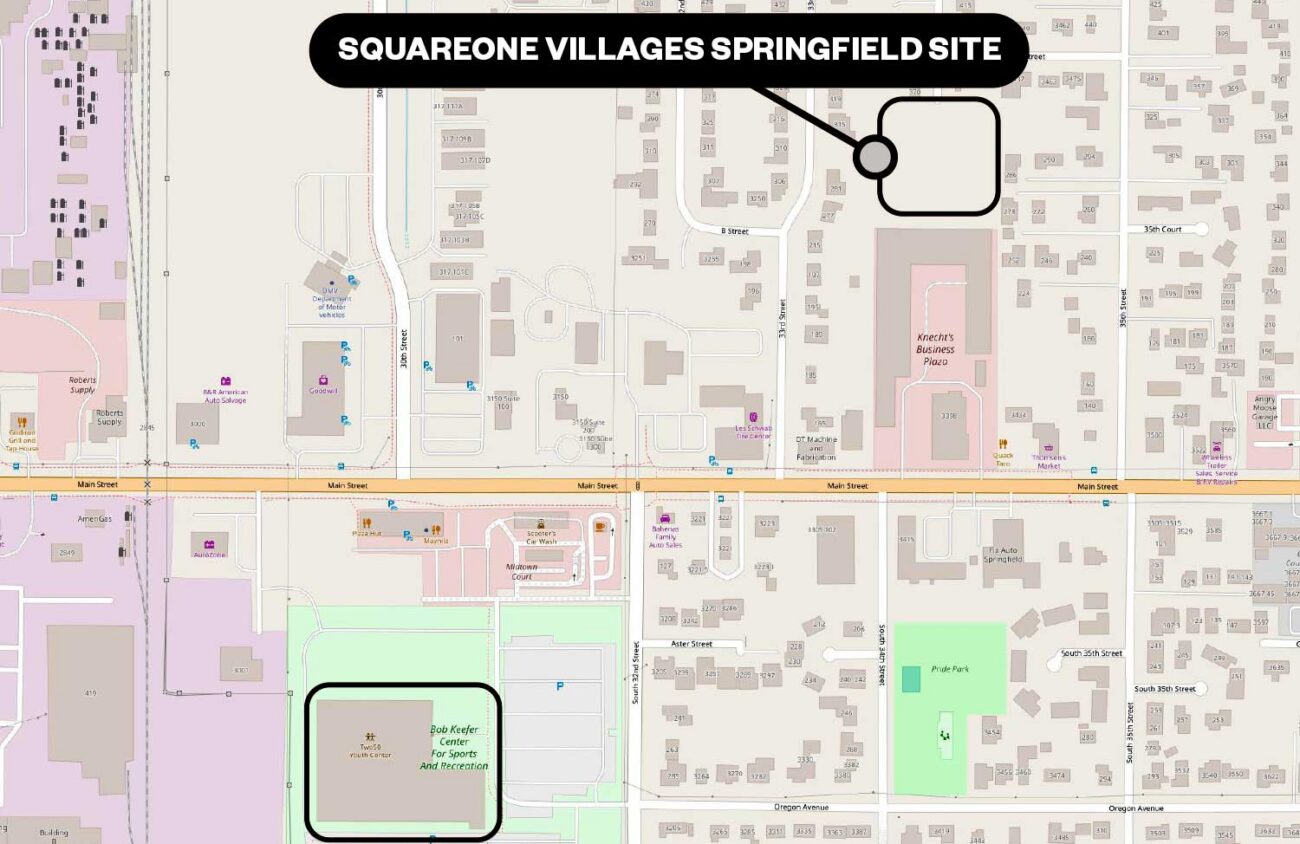
Nonprofit housing developer SquareOne Villages has picked a vacant two-acre parcel off Main Street in Springfield as the site for its latest affordable-housing cooperative.
SquareOne hopes to begin construction of the roughly 50-unit complex in 2028, after it completes two co-op developments underway in Eugene, says Executive Director Andrew Heben. SquareOne has begun preliminary planning for the Springfield complex, on land the nonprofit has bought near Main and 33rd Street.
It will be Eugene-based SquareOne’s second co-op in Springfield. The first, the six-unit C Street Co-op, is at 11th and C streets, near downtown.
Since its modest beginnings more than a decade ago, SquareOne has developed a sophisticated financial and planning pipeline to build clusters of compact housing units reserved for lower-income residents using a co-op ownership model. Courtesy of big construction subsidies from taxpayers, residents at SquareOne’s co-ops typically pay monthly fees that are about half what a similar unit would fetch in rent on the open market.
The co-ops are popular in a county squeezed by soaring market rents. A typical one-bedroom apartment in Eugene rents for about $1,400 a month, rental websites and studies show. At SquareOne’s soon-to-open Rosa Village Co-op in Eugene, a one-bedroom will have a monthly fee of about $700, Heben says.
The co-ops offer “the stability of having a place to call home and not worrying about an arbitrary rent hike” from a landlord, says Heben. “That gives peace of mind.” Each co-op’s elected board sets the monthly fees to cover all costs.
SquareOne has five co-ops in operation, plus Rosa Village nearing completion, and two — including the Springfield project — in planning.
Assembling the money
A big hurdle for SquareOne is cobbling together money — government grants, low-cost loans and donations — to buy land and fund planning and construction.
The Springfield project, near Willamalane’s Bob Keefer Center, is a case in point.
The vacant land was once part of the Knecht’s Auto Parts chain. It sits next to a commercial building still owned by the Knecht family. Hammered by tough competition, the Knechts shuttered the chain in 2023 and began selling off real estate.
A development group in 2024 bought the two-acre field at 33rd and Main from the family, then in 2025 sold it to SquareOne for $525,000. To fund the purchase, SquareOne used a $504,000 forgivable, no-interest loan from the city of Springfield. The loan is forgiven provided SquareOne ensures units are reserved for and affordable to low-income residents. For the loan, the city used leftover money from the federal government’s COVID-era economic stimulus program.
Now, SquareOne is applying to the state for a forgivable no-interest loan for much of the new Springfield project’s construction, Heben says. That money would come from the Local Innovation and Fast Track program, created by the Legislature in 2015 to fund housing for lower-income residents. Competition from applicants is strong. SquareOne will also need a bank loan and a state-awarded tax credit that reduces the interest rate of the bank loan, Heben says.
Self-sustaining
SquareOne also must ensure an income stream from members of each co-op to cover the project’s monthly interest and principal payments on loans, plus repairs, utilities and the like.
“We do get a subsidy on the capital side in order to minimize that monthly debt payment,” Heben says. “The idea is, it is set up to be self-sustaining.”
When members join a SquareOne co-op, they don’t buy their unit. Rather, they buy into the co-op and get the right to live in their unit. The one-time buy-in is typically $5,000 to $10,000, and the member can borrow up to 80 percent of that from SquareOne, Heben says. When a member leaves, they get back their one-time buy-in payment, plus three percent annual interest.
Monthly member co-op fees vary by project and unit. At Rosa Village, the monthly fee for a two-bedroom unit will be about $850, Heben says.
Income caps
Plans for the Springfield co-op show 24 studio units, 14 one-bedrooms, 11 two-bedrooms and one four-bedroom, plus a building with laundry facilities, a common kitchen and a small office for a SquareOne employee. Costs are still being calculated, Heben says.
The land is zoned low-density residential and is abutted on three sides by single-family homes. The project is allowed under a new state law permitting higher densities — so-called “middle housing” — in low-density housing zones, SquareOne says.
To comply with the forgivable government loans, SquareOne sets tight income limits for members, although these vary by co-op. Typically, the income limit for a one-person household is about $35,000 to $40,000, and about $40,000 to $47,000 for a two-person household.
Want to live in a SquareOne co-op? Don’t get your hopes up. Most have no vacancies and open for applications only when a member leaves. Peace Village Co-op on River Road has a wait list of about 100 people that dates to 2025, when it opened applications for a couple of weeks, Heben says.
Bricks $ Mortar is a column anchored by Christian Wihtol, who worked as an editor and writer at The Register-Guard in Eugene 1990-2018, much of the time focused on real estate, economic development and business. Reach him at Christian@EugeneWeekly.com.