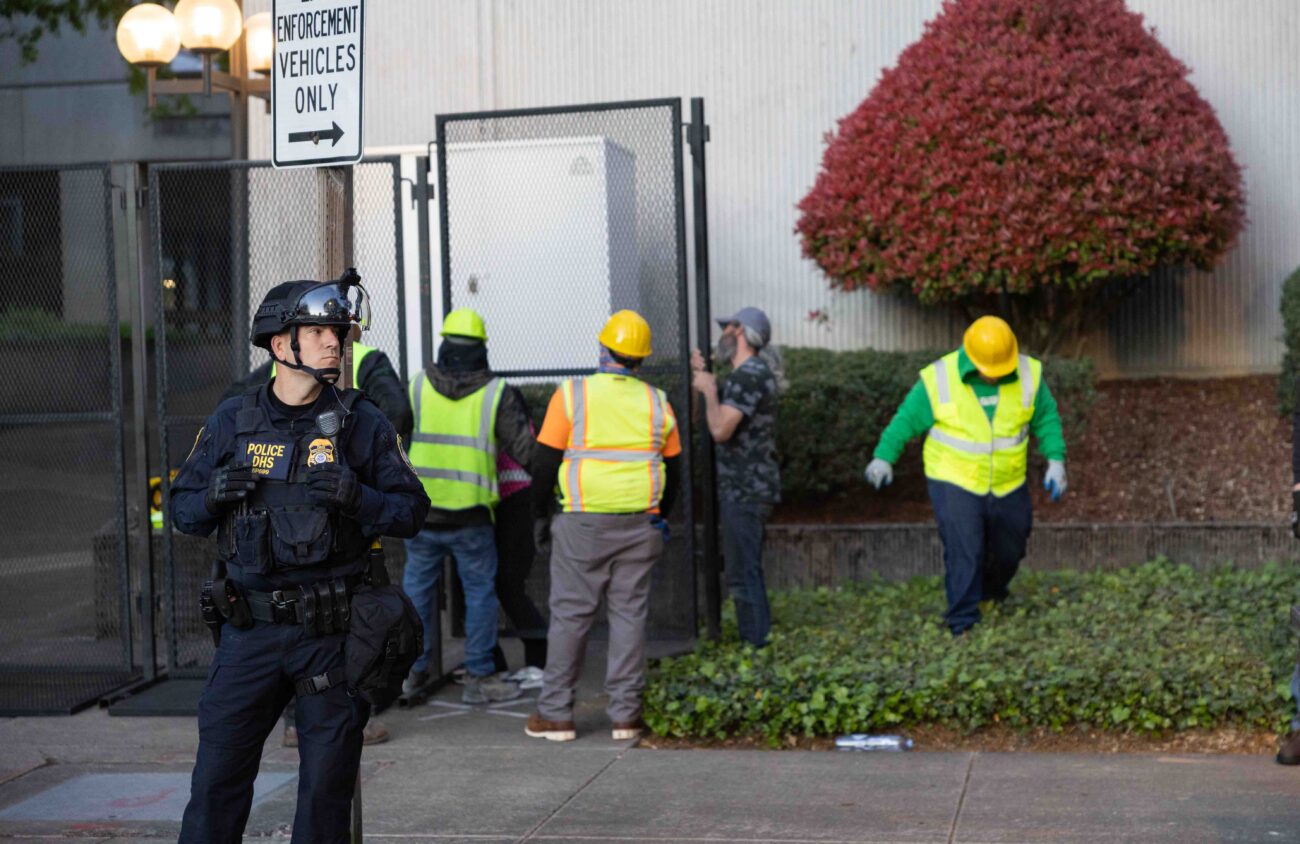
U.S. District Court Judge Mustafa Kasubhai granted an extension to the federal General Services Administration, allowing an extra seven days to remove a controversial security fence surrounding the downtown Eugene Federal Building.
Work to remove the fence surrounding the previously open plaza must begin July 1 and be completed by July 2 at 7 am, the ruling says. This means the Federal Building plaza should be open for July 4.
The order is part of a lawsuit filed by several local activists, represented by the Civil Liberties Defense Center, which alleges that the fence restricts their First Amendment right to protest. On June 22, Kasubhai granted a preliminary injunction, ordering the complete removal of the fence within 48 hours after the GSA, the federal agency responsible for the management of federal buildings, could not come up with a timeline for when it could move the fence. Kasubhai authorized the fence to be moved back to the perimeter of the building’s entrances and windows — opening up the plaza for protest activity.
Protests at the downtown Eugene Federal Building have been ongoing since early 2025 against unjust Immigration and Customs Enforcement activity and the policies of President Donald Trump. The majority at the Federal Building have been peaceful. A Jan. 30 protest was declared a riot by the Eugene Police Department after windows were broken.
Lauren Regan, director of litigation and advocacy for the CLDC, writes in a text message to Eugene Weekly that Kasubhai made sure the plaza would be open for Fourth of July protest activities.
She adds that the court will reconvene July 2 at 9 am to determine if the GSA is in contempt of court for not complying with the order within the given timeframe. On June 23, the GSA submitted an appeal to the Ninth Circuit Court regarding the preliminary injunction.
Regan says Kasubhai ruled that there is no reasonable chance of success for the appeal and denied the GSA’s request for a stay on the order. “He ruled the government burden is minimal compared to the public’s First Amendment rights,” Regan says.