By Nate King
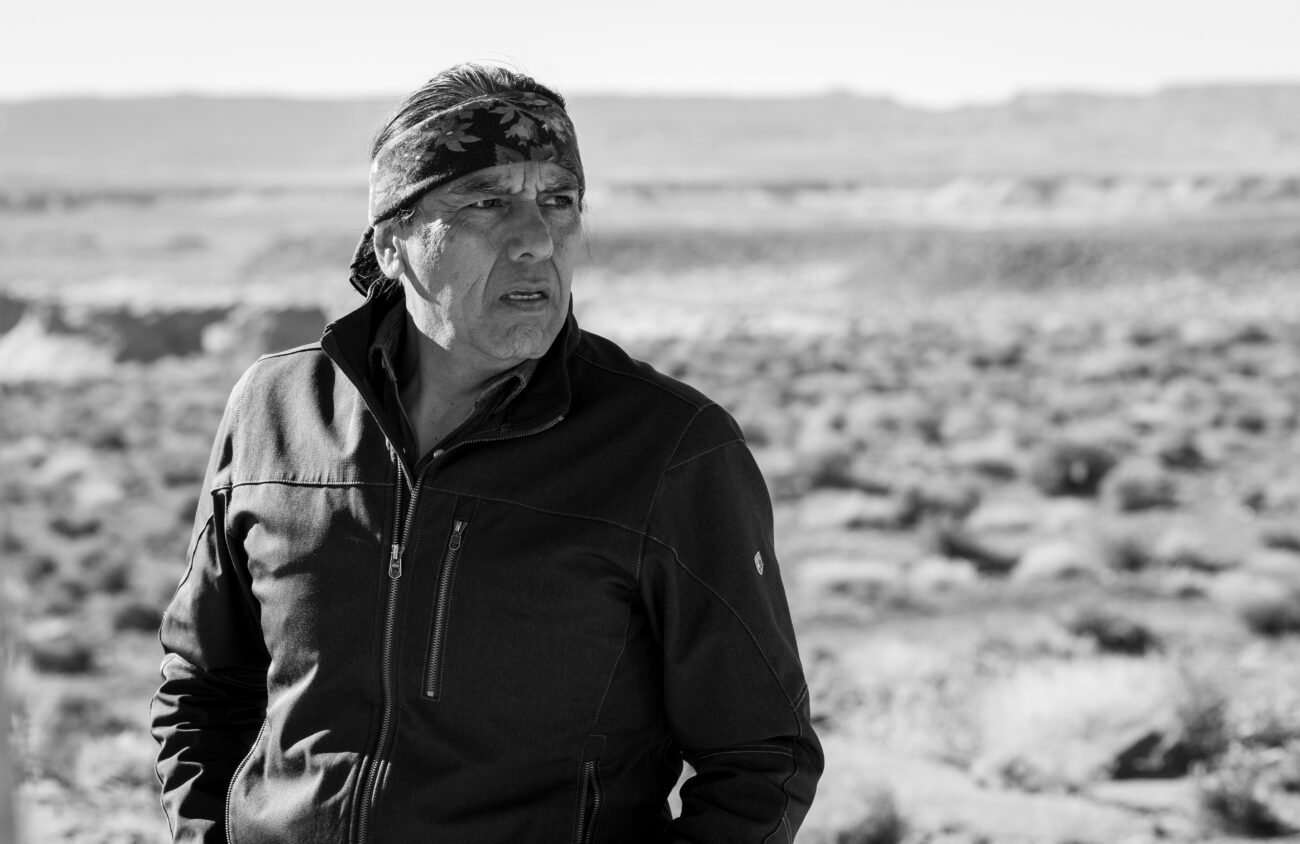
This weekend the Art House will see a run of the new buddy film Road to Everywhere, written and directed by Michael Shoob and starring Robert Mirabal and Whip Hubley. Everywhere is a sequel to Schoob’s 1996 indie film Driven. It plays Friday, July 10 through Wednesday, July 15.
Mirabal plays Jake, a casino operator who has been estranged from his Native Navajo land for 30 years. On the cusp of old age, he impulsively takes a long cab ride home to see his grandson compete in a rodeo. Along the way, Jake and Hubley’s character, Skye, push one another to embrace a sense of maturation each has been arrested in for decades.
Mirabal is a highly respected voice in the Native community, and his philosophy informed his approach for this role. In a 2024 interview with ¡Globalquerque! Mirabal explains that his ethos centers on the importance of sacred, ceremonial language as a living thing, fostered by community and creating an appetite for spirit.
Mirabal is a two-time Grammy winner whose handmade flutes have been displayed in the Smithsonian. In 2018 he had a recurring role on the hit series Yellowstone.
The following interview has been edited and condensed for clarity.
Your discography is more robust than your film credits. What made you take this role?
I always tease my agent, what’s this audition? It’s going to be another Native cop or what? With this one, I really liked the writing. This character could have easily been some dude from Jamaica or Queens. It just so happens that he’s a Navajo.
Jake represents an archetype that exists in most ancient myth, the trickster. Was this figure considered for your role?
It was the character that I created because there were so much contradictions. The only way to really approach the character is not to address them. We have [these figures] in my society. We’ll talk to each other like we’re angry, then all of a sudden, it’s like, “Ah, he’s just [being absurd].” It’s always that element: what is he going to do? Sometimes that’s the only way to really approach the dark things in life. That’s what ayahuasca does, the demons come up. It’s a trickster approaching you in a dark way. If you smile at it and present goldenness, it reacts to that element. You have to look at life in different forms, rather than just sorrow.
Groucho Marx said “The only real laughter comes from despair.”
Charlie Chaplin did the same thing. But if we approach the trickster, it can change the whole aspect. Rather than becoming the diplomat, you can become the trickster — then you realize that the diplomat is the trickster.
The casual viewer might not realize the socio-economic realities and deep emotional hardship experienced on Native lands. Jake leaves his Navajo community and doesn’t return for 30 years. Why does he leave?
The reason he left is because his grandma died, the matriarch. And he’s like, where do I belong here?
I have to find the things that I’m familiar with and why I left [my own community], the Pueblo, for a while. The aging population — that was so powerful for belonging — were dying away. I couldn’t stay there; washing the dead, burying the dead, burying my grandma, my grandpa — and creating the birth of what? Another drunk fucking construction worker playing softball. What the fuck am I going to find here? I had to have the strength to leave, to walk away from that cattle garden and kept walking until I got to New York City. I was too young and ambitious.
One of the most potent scenes in the film is when Jake returns to his grandmother’s home, but it’s been torn down. He initially holds onto the past and resists an invitation to go into the new structure. At the end of the movie, he walks through the door and accepts the present. What does this say about the adaptability of Native culture today?
Within regards to that scene, he has reached the goal of actually attaining what he set out to do, and that was to see his grandson. There’s that moment, he has attained a goal on the reservation, which he couldn’t do in his past. All he wanted to do was to reach that particular goal with his grandson.
What cannot be torn down? When does it veer into desecration and therefore going into the “new structure” would not be tolerable?
There are some things that the Earth needs to take, not human beings. It’s the sensitivity of Native people on existing reservations — that are sober and are trying to battle the demons. There are some fights that you cannot fight. You gotta let them evolve, and sometimes the Earth takes the whole value system.
I’ve seen families totally disappear because alcoholism, drug abuse, diabetes, hypertension — whole families literally extinct. There’s a lot of little backstories that I created where he’s trying to look for things that [were unique], and now it’s all gone. Where do I put in my heart that actually was not just some fable, that it actually existed.
Native Americans in film have gone through an intense evolution. First they were savages justifying genocide, then caricatures for laughs. By the ’70s, Hollywood pushed for authenticity, but that included larpers like Iron Eyes Cody or Sacheen Little Feather. The ’90s then saw an outpouring of tribal expression, but most films turned these people into “noble savages” or “magical Natives.” Popular films like The Last of the Mohicans or Dances with Wolves inserted a white person as a savior. Can we look at any of this as progress? Or in retrospect should it be seen as offensive and be disregarded?
We have been pushed that anything — even if it’s good — it’s like beating down a dog. That dog still has that energetic belief that he is going to get hurt. As a performer I feel that there is still a huge mistrust. If there were a thousand more Native movies, it wouldn’t make a difference. Are we getting closer to it? I’m not quite sure.
Have we gotten to a point where we don’t want to exploit these people, but we don’t want to offend them; therefore, they just don’t exist in the mainstream?
I think that with Native media because of what they call the YouTube warriors or something. [So-called “activists”] get on a bandwagon of becoming overly righteous about what the world has done to these people, but they’re couch warriors.
Sometimes that’s called “performative activism.”
That doesn’t help any of us. That doesn’t help the system. It just makes everybody angry. You feel justified because of what you said. In a lot of different communities, not just Native, media has been a form of exploitation.
How can our country foster Native expression in the mainstream but have it with dignity?
Educate yourself. Read as much as you can. Once you start to write and have the opportunity to create financial opportunity, make sure that what you’ve written is based on integrity.
It has to start from the creator’s side?
Yes. There was a movie that came out in the ’80s called Powwow Highway. It was a powerful expression that had a strong foundation of integrity. The way the characters were built and the way the actors were portrayed, everything was built right into the narrative.
That was produced by George Harrison’s film company, which also commissioned a Ravi Shankar documentary in the ’70s. It really speaks to the culture today where a person like Taylor Swift has immense wealth, but chooses to spend a billion dollars on a wedding rather than doing something for the world.
That’s what I mean. One of the best paths for the next evolution is docudramas. My wife and I saw this movie based in Bolivia. It’s just three characters and the simplest story is based on them living in a drought-ridden climate. It really affected me as an indigenous person because I can relate to it — that’s what I want to see — but it may not have the same effect in Hollywood. We can do a shit ton more in this country. Everybody’s selling 250 years of this country, and it’s just another way of telling these Native people: “You know what, it used to be your country. Fuck you. Let’s celebrate 250 years of fucking genocide.” A thousand more Native stories, but it wouldn’t make a dent.
The film’s tagline is “a coming-of-age story for grownups.” Jake and Skye are both so broken and stuck in the past. They push each other to embrace rites of maturity that they avoided as younger men. Is running from responsibility or hard times a defining trait in your generation of men?
Growing up on the Pueblo, there was the aspect of the warrior in the generations before us. There was World War I, World War II, then Korean conflict, and my dad’s generation of Vietnam. There’s this huge element of success based around a war. We were teenagers in the ’80s, and it’s like, where the fuck do we belong? What the hell? All we would hear is the warrior way, and then all of a sudden, it’s like, what’s going on with us?
Alcoholism came really quick in my generation. Once it got really developed, it wasn’t hidden anymore: singing, dancing and drumming while they were drunk. We began to see more and more as a kid, then it was established within our generation as a normal thing.
There was a whole generation of us that were wanting to keep with the culture, then the generation before us were saying, “Don’t worry about that culture. It’s going to be there.” In that running away, 20 years went by. You come back home, and there’s nobody left. It sneaks up on you.
Do broken men beget broken men? And if so, how do we change the cycle?
Where I grew up, it’s an inevitable cycle. We are a part of society, and a long time ago they would take care of the brothers, they would take care of the children, the mothers and sisters. The new generation is wanting [a return], back to the old and being supported. It’s forcing the older generation to really show up.
A lot of mainstream perspective on initiation comes from the community fostered by the late poet, Robert Bly. In ancient societies, men are subjected to a series of rituals that bring them into manhood. As Joseph Campbell outlayed to Bill Moyers in The Power of Myth, some of the most consistent elements are: a separation from the mother, a “death” experience, and a revealing of a new language that is masculine/ceremonial. Why is keeping the ceremonial language fixed and secret so crucial to the culture?
It’s based around all the things that Bly talked about; there has to be this elemental or magical transformation. As a little boy, you would hear your grandpa talking in that mystical language, and then you emulate yourself going into manhood with pride and with justifiable strength. It puts you into a certain place of preparation. You can actually feel how the language differentiates to the practice of everything, from food to how you express yourself with your brothers.
It’s become common for modern men’s groups — who are often primarily white — to offer retreats in the wilderness, where programming is influenced by Native rituals. There’s a cruel irony in the fact that white people shirked their own ancient rituals, performed a genocide on people who still honored that part of their humanity, and now the colonizer’s descendants — who long for maturity — are appropriating the rituals that their ancestors tried to violently erase.
It’s funny, huh? It’s funny and sad, but at the same time, I’ve seen it all. I’ve seen guys do the talking circle and then do the sage, playing on cojones and didgeridoos, making up their own shit with tribal drums and beats. You can see that it’s desperation. But just act to become more than what you are. It just shows how dire it is and how much it is needed.
Does ritual appropriation impede the survival and evolution of Native culture?
Unless you’re losing your own culture, that’s when it begins to feel like it’s harming it. They told us that this language, this culture, this way of life is yours. This was bequeathed to you, and it’s your responsibility. And if it’s going to fall, don’t blame the white man. Blame yourself.
Without appropriating from tribal communities, what basic elements do you feel is necessary to create that liminal space and gain that sense of maturity?
Maturity comes in different phases for different people. In the non-Native world, the linear world, we haven’t even come to the point: What is our foundation? But imagine if there was like 10 other guys that are basically going through the same things. You begin to feel a sense of comfort [and identification]. I’m going through it now. We need to sing songs. We need to dance. We need to come together to re-instill our initiation rites and our rituals.
A part of it has to be in brotherhood but some might be individual journeys?
I think that’s what Bly was trying to create. He started to use poetry as a way of instilling a sense of magic and mysticism. Michael Meade really got affected by that. But then where did you find the foundation of the ritual, of the particular man? I think that’s why it became obscure and turned into a boy scout weekend for old dudes. So that’s where I think both of them had to give in to the moment of pain and say: “We know where we belong together. We know what our trial is, and we know what our initiation process is. I may never see you again. Boom. Let’s go home.” But then where we lose it is that there is no community to come to — to re-instill the rituals of the brotherhood.
Ancient people who created these rituals were tapping into a universal level of their subconscious; they weren’t as distracted and paid attention to their inner-wisdom. We embrace distraction, repressing and running from old pain.
You guys don’t have a community. I can go back home and feel safe within my community, community of brotherhood, even if it’s through sorrow. Even if it’s through being in fear because you’ve lost a certain element of the ritual. We have the whole aspect of coming together, but then where does it belong in the whole scheme of things? We’ve become islands unto ourselves and feel like, “Oh, we don’t do those songs anymore. I don’t do those things. I’m a lawyer now.” And I think we have seen the evolution of manhood to a certain point. And now where do we go? What’s the next step?
The Road to Everywhere is Friday, July 10, to Wednesday, July 15, at Eugene Art House. Tickets and more info at EugeneArthouse.com/movie/road-to-everywhere.