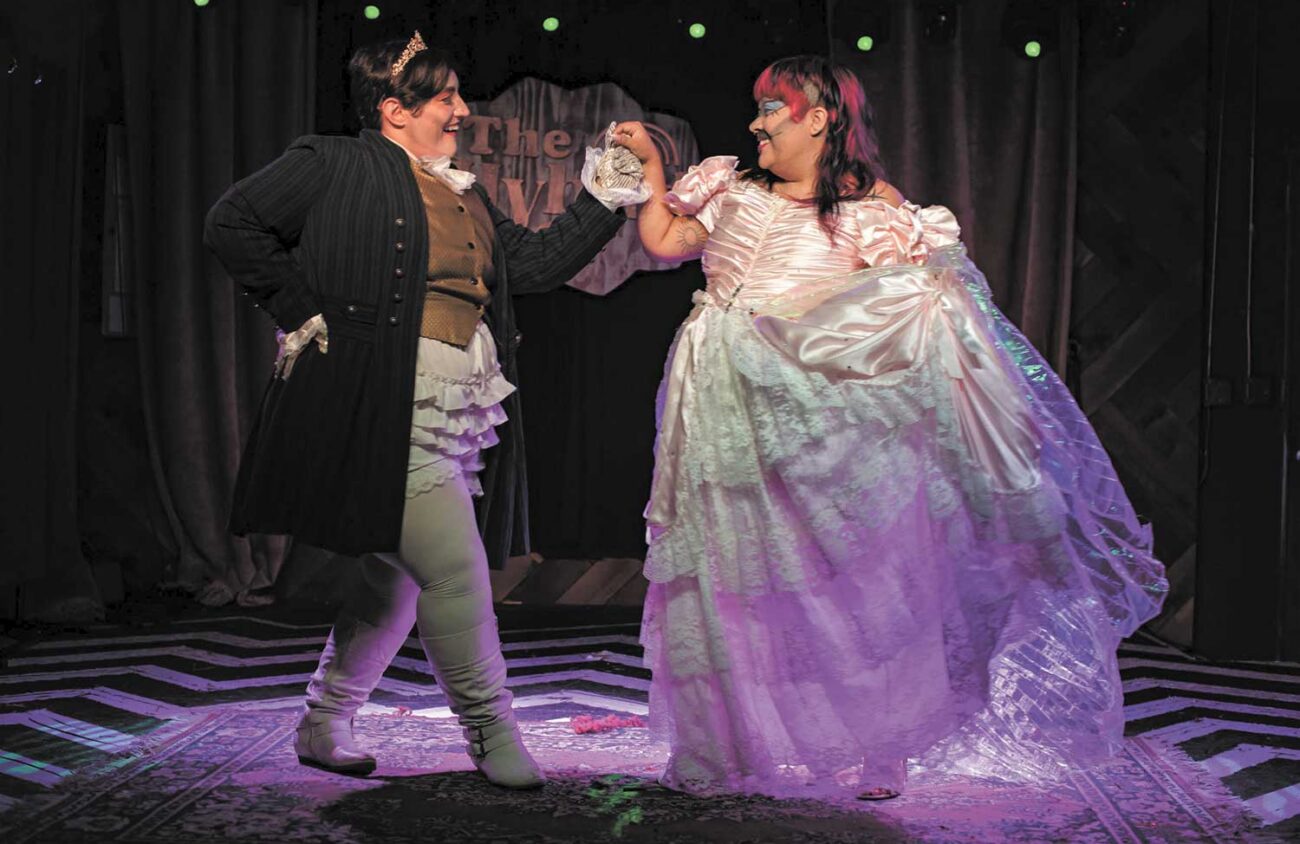
Last Halloween, Eugene-based draglesque performer Lez. B Honest took to the stage for the very first time. She was waiting in Corvallis’ historic Whiteside Theatre, where the lights were down, the audience was quiet with anticipation and she was ready to throw up from stage fright. “I was so nervous,” they say. Even now, after almost a year of doing all this, “I want to run away before I perform.”
Honest walked out from the curtains, donning a long silk gown and a leopard-print jacket as “Touch-a Touch-a Touch Me” from Rocky Horror Picture Show (1979) powered through the auditorium. As she lip-synced to this song about a virginal woman embracing her sexuality, Honest did the same with her audience: teasing them, flirting with them and gradually removing pieces of her clothing throughout the performance — until the song ended and they were left with almost nothing on. As a queer person from a Hispanic family, “I felt so empowered in that moment,” they say.
In her background, “it’s not seen as a good idea, or very appropriate as a woman to show my body off,” they say. But that performance “was the moment where I wanted to continue doing draglesque — really being more comfortable with my body, and also empowering myself to accept the way that I look.”
Draglesque is performance art that intertwines drag and burlesque. Drag features large, artistic and exaggerated gender expression, with performances involving dancing and lip-syncing, while burlesque is a showcase of striptease and theater. Both burlesque and draglesque are noted for their glamour, comedy and performers removing their clothes onstage. From the perspective of Eugene’s performers, the act is beautiful, complicated and empowering.
According to burlesque historian Laurie Kurutz, burlesque today is “very grounded in queer liberation, feminism, take back the night.” This is opposed to American burlesque in the 1880s when it was strictly middle-class family entertainment — before nudity eventually appeared in shows, catering to the male gaze.
Since the 1990s, burlesque performances, she says, reject the establishment, while “teasing and disrobing in ways that surprise and delight the audience. When you go to a burlesque show, everybody knows that clothes are going to be taken off. So it is how they are taken off that is of interest.”
Belle Aire is a queer plus-size burlesque performer who organizes bi-monthly draglesque shows and performs at John Henry’s Shibari and Fire night — where they get, in their words, “pretty naked.” Shibari is the Japanese art of rope bondage. They say that onstage nudity has helped them connect with themself and their body image more than anything else ever has. “Specifically with shibari, if I’m tying myself, it’s a very connected experience, and the fewer clothes I have on, the more connected I feel.”
Luke N. Good is a plus-size drag king who started going to burlesque shows because there were more open calls than there were for drag shows. It ended up being a journey of self-discovery. “I was able to access my femininity in a way that I felt I had control over,” he says. “I really like starting out in a very masculine-presenting attire, and then transitioning into feminine lingerie, and that way, I’m controlling how I’m perceived in my gender.”
Bebe Boudoir used to be a stripper, and says that performing burlesque satisfies both her desires to command the room with her body, while also creating elaborate sets, costumes and musical numbers. Onstage, Boudoir says she feels powerful “just touching my leg, elongating myself in the silhouettes that I can create and how far I can push my body.” As a burlesque performer, she doesn’t hold back on how important sexuality is to the show. “I want to represent something in the night for you — inviting you into a fantasy. I’m pulling you out of your reality.”
Kurutz notes that a major difference between going to a strip club versus a burlesque show is that “the audience interaction in burlesque is not expected nor mandatory.” But Aire, Honest, Good and draglesque performer Allah Verga have all struggled with people from all demographics inappropriately harassing, touching and catcalling them onstage. “We’ve talked about consent every single show. We say it’s mandatory,” Honest says. “We have people say it with us, and so it gets to a certain point,” where, she wonders, “Why aren’t you understanding that consent goes both ways? I don’t want to be touched.” Even still, Honest says that “when boundaries are set, we’re seen as wrong or rude or pushy.”
Verga says that as someone who is quite short, “I can have pasties and a G-string and walk around, and I can feel 1,000 feet tall.” But the moment lines are crossed, “that shrinks me down,” she says. “I feel so vulnerable.”
This vulnerability and judgement are even more exacerbated with performers of color. “I feel like a lot of the queer community is white, and as a person of color, I can see how a lot of our community stands behind these people who are misogynistic or transphobic,” Verga says, “and they still choose to be blinded by it or ignore it because it doesn’t affect them.” The biggest problem the burlesque and draglesque communities face, he says, “is that if you want to have that queer community behind you, you need to step up for the others that can’t speak up — especially now, with people of color.”
Boudoir says that being a POC in burlesque is difficult for many reasons. “I will say specifically from my experience as a Black woman, I feel like I have to go 10 times as hard.” Performers of color and those who don’t fit conventional beauty standards have a much harder time finding protection, acceptance and opportunities to book shows, she says.
However, despite the drawbacks, Eugene’s performers who are trans, plus size and POC maintain that change can only happen when people like them take up space in the world. “It’s important to see bodies that don’t look like yours,” Boudoir says. Honest agrees. “Whether you like it or not, drag and burlesque is political, no matter what,” Honest says. “It’s really important for me to step up as a Latina,” and tell the world, “this is me.”
Kurutz notes that society asks, “Who’s allowed to be naked? ‘Fat’ and ‘ugly’ people should cover up and shut up and go away, right?” Yet, burlesque gives silenced people “a stage and a voice for their own particular point of view — their political and artistic and societal point of view.” Which, she says, burlesque audiences yearn for.
Kurutz says, “I think contemporary burlesque gives permission for audiences to feel freedom in their own bodies, and when contemporary burlesque shows diversity of bodies or differently-abled bodies, it is affirming sexuality and affirming freedom for those like-minded people.”