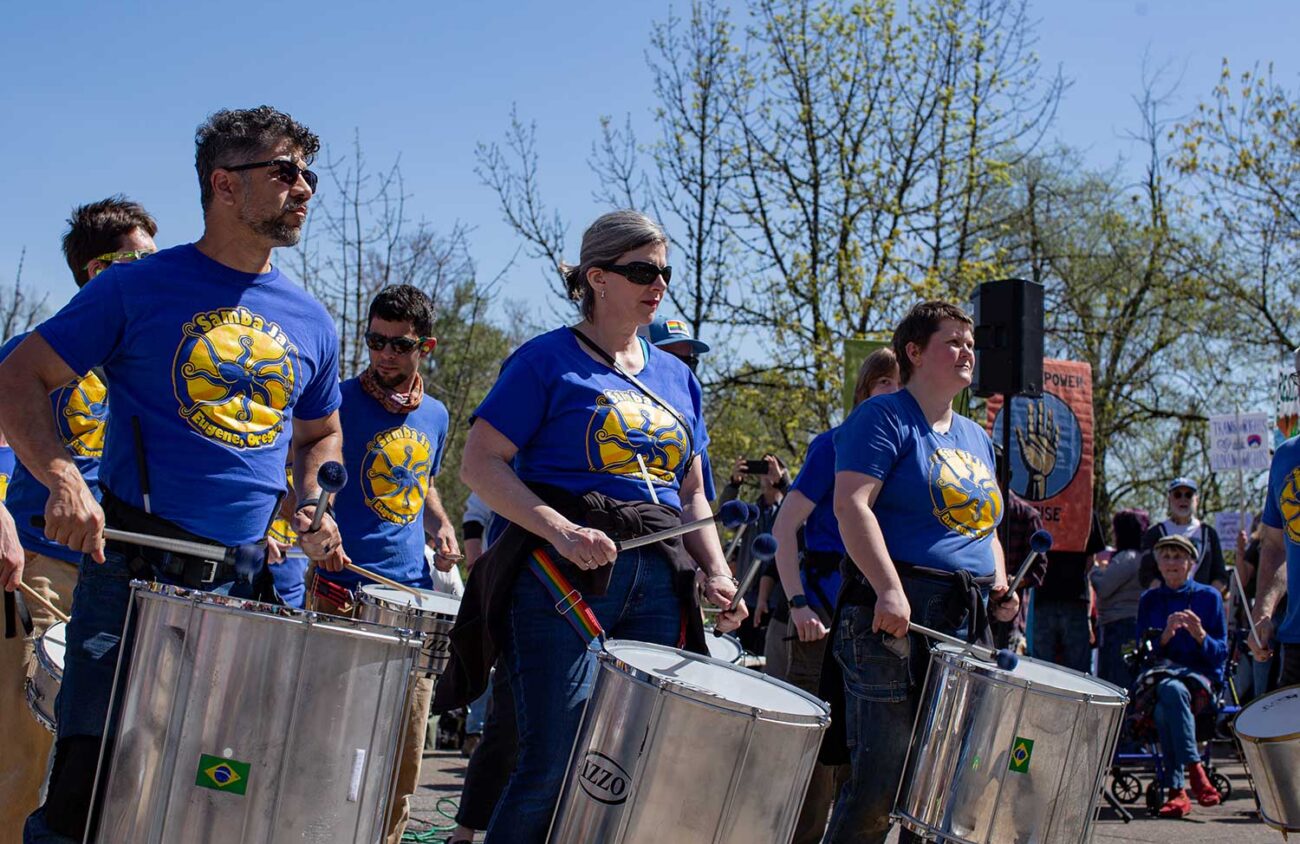
If you have been to pretty much any classic Eugene event — Pride, the BRiGHT Parade, Eugene Marathon and even Oregon Country Fair — chances are, you’ve heard the upbeat rhythms of Samba Ja. For most gatherings, the community ensemble is standing together, wearing blue and yellow, moving their bodies in unison and providing the event’s heartbeat with large drums.
Samba Ja is a Eugene-based percussion ensemble, or bateria, that perform Brazilian street music on large authentic drums. For the last quarter century — longer than most marriages — you’ve seen the group grooving out to samba reggae on the stage, on the sidelines or marching through the streets of Lane County. An estimated total of 500 members have been a part of the group throughout its history, and this year, the bateria is bigger than ever before.
To celebrate its silver jubilee, Samba Ja presents the AXÉ Samba Music Festival August 1 at the downtown Riverfront Park. The word “Axé” (pronounced “ah-SHEH”) is Brazilian for “good energy,” which the ensemble promises to deliver with their own headlining performance, as well as music from Seattle and Portland’s baterias.
In the mid-1990s, Michigan bass player and music student Jake Pegg found himself in a Tower Records store. His friend played him excerpts from the compilation album Batucada Por Favor — which translates indirectly to “hammering, please.” Batucada is a form of percussion-only Samba played by a bateria.
“Hearing that record changed my life,” Pegg says. “It really plugged into something that was central to my being.” He says the feeling he got listening to the record was “hard to explain, but I think people who really love samba music will understand,” and he can still hear the sound of that first record.
Within the next year, he moved to Portland for college, where he joined a brand new bateria. Playing Brazilian music in a group, Pegg says, “offers a musical experience, a community experience, with relatively low barriers. The music is fast and it’s syncopated, and it’s organized rhythmically in a way that’s pretty foreign to a lot of Western ears.”
When he moved to the University of Oregon to get his second bachelor’s degree, he knew he had to bring the music with him. With the help of his professors, he and co-founder David Adee created Samba Ja.
Gladys Campbell attended one of the ensemble’s first few weekly meetings, along with 34 other people. She didn’t have much music experience, but she was in love with percussion. “I remember that Jake was very charismatic, and you knew he had a vision. You knew this was going to happen,” she says. 25 years later, “I haven’t missed since.”
Pegg and Adee have since moved on from Samba Ja, but the ensemble stays strong with music director Steven White. Over the years, the structure has changed. According to White, when he joined in 2006, the group was centered around bringing people together to learn and play the music for shows. However, it was difficult when people would come in every week on different levels — and it would be even more so now that there are 36 people in the performance group, more than there have ever been.
Instead, Samba Ja, which is now a nonprofit organization, hosts eight-week classes to give people their chops and familiarity with the drums. “I still go to the beginner group,” Campbell says, “I always learn something.” The appeal of the classes, she says, is that “since we’re a community band, Steve can have people who’ve never played the drum walk in the door, and eight weeks later they’re playing two samba songs in a recital.”
When Fabio de Andrade moved to Eugene from Brazil, he was looking for ways to connect with his culture. One day at Oregon Country Fair, he heard a familiar sound echoing through the forest. “I heard the drumming, and that immediately reminded me of home,” he says. “It was a really exciting moment to see so many people drumming, and everyone was so happy.”
Andrade himself had never played any of the instruments before, but he had grown up listening to the music. He decided to take Samba Ja’s class to learn how to play and be part of the ensemble. Playing the drums in Eugene “helped me feel connected to my culture, and I appreciate that people want to learn it,” he says. “When you are drumming, you are not just standing there hitting the drums. You are moving your whole body, and that makes it easier for you to get into the groove.
He is one of the only Brazilians in the group, but that has not impacted his ability to find community with Samba Ja and its music. “It is an accessible kind of music for people who are not familiar with drumming, so it’s easy for people to learn it,” he says.
“And when we go to the parades, people are happy to hear the music, and it doesn’t matter if most of the members are not from that culture. The music is available for everyone who likes it to learn it, and no one is profiting from that,” Andrade adds.
His favorite part of performing, he says, is “when you see the kids, like they are the first ones to jump in front of the game. They start dancing and moving, so it brings a lot of joy to a lot of people.”
Samba Ja’s 25th Anniversary AXÉ Samba Music Festival is 11 am to 5 pm Saturday, August 1 at Riverfront Park, 701 East 8th Avenue.