It was two years ago and more than 5,500 miles from his home in Eugene, and Stephen McKeon found himself at the global art exhibition La Biennale di Venezia. There, he stood face to face with “A Puzzled Mind,” a seven-foot-tall, 1,500-pound bronze self-portrait by Jim Dine, one of Stephen’s favorite artists and a major figure in American contemporary art.
Stephen had admired Dine’s work for years, tracing his love for sculpture to seeing Dine’s “Two Big Black Hearts” in 2015 at deCordova Sculpture Park in Massachusetts. Standing in the Venice courtyard, Stephen decided he could finally own a Dine sculpture; it was just a matter of getting it home to Oregon.
Then a representative from Dog on the Forge, Dine’s exhibition at the Biennale, told him the sculpture had been cast at a foundry, Blue Mountain Fine Art, in Baker City, where he was free to purchase another casting. The biggest obstacle disappeared. And so Stephen bought it, later picking it up with a truck and trailer and driving it to Eugene.
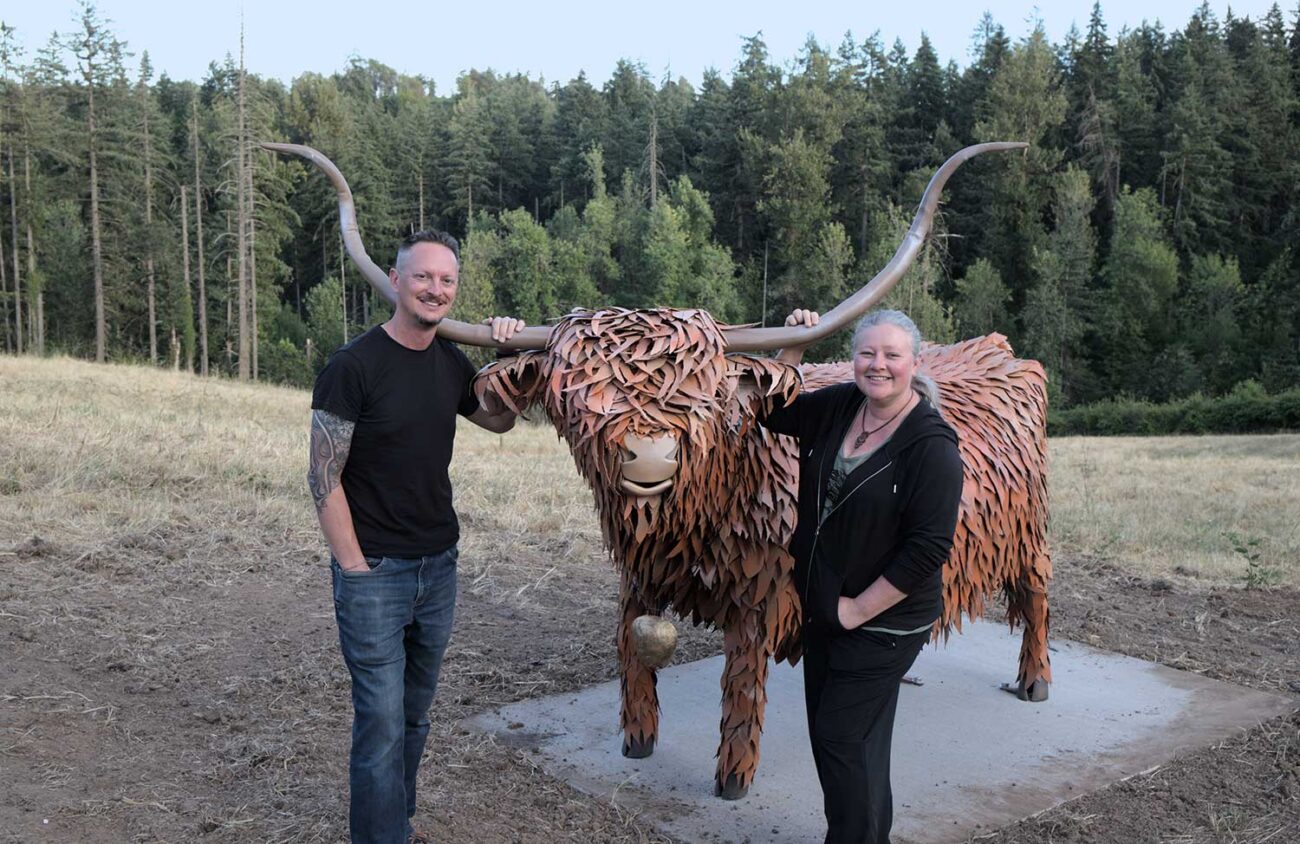
The sculpture would find a home at Chaos Vineyard, an emerging artscape in the McKeons’ backyard in south Eugene. The 13-acre property is where Stephen, a former tenured associate professor of finance at the University of Oregon, and his wife, Michelle McKeon, grow Mencía, a rare Spanish grape variety. The property also features large-scale outdoor sculptures by Oregon and nationally recognized artists. The McKeons plan to open the growing sculpture garden to visitors in summer 2027, and launch a wine club alongside the vineyard’s first vintage.
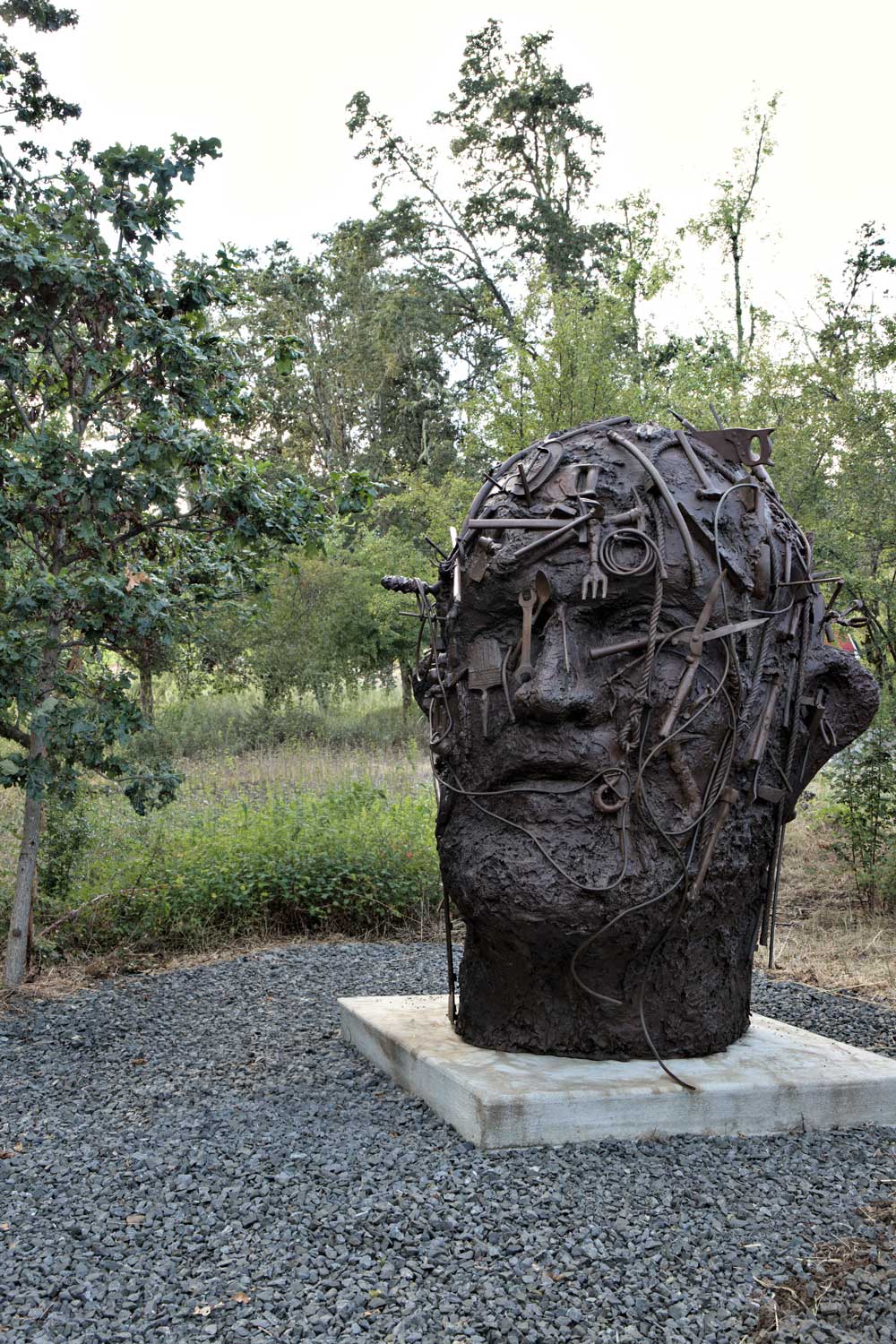
For Stephen, “A Puzzled Mind” represented more than an addition to his collection. It reflected the larger vision behind Chaos: a place where art and wine could exist side by side.
That vision began taking shape when a timber company down the road from the McKeons’ home began selling parcels of land in 2017. Then, during the height of the pandemic, the couple planted 11 clones of pinot noir across five different rootstocks. Their vineyard consultant, Chad Stock, called the experimental approach “controlled chaos.”
Stephen’s path to winemaking began after his earlier career at an internet startup ended during the dot-com collapse in the early 2000s. He later spent seven years working in Napa Valley’s wine industry, gaining experience that would shape his vision for Chaos.
“We wanted the vineyard to be more than just wine. We wanted it to be more experiential,” Stephen says.
That experience extends beyond the vines themselves. As visitors move through the property, unexpected pieces of art appear throughout the landscape.
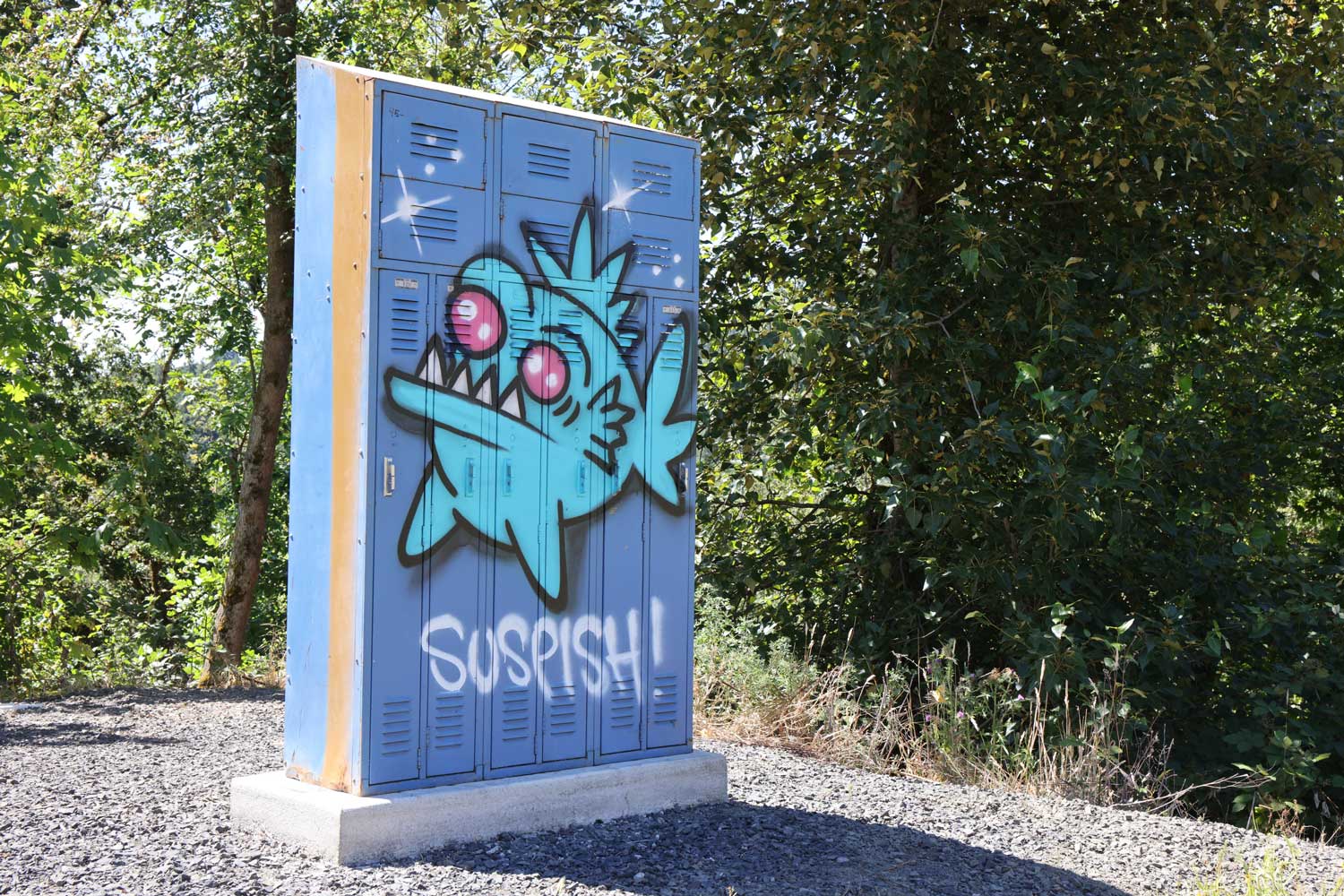
Near the rows of grapes, the only works that are not sculptures are the refurbished North Eugene High School lockers and a mural reading “Chaos Vineyards.” The lockers are spray-painted with Suspish’s signature fish, while the back reveals a giant squid mural.
The piece arrived through a simple request. Suspish, the anonymous Eugene graffiti artist whose colorful fish have become a local icon, had been a family favorite as the McKeons explored Eugene. After discovering the artist’s work in a local store, they asked the owner if Suspish would consider creating a mural for their property.
Suspish agreed to create a piece for their property under one condition: complete anonymity.
The McKeons waited months for a weekend when the property would be empty. When the time finally came, they notified the store owner but heard nothing back.
“We went on our trip, we got back, and then the next day I came out to the barn to grab something, and I was like, ‘Suspish was here,’” Michelle says. “It was like Santa Claus.”
Surprises have become part of Chaos’ identity. The vineyard’s name reflects not an attempt to avoid uncertainty, but a willingness to adapt when it arrives.
A year after planting their vineyard, the McKeons had to start over.
In 2020, “There was a heat dome that came in,” Stephen says. “It was 113 degrees for three days, and it killed the whole vineyard.”
Rather than abandon the project, the McKeons adapted. They replanted with Mencía, native to Spain’s Galicia region, where the cool, rainy climate closely resembles Oregon’s. Mencía is just as unique as the property itself, with very few vineyards growing it in the United States.
For the McKeons, that sense of discovery extends beyond the vineyard rows. Many of the sculptures at Chaos arrived through unexpected encounters, personal connections and moments of coincidence.
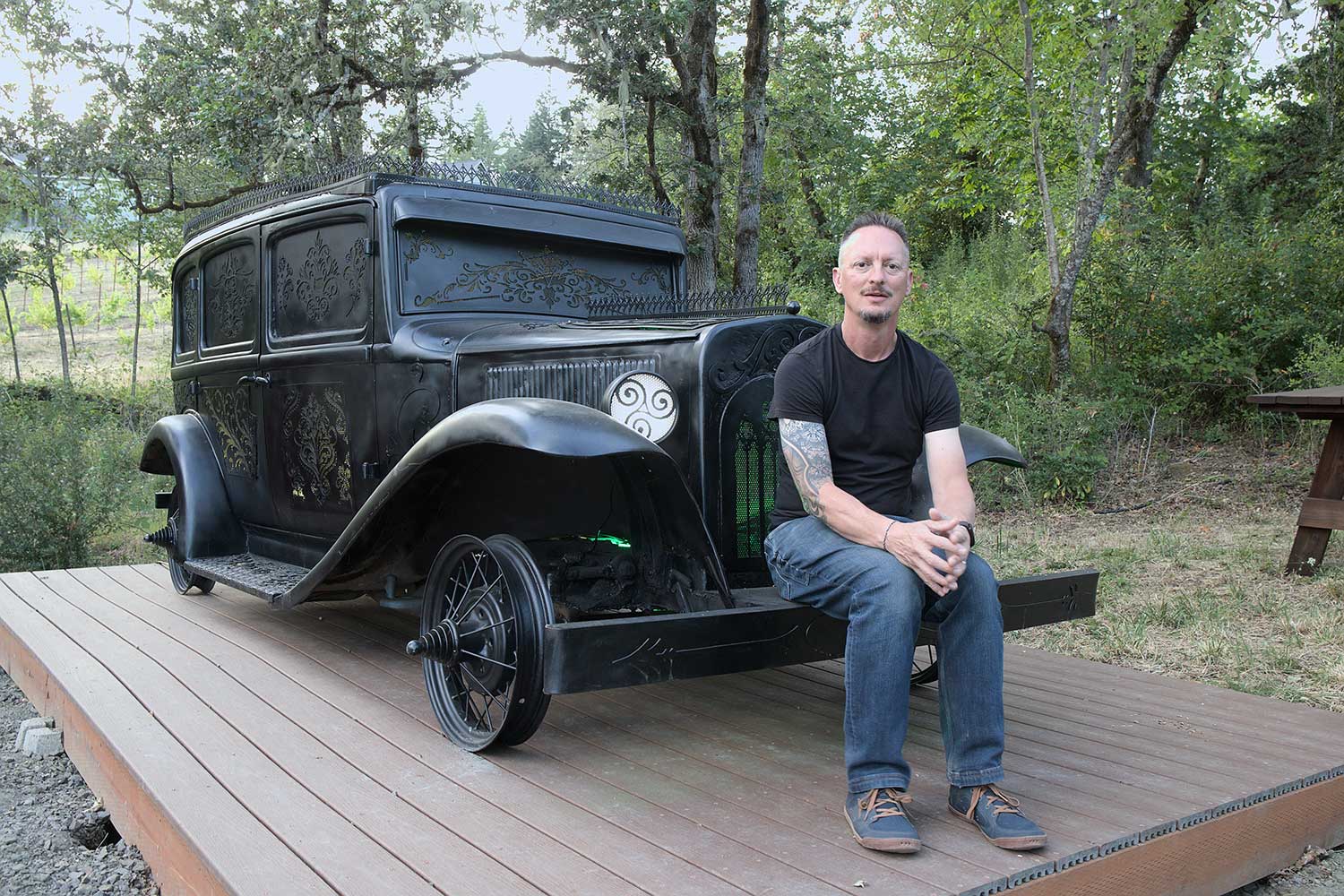
Just below the vines sits Eugene artist Jud Turner’s “Ghost,” a sculpture born from a chance connection with the McKeons. Using the frame of a restored 1930s Studebaker, the piece seals fragments of the original rusted vehicle inside, while engraved patterns in the metal allow LED lights to illuminate the sculpture from within.
After the McKeons purchased Turner’s 5-foot-5-inch welded steel seahorse sculpture, “Galeta,” from a local MECCA (Materials Exchange Center for Community Arts) exhibition, Turner delivered the piece and discovered the couple’s larger vision.
“I hadn’t understood who they were and what they were doing,” Turner says. “I got really excited about their project.”
While exploring the property, Turner noticed a rusted 1930s Studebaker unearthed during the McKeons’ trail construction. The abandoned car became the foundation for “Ghost,” a reliquary that transforms pieces of the original vehicle into a tribute to American car culture.
As visitors move beyond the vineyard, a 16-foot head rises from the landscape, its steel frame surrounded by two hands turning inward. Created by Colorado artists Ryan Elmendorf and Nick Geurts on a commission from Burning Man, where it first appeared in 2016, “Awakening” is more than a sculpture to observe; it is a space to enter.
Inside, the head becomes a camera obscura, projecting an inverted view of the surrounding landscape through the sculpture’s stereoscopic eyes projected on a large screen. The work explores the idea of becoming aware by engaging the senses and encourages viewers to experience the world from a different perspective.
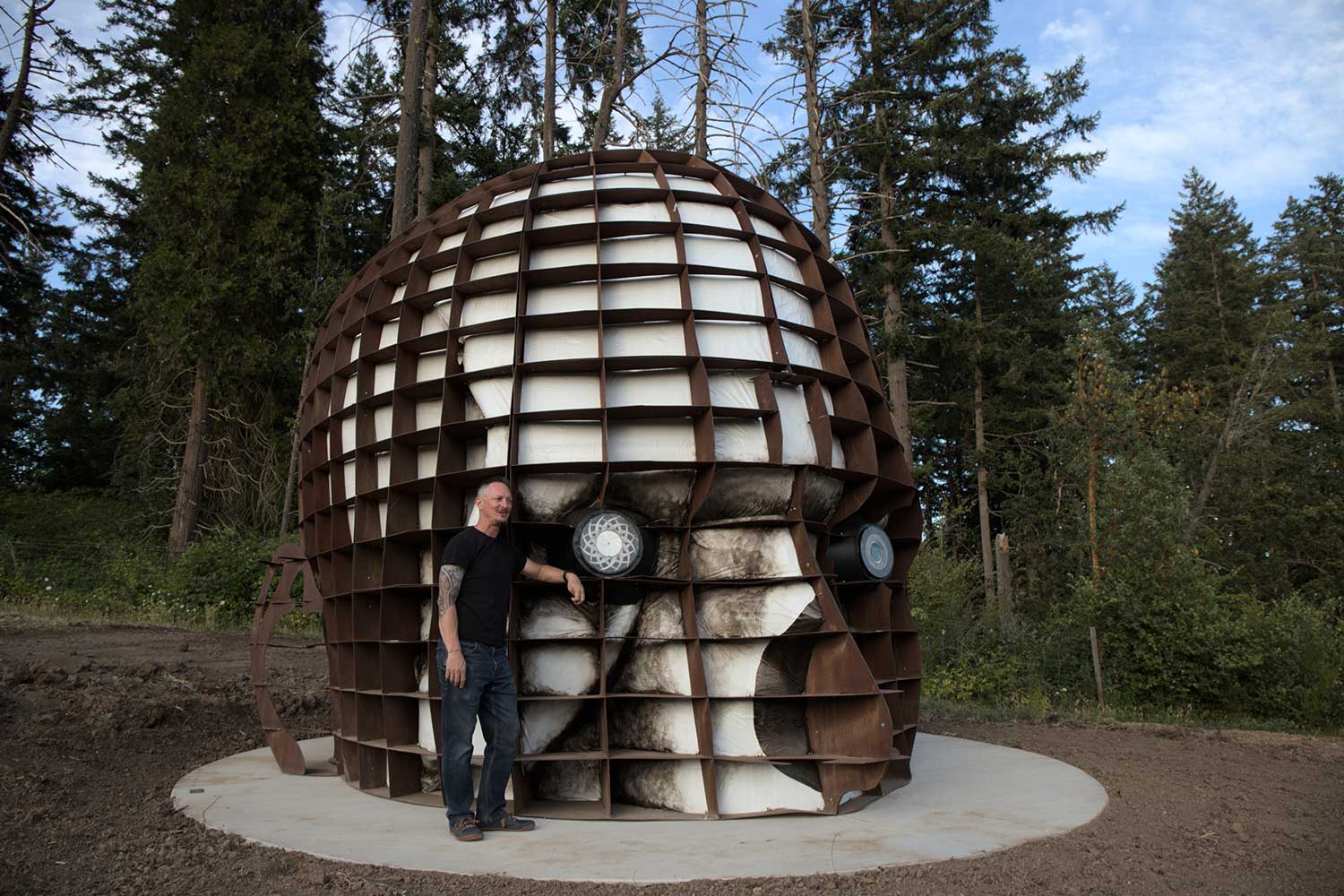
Like many works at Chaos, “Awakening” arrived through a network of unexpected connections. Before becoming a vineyard owner and collector, Stephen’s work at the University of Oregon introduced him to the emerging world of blockchain technology. In 2018, that connection led to an invitation from Collab+Currency, a fund focused on investing in blockchain and digital culture.
Through that work, Stephen connected with a business partner involved with a company headquartered in Marfa, Texas. The tiny, remote desert town became an art world hub in the 1970s after the late American minimalist sculptor Donald Judd purchased land there to establish contemporary art galleries. Stephen’s interest in the town’s growing art community eventually led him to start Glitch Gallery in Marfa in 2022, which calls itself an analog space for digital objects. There, he met Valeri Santerli, a fellow gallery owner and partner of Elmendorf, one of the artists behind “Awakening.”
“It’s almost like the piece found us,” Stephen says.
For Santerli, “Awakening” represents the kind of unexpected connection that defines Chaos, bringing together artists, curators and spaces that would not typically intersect.
“It’s these alternative spaces that you wouldn’t necessarily think: ‘I’m going to go to a vineyard and taste wine, but then also have this sprawling experience,’” Santerli says. “This way finding that happens on their land that’s like a sense of discovery. It’s pretty great.”
Michelle laughs, saying the couple “tend to just be collectors of things,” and that Chaos has given them space to keep collecting. For the McKeons, that spirit of discovery is what continues to shape Chaos. As they collect artwork, learn to operate excavators, pour concrete and build the vineyard by hand, the McKeons are still shaping Chaos into what it can become with plans to open to the public in summer 2027.
For more information about Chaos Vineyard, the wine club and potential public events, visit ChaosVineyard.com.