By Will Kennedy
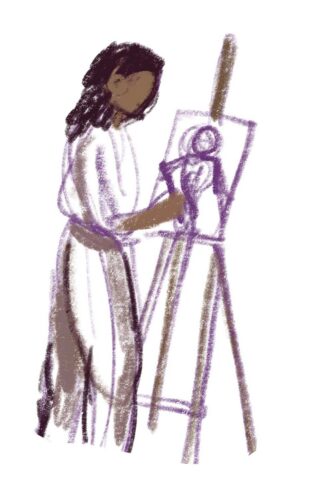
On a recent warm July afternoon, seven artists gathered behind easels in a curtained-off area at New Zone Gallery in downtown Eugene. They were there for a workshop, led by Eugene artist Will Mitchell.
Eugene Figure Drawing facilitates these sessions three times a week at both New Zone and at Lane Community College. The Hybrid Gallery in the Whiteaker neighborhood hosts its own twice-a-month figure-drawing workshops with queer, trans and body-positive models.
On social media, our images are more viewable than ever, but these models — male, female, young and old, of all body types, shapes and sizes — stand naked in front of strangers for the sake of art, and two models say it’s a rare way to be seen. For an outsider, it also seems a uniquely brave and raw way to be looked at.
Back at New Zone, a model arrives, disrobes and strikes a pose as artists sketch — a soft spotlight illuminating the contours of their body and the textures of their skin.
Leah Geocaris, who did not model that day, has modeled for Eugene Figure Drawing for about 11 years, nearly as long as she’s lived in Eugene. “It’s been eye-opening,” Geocaris says. “You don’t have to have this perfect yoga body.” Artists want a “real-life pose,” she says, “so they can practice getting the angle of your finger just right, or your foot or your elbow.”
Geocaris doesn’t make eye contact with the artists. “I don’t know what part they’re focusing on. I just assumed when I went that everybody’s going to draw me head to toe. And that is not true. Some people want to focus on the foot, or a hand or an ear. Sometimes just a torso.”
Mars Cantrell facilitates and models the queer, trans and body-positive figure-drawing sessions at The Hybrid. “I think of it as an exercise of observing and looking as much as I find it an exercise in drawing,” she says.
As both a model and an artist, “when I’m drawing someone, I’m not thinking about any kind of imperfections. I’m not thinking about their body in a judgmental way. I’m thinking about it creatively,” Cantrell says.
It helped as a model, she adds, “to understand that the people were looking at my body as a creative process. I think about figure drawing as something that the artist and the model are doing together.” The practice of figure drawing is fundamental to visual art, and has been for centuries. Mitchell says his sessions aren’t classes, but opportunities for artists of all skill levels to hone their craft independently.
He says his models are paid with artist entry fees and often have an athletic background. Typical workshops last three hours, and models hold their poses from a few minutes to about half an hour, depending on the format. For this reason, they need to choose poses they can comfortably hold for extended periods and stay relatively still.
For novice artists, “they’ll come in, and they’ll draw what they think an eye or a nose looks like, rather than the shape that they see in front of them,” Mitchell says. The more artists understand the human figure, he adds, “its proportions, how it moves, the shapes it makes,” the better artists become at their discipline. Figure drawing, Mitchell says, teaches artists to see accurately.
Cantrell says queer, trans and body-positive sessions “help people see a wide range of bodies in different and more beautiful ways.”
Models “who may not feel like they see themselves represented in a lot of the traditional figure drawing” can see themselves represented as art “through a lot of different people’s eyes,” she says.
“I’ve been doing this for over a decade now,” Geocaris says. “It’s fascinating to see the way that others see me, what they are creating in their quest to interpret me to the world.”
More info about Eugene Figure Drawing and modeling opportunities at New Zone, 110 East 11th Avenue, and EugeneFigureDrawing.com. More about The Hybrid’s queer, trans and body-positive figure drawing and modeling opportunities at TheHybridEugene.com and at 941 West 3rd Avenue.