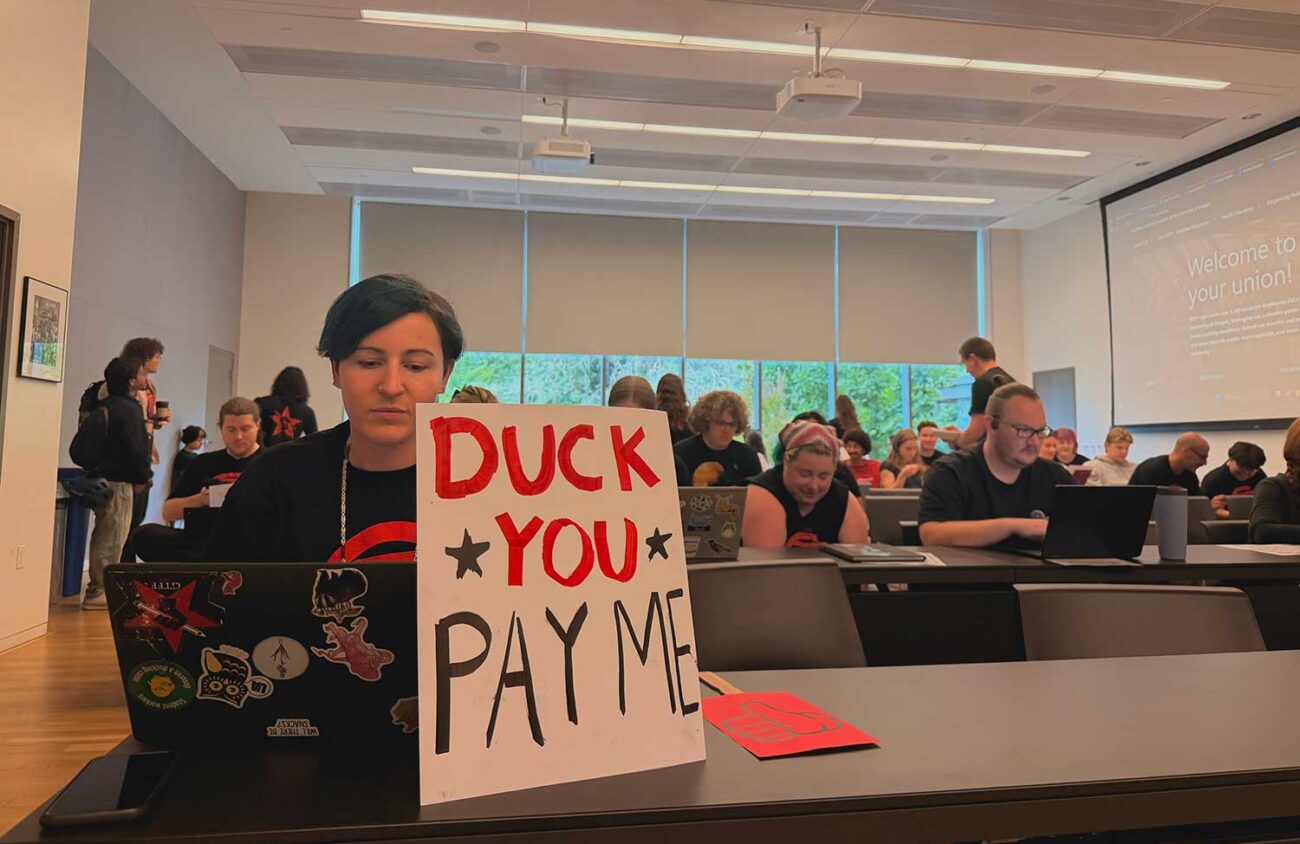
As of July 29, the Graduate Teaching Fellows Federation and the University of Oregon’s bargaining team are still mostly in a stalemate. The groups met for their sixth bargaining session and there was an opportunity for GTFF members to speak .
GTFF members met at the EMU Crater Lake room and passed each other humorous bingo boards, with squares that read “UO obfuscates,” “health insurance” and “UO mentions the budget.”
The UO currently carries $65 million in debt in the general fund, making economic requests hard to account for. In past negotiations, UO pushed for a 0 percent increase in salary for five years and significant increases to health care copays, which were continuing points of contention.
UO’s bargaining team was specifically asked to create responses for four articles in the July 1 meeting that look into the university’s policies interacting with federal law enforcement, noncitizen graduate employee support, layoff procedures and summer-term employment. Articles are changes to current or ongoing proposals within the contract, each working to address a specific issue.
In the July 1 meeting, UO’s bargaining team agreed to prioritize the articles for the next session. Four weeks later, the university had not proposed significant changes in counters and had not responded to the article addressing federal law enforcement.
“We’re seeing a trend where UO is just not really giving anything. At the beginning of the bargaining cycle they said they were fine with everything in the contract exactly as it is,” Allison LaSalvia, GTFF lead negotiator, told Eugene Weekly after the session. “Today was particularly frustrating, specifically because we had asked UO at our last session for four of the articles that we really wanted to get back as quickly as possible — there are a number of articles that UO has not given us a response on.”
During the meeting the two sides were able to reach clarity on proposed article 33, which covers library-use privileges. GTFF also went over an article that looked at the use of artificial intelligence and aimed to streamline a formal policy.
“We want to make sure that we are protecting our intellectual labor, our privacy and our job security and acknowledging any equity issues that may come from AI usage,” LaSalvia says. “We know that this is a rapidly changing area. So we’ve added in the language that the university has to notify the union about any AI-related policies that are likely going to impact GE working conditions, and the university shall notify the union at least 30 days prior to implementing new artificial intelligence technology.”
LaSalvia read a testimony from Ava Olson, a GE who works as a research assistant in Indigenous studies. Olson says, “Those of us building our careers off of other people’s knowledge and other people’s land owe them our care and thoughtful consideration when we work in partnership with them. Being in good relation demands, at the bare minimum, a deprioritization of output and a focus on reciprocity and accountability.”
In the following section, LaSalvia and GTFF members read statements and testimonies which were submitted regarding the fiscal impact a raise in health care premiums would have on grad student workers.
“In order to do my work, I need to be alive. In order to be alive, I need to be able to afford my medications,” says Bella Mobely, a first-year GE in the chemistry department. “By refusing to increase our salary, you are making living even more expensive for us.”
LaSalvia says, reading a statement given to her by an anonymous GE, “I carry the health care insurance for my wife, who is diabetic, and two young children. It is paramount that we have access to affordable health care.”
GTFF asked UO to address any comments or changes for article 35 on university policies around cooperation with ICE, 19 on summer reappointments and 21, on layoffs. Regarding cooperation with federal agents, UO’s bargaining team asked the GTFF to update articles based on recently passed state legislation, referring to House Bill 4079, which requires universities and schools to send campuswide notification of ICE presence.
“So your response since March is ‘redo it,’ and at no point since March could you have let us know that. We could have made substantial movement on an article that means a lot to our members,” LaSalvia says. “This was a huge waste of time and really signaled the lack of care, a lack of awareness, of how important this is to your employees.”
Responses to articles 19 and 21, were met with similarly noncommittal counterproposals. Although there were multiple points on which both GTFF and UO’s team agreed, they were unable to reach a commitment.
“The challenge is that we are in complete disarray in terms of our budget broadcasting,” Krista Chronister says, vice provost of graduate studies.
Eugene Weekly reached out to Chris Meade, UO’s lead negotiator, for comment, and was redirected to Angela Seydel, university spokesperson and director of issues management, who says, “As shared after your last article, the university values its relationship with the GTFF and is committed to negotiating a contract that meets the needs of both parties.”
In the interview after the bargaining session, LaSalvia says that at the beginning of the bargaining process GTFF tried to set a list of ground rules for bargaining, which UO didn’t accept. GTFF also wanted to meet twice a month during public bargaining, which UO denied, opting to meet monthly instead.
“So they’ve definitely been intentionally, I believe, stalling on their end, so that more of the movement can happen during mediation. They don’t like when there are members in their face — they don’t like to have to see the people that are disappointed in them.” LaSalvia says.
The next bargaining session has not been scheduled yet. Stay up to date on GTFF schedules on the Bargaining Tracker.