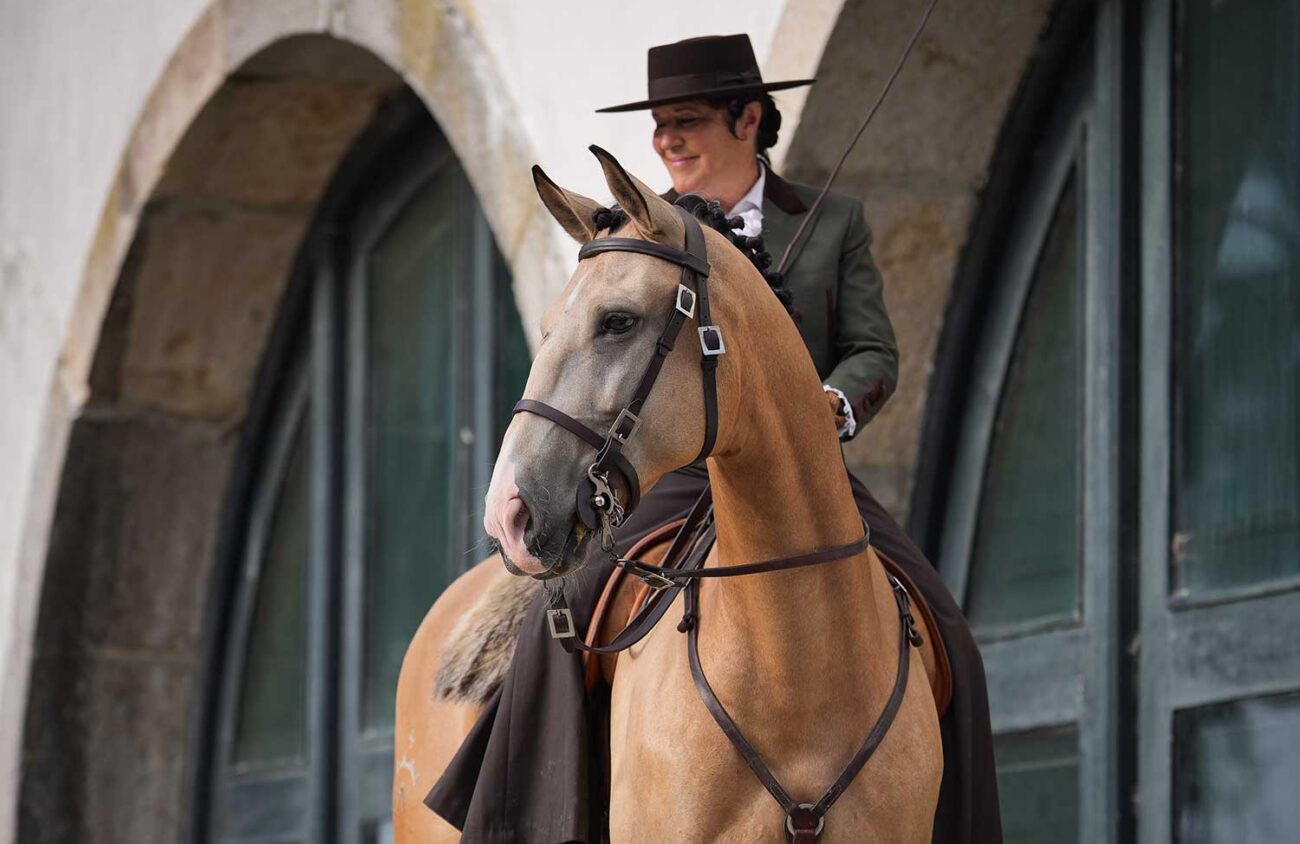
Nairobi stands tall and proud in his at-home stable as Kimberlee Barker prepares him for a run through his course. He’s a bay Lusitano gelding horse who Barker imported from Portugal to Corvallis in 2024.
Despite being only 9 years old, Nairobi is confident and handsome, with a long flowing mane, a love for the camera and a vigor for competition that has made him one of the top working equitation horses in the United States this season.
Barker shares his confidence. “All of his tack [equipment] was handmade in Portugal, as was my outfit,” she says, “because if you’re gonna do it, I do it right.”
Barker is a Corvallis-based equestrian who has been named to the first-ever U.S. team to compete in the World Association of Working Equitation World Championship. Working equitation is a competition that was established in 1996 in Italy and France. It has four different phases, or trials, that honor equestrian practices and European field riding traditions, while showcasing the art of riding and costume.
The World Association of Working Equitation World Championship is held every four years in Europe. Barker, along with her three other teammates, will compete at the 2026 championships held in Jerez, Spain, Sept. 8 to 13.
Back at the stable, she places fleece-lined brushing boots on Nairobi’s legs to protect his legs from the jumps and other obstacles. She then places brown leather “bell” boots around his hooves that match his European saddle, breastplate and other tack. The boots protect him from stepping on himself, she says, adding that they are only used for high-speed and cattle-driving events. “OK, confession. He needs them, but they’re fashionable.” Nairobi has boots of every color. When she can, she coordinates her riding costume with his.
The two enter the course on Barker’s property. The next day, Barker will fly to Portugal to join her 7-year-old Lusitano horse Paquirri, and compete with him in early September. In preparation, Nairobi and Barker begin by practicing the phase called “ease of handling.” This is where the pair completes an obstacle course, encountering 15 objects that would be found in a typical working environment for a horse, such as a gate, a bridge and a jump. During the ride, Barker’s level of equitation requires her to ride one-handed — with the horse in one hand and a spear in the other.
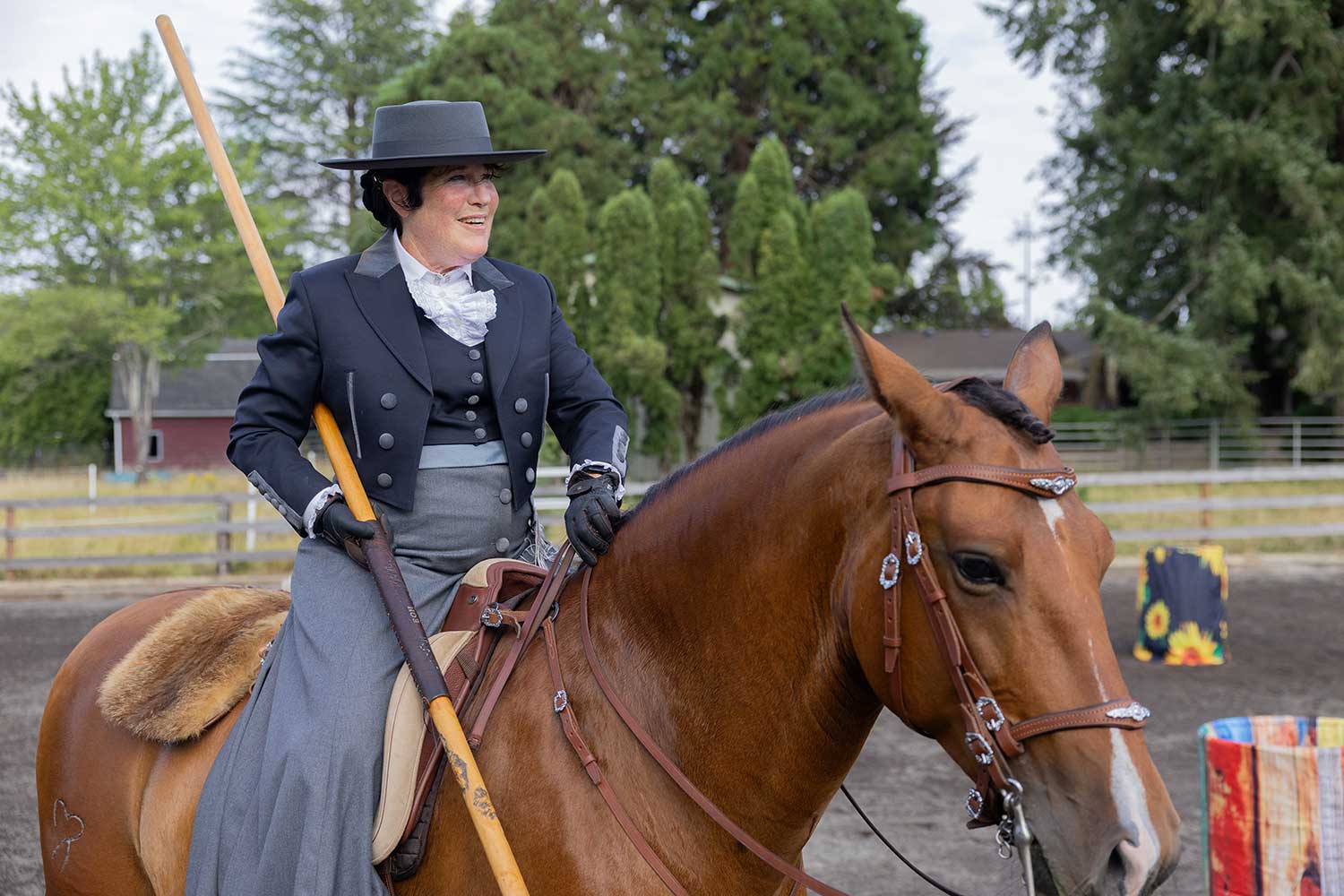
As they glide across the bridge, Barker directs Nairobi into a rhythmic and graceful trot, demonstrating how dressage aspects are imperative to this phase. “What they’re judging us on is how harmonious, balanced and relaxed the horse looks,” she says, as they make their way around turns, barrels and other obstacles. Barker and Nairobi then soar over the jump.
Barker has been a dressage instructor for 26 years, through which she developed a reputation for training horse breeds that don’t traditionally compete — such as smaller-statured Morgans and Dales Ponies — up to the highest skill level. Dressage is a kind of equestrian ballet, and the first trial in working equitation.
She started competing in working equitation in 2018 after her students recommended the sport, and continued competing with her “unusual” horses. “I couldn’t always beat the big fancy warmblood dressage horses, but I could a quarter of the time,” she says. “I was often top three, and that was a big deal,” because her opponents were often “on some fancy German warmblood, and I’m on a little tiny Morgan. I’ve always enjoyed the underdog.” Since then, she has frequented the working equitation leaderboards at the national levels, and in 2023, earned the most points of any competitor in the country.
Dressage riders, she says, are engineers. “It’s very precise. It’s very organized. You come at it in a certain way.” But in working equitation, “you get to be more individual.”
After ease of handling, the obstacles are reordered and renumbered for the speed trial. For this phase, the horse and rider must complete each obstacle as fast as possible without deviating from the new order. “But how I get to them, how I approach them, the little bits of style that I might do — where I do my transition, how I hold my hand,” she says, “All those details matter.”
The sport resonates with her because “it’s about your horse performing with the biggest, most expressive movement it can have.” She says that “we have some freedom, we can create.”
While Barker is in Portugal, she will be dedicating the last few weeks before the competition to developing a close working relationship with Paquirri — whose worst event is the dressage trial but is top scoring in speed trial (one of Barker’s less confident areas) — as well as training with her three other teammates for the fourth phase of working equitation: Cattle trial, where each member takes turns separating a cow from a small herd, and working together to bring and hold it in a pen for 30 seconds. She says that of all of them, she’s the “novice” when it comes to cattle.
Yet, with just a month left before she represents the U.S. on its inaugural team, Barker says the pressure only fuels her. “I’m the kind of person that usually rides better if someone’s watching. I try harder. I work harder. I show off a little more. I’m a little braver.”
The 2026 World Association for Working Equitation Championships is Tuesday, Sept. 8 through Sunday Sept. 13 in Jerez, Spain. For more information, visit Wawe.dev.