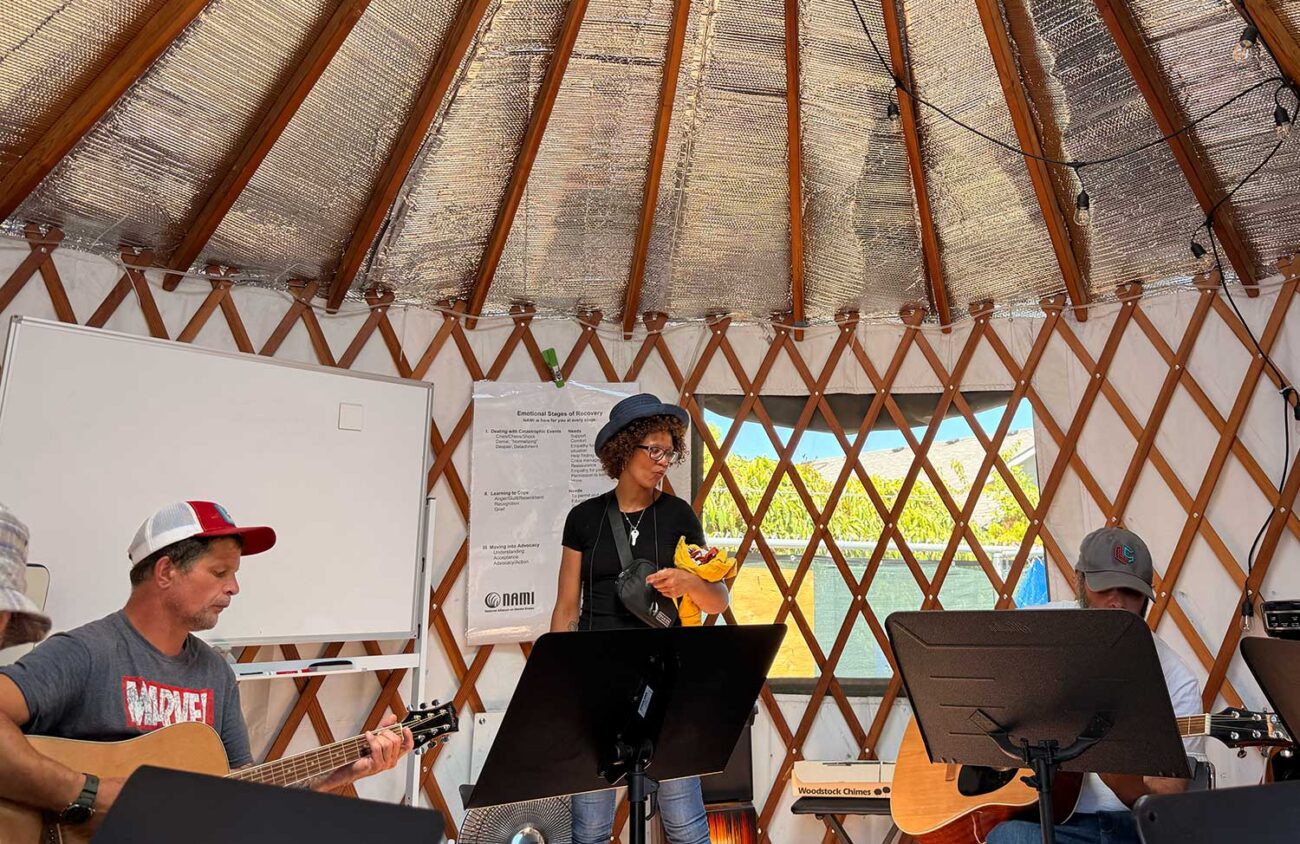
Jordan Bunker gently holds the neck of an amber-colored guitar, strumming chords. He visits the circular shelter at Community Supported Shelters weekly, to sit with others and unite over music via CSS’ Street Jams program.
CSS, a nonprofit aimed at providing holistic housing services for homeless people, started a music program two years ago. The program provides homeless people an avenue to access musical instruments and structured lessons. Street Jams has been one of its most popular services offered.
“It’s really helped me tremendously. I mean to have some kind of outlet, while I’m struggling through my own situation,” Bunker says. Bunker is currently enrolled in temporary housing programs, but is legally defined as homeless. “I have this to look forward to every week.”
Bunker has been playing guitar for 35 years and loves to play rock ‘n’ roll and heavy metal. “Originally I wanted to play the drums, but my dad, I don’t think he wanted that kind of racket in his house, so he told me I would play the guitar,” he says.
On this day, he joined a group of fellow homeless people to play folk and country. There were new faces in the room, but despite the unfamiliarity, they crowded together and peered over music stands to learn the chords for a Roger Miller song.
“When times are tough, art is bread,” says Anna Alkin, programs manager.
CSS is located off West 11th Avenue and provides a variety of services in the backyard of the main outreach office. The complex has access to three showers, a clothing closet and a trailer to do laundry.
Service navigators also help qualified enrolled clients get IDs, find food banks, apply for Social Security cards, receive birth certificates and navigate social services. The waiting list is more than a year.
The music program was created by Ron Sticka, who started teaching guitar at the veterans camp. Sticka started the Kim Sticka PTSD Music and Arts Foundation, which aimed to support PTSD awareness, music and art therapy programs. Over time the program grew so CSS could host it for all of its shelter participants, and the second iteration opened the services up to people who are still on the street.
“That’s your way of relieving stress, like to have a place where you can come in and basically be handed a guitar,” Alkin says. “It helps you hang in when it’s really really tough.”
When participants complete eight classes with Sticka, they have a chance to earn their own guitar. Street Jams allows all homeless people, enrolled at CSS or not, to come in and play the guitar.
“We notice that when people are engaged in this music programing, if they’re in the shelter or on the streets, people are more inclined to do housing navigation services,” Alkin says.
As of the 2026 Lane County Homeless By Name count, 2,039 individuals (45 percent) of the 4,490 people counted in January were chronically homeless. Researchers attribute some of this to ongoing stigma in accessing resources and structural barriers such as fear of family separation, safety concerns in congregate settings, past traumas, institutional bias or discrimination and shelter rule.
“They’re more inclined to engage in the services they need to move forward, because we’ve built trust at this level,” Alkin says.
About a year and a half ago Frank Portoghese, CSS service navigator, reached out to Guitarists for Good in North Carolina. Portoghese explained the general mission of the CSS music program to them, and they sent 10 free Mitchell acoustic guitars.
“We’re trying to help clients get out of their ruts and get people engaged with navigation, so we can get people where they need to be in line,” Portoghese says.
He flips through a binder and shows laminated pages with songs from different genres. His personal favorites to play and teach are Creedence Clearwater Revival.
He is the staff member who facilitates Street Jams, and wants to serve as “a friendly face” encouraging potential clients to enroll for services. “One person I was working with directly was very musically talented, but not very outgoing. He got into this program, and through that, got a little bit more engaged and was able to get housing here — around three or four months ago, and now he’s in permanent housing,” Portoghese says. “He shows up every now and then, but he’s got a life outside of this. That’s motivation for me to try and vamp this up as much as I can because there’s a lot of healing in music.”
Aileen, a “graduate” of the CSS music program, was offered an acoustic guitar after six weeks of training and attending workshops. Aileen has a fine arts degree from an accredited New York music academy, where she focused on studying musical composition. Due to her involvement in CSS’s homeless services, Aileen’s full name was not provided to Eugene Weekly.
“I liked it so much that I kept coming back, and then Ron asked me to help with it, and be more involved and take a volunteering kind of role,” Aileen says. She’s been setting up the music workshops, and promoting it amongst the homeless community.
Outside of playing the guitar, Aileen was trained in piano and singing. She grew up listening to Woody Guthrie at school and listening to a variety of genres at home. She says the music represents something that if she had not had in her life, it wouldn’t have been as endurable. Aileen says, “Music can make it endurable somehow.”
“It represents two hours out of the week. That discipline to show up in a very welcoming, comfortable environment,” Aileen says. “This has a lot to offer in terms of people connecting with one another who wouldn’t normally do that under these circumstances.”
CSS also runs Amplify Arts, which brings talented homeless musicians to perform in third spaces. CSS musicians perform at the city of Eugene Reimagine Earth Day celebration, where each performer is paid $100.
The funding for the programs comes from CSS’s Nourish Fund, which gets community donations as well as grant contributions, such as a Millsdavis Foundation grant. The funding for the Street Jams program is estimated to be under $5,000 annually, and is completely volunteer led.
“I’ve been here for five years now, and I quickly realized that OK, yes, we’re meeting the basic needs, but where’s the joy? Where’s the opportunity to participate and to be heard and seen through your creative expression?” asks Mellinda Poor, CSS service navigation manager.
She emphasizes the importance of bringing homeless people into creative spaces to further a sense of belonging in society: “That is essential for human beings to be able to express themselves creatively, to be seen for it and to be recognized.”
Find out more about Street Jams and CSS at CommunitySupportedShelters.org and program schedules on Instagram.